










Western Carriers opens Kolkata terminal, activates Devaliya
Key highlights
- WCIL inaugurated a Kolkata Dock System general cargo terminal under a 15-year agreement.
- Phase I of WCIL’s Kolkata terminal was fully operational in Q2/H1 FY27.
- WCIL fully commercially activated its 42-acre Devaliya Gati Shakti Cargo Terminal at Morbi.
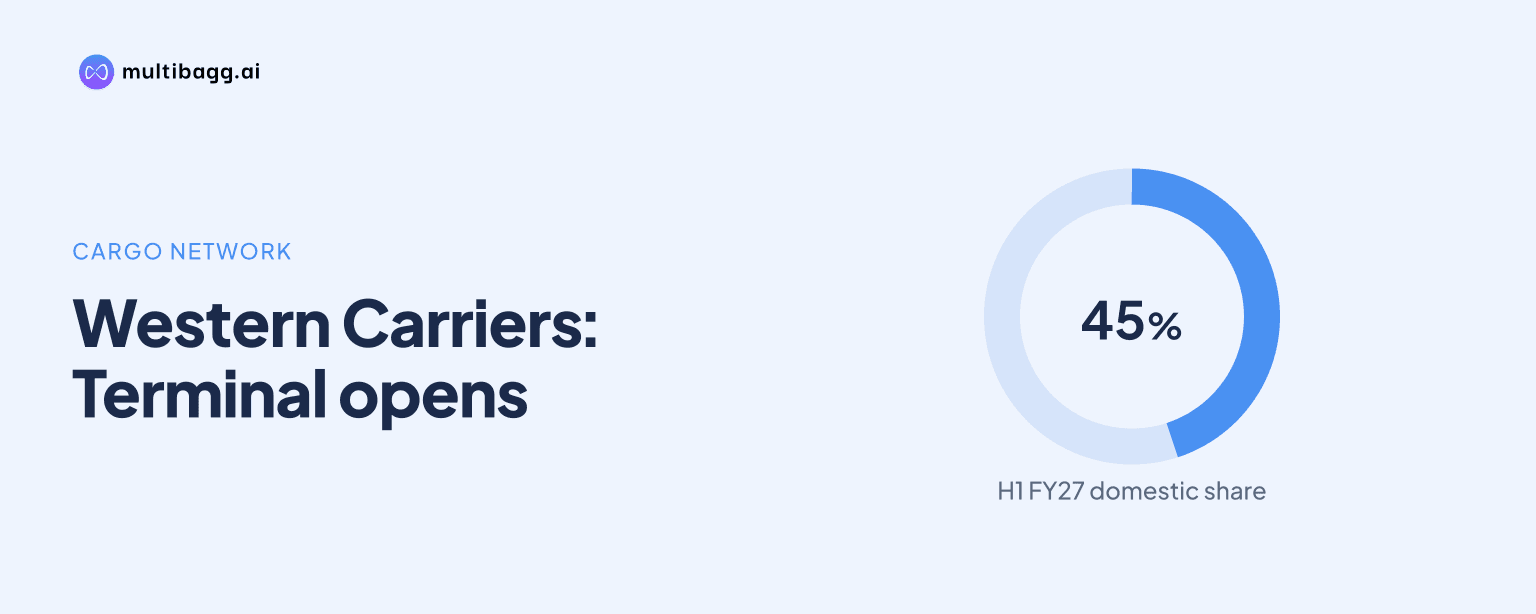
- H1 FY27 total volume rose 10.3% year on year to 117,604 TEUs, while domestic share reached 45%.
powered by IRIS
Western Carriers entered east-coast port infrastructure in Q2/H1 FY27 through a 15-year Kolkata Dock System agreement and fully commercially activated its 42-acre Devaliya Gati Shakti Cargo Terminal at Morbi. Phase I at Kolkata is fully operational, while Devaliya flagged off its first Bulk Tiles Train.
Know Western Carriers (India) inside out
Results, valuation, peers and who's buying, in one view.
What infrastructure did WCIL add in Q2/H1 FY27?
WCIL added a General Cargo Terminal at Kolkata Dock System and brought the Devaliya Gati Shakti Cargo Terminal at Morbi into full commercial operation in Q2/H1 FY27. The Kolkata facility was inaugurated under a 15-year agreement and marks WCIL’s stated entry into east-coast port infrastructure. The company says Phase I of the Kolkata project is fully operational, rather than describing the entire development as complete.
At Devaliya, WCIL reported full commercial activation of its 42-acre terminal with the flag-off of its first Bulk Tiles Train. The first disclosed movement identifies bulk tiles as an initial cargo flow from the Morbi location. WCIL has not disclosed terminal capacity, capital expenditure, tariffs, customer contracts, handled volumes or revenue for either Kolkata or Devaliya, so their financial contribution cannot be calculated from this presentation.
The two additions serve different logistics points in WCIL’s network. Kolkata is a dock-system general cargo operation on India’s east coast, while Devaliya is a cargo terminal at Morbi with a first disclosed rail movement for bulk tiles. The company’s operational update places both milestones alongside H1 FY27 total container throughput of 117,604 twenty-foot equivalent units, or TEUs.
How do WCIL’s Kolkata and Devaliya terminals differ?
WCIL’s Kolkata and Devaliya facilities differ in their location, reported operating status and disclosed development pathway. Kolkata is located at Kolkata Dock System and operates under a 15-year agreement, with Phase I fully operational. Devaliya is a 42-acre Gati Shakti Cargo Terminal at Morbi that WCIL says has achieved full commercial activation.
Kolkata’s Phase I status distinguishes it from Devaliya’s reported activation because WCIL has already disclosed a Phase II expansion plan for Kolkata. The current operating phase is therefore not the stated endpoint of the Kolkata project. At Devaliya, WCIL plans an ICD and warehousing facility, which would add infrastructure alongside the terminal’s first Bulk Tiles Train service.
The projects also sit within a wider logistics network that WCIL describes as rail-focused and asset-light. As of March 31, 2026, WCIL reported more than 50 branches, 16 leased warehouses across 12 states and more than 55 major railway rake handling points. The presentation does not specify whether the Kolkata agreement or Devaliya terminal is owned, leased or otherwise structured within that operating model.
Got a follow-up? Ask IRIS
How does the terminal rollout compare with WCIL’s volume mix?
WCIL’s terminal update came alongside a shift towards domestic container throughput in H1 FY27. Total volume rose 10.3% year on year to 117,604 TEUs, while domestic volume increased 34.0% to 52,842 TEUs. Domestic cargo represented 45% of H1 FY27 throughput, compared with 37% in H1 FY26.
The H1 comparison shows that total volume increased by 10,983 TEUs. Domestic volume increased by 13,404 TEUs, while EXIM volume declined by 2,421 TEUs, changing the mix toward domestic business. Devaliya’s first identified movement was a Bulk Tiles Train, but WCIL does not state whether any H1 FY27 container volumes were handled at Devaliya or Kolkata.
The same direction was visible in Q2 FY27. Total throughput increased 6.3% year on year to 59,343 TEUs as domestic volume rose 31.9% to 28,933 TEUs; EXIM volume was 30,410 TEUs, down from 33,897 TEUs in Q2 FY26. WCIL describes the domestic increase as momentum in that segment, without attributing the volume growth to either new terminal.
What expansion plans has WCIL disclosed next?
WCIL plans to develop an ICD and warehousing facility at Devaliya and to undertake Phase II expansion at Kolkata. The company identifies these as its next infrastructure steps after full commercial activation at the 42-acre Devaliya site and the operational start of Kolkata Phase I. Management says the projects are intended to strengthen WCIL’s East-West logistics network.
WCIL has not provided a completion date, investment amount, added acreage, capacity or traffic target for the Devaliya ICD and warehouse plan. It likewise gives no scope, cost, capacity or scheduled start date for Kolkata Phase II. Those omissions leave the timing and eventual operating scale of both expansions unresolved in the Q2/H1 FY27 update.
The expansion plans would be added to a fleet and equipment base that, as of March 31, 2026, included more than 650 GPS-enabled trucks, more than 1,050 shipping containers and more than 120 equipment units. WCIL also reported operations across 23 states through four zonal offices. The presentation does not quantify how many vehicles, containers or equipment units will be dedicated to Kolkata or Devaliya.
Conclusion
The Q2/H1 FY27 update establishes two separate operating milestones for WCIL: Kolkata Phase I is operational under a 15-year agreement, and the 42-acre Devaliya terminal is commercially active after its first Bulk Tiles Train. These new logistics nodes arrived as H1 throughput reached 117,604 TEUs and domestic cargo increased to 45% of total volume from 37% a year earlier.
The next disclosed milestones are Phase II at Kolkata and the planned ICD and warehousing facility at Devaliya. WCIL has not disclosed dates, spending, capacity, customer commitments or volume targets for those projects, leaving future updates to show their execution timetable and any measurable effect on domestic or EXIM throughput.