










Western Carriers domestic volumes rose 34% during H1 FY27
Key highlights
- WCIL's domestic throughput rose 34.0% year on year to 52,842 TEUs in H1 FY27.
- Domestic cargo reached 45% of H1 FY27 throughput, compared with 37% in H1 FY26.
- EXIM volume declined to 64,762 TEUs in H1 FY27 from 67,183 TEUs a year earlier.
- WCIL's total H1 FY27 container throughput increased 10.3% to 117,604 TEUs.
powered by IRIS
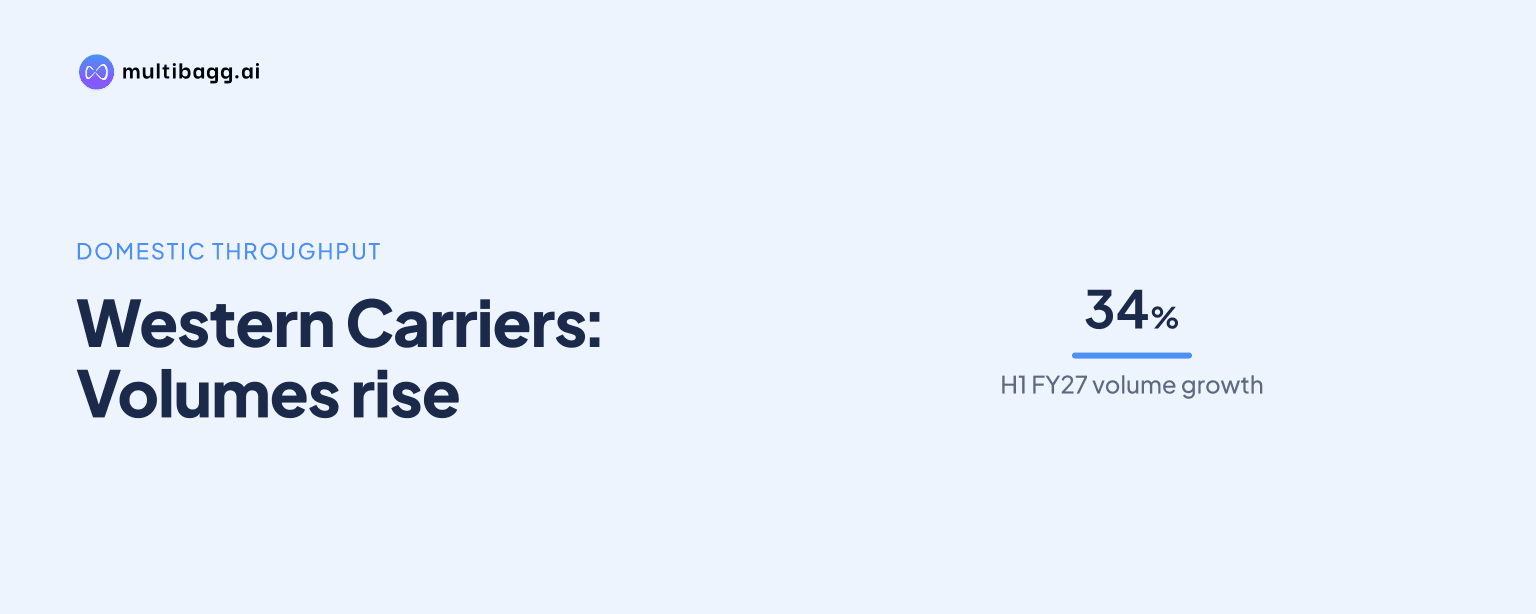
WCIL reported a 34.0% year-on-year increase in domestic container throughput to 52,842 twenty-foot equivalent units (TEUs) in H1 FY27, while export-import (EXIM) volumes declined to 64,762 TEUs. The shift increased domestic cargo's share of total throughput to 45% from 37% in H1 FY26.
Know Western Carriers (India) inside out
Results, valuation, peers and who's buying, in one view.
What changed in WCIL's H1 FY27 container mix?
WCIL moved a larger share of its H1 FY27 containers in the domestic segment, with domestic volumes rising by 13,404 TEUs from H1 FY26 while EXIM volumes fell by 2,421 TEUs. Total throughput still increased by 10,983 TEUs to 117,604 TEUs, in line with the company's stated 10.3% year-on-year growth for the half year.
The movement was evident in both volume and mix. Domestic throughput accounted for 45% of H1 FY27 total volumes, compared with 37% in H1 FY26, an increase of 8 percentage points. EXIM remained the larger segment at 55% of H1 FY27 throughput, but its absolute volume was below the 67,183 TEUs reported a year earlier.
The respective growth paths explain the change in mix. WCIL reported 34.0% domestic volume growth in H1 FY27, while the disclosed table shows that EXIM volume declined by 3.6% year on year. Domestic additions therefore exceeded the EXIM reduction and accounted for the net increase in the company's half-year throughput.
How did WCIL's second quarter compare with the half year?
WCIL's domestic expansion was also recorded in Q2 FY27, when domestic container volumes increased 31.9% year on year to 28,933 TEUs from 21,940 TEUs in Q2 FY26. This was an increase of 6,993 TEUs, while total Q2 throughput rose by 3,506 TEUs to 59,343 TEUs, or 6.3% according to the company.
EXIM volumes moved in the opposite direction during the quarter. Q2 FY27 EXIM volume was 30,410 TEUs, down 3,487 TEUs from 33,897 TEUs in Q2 FY26. The disclosed segment figures put domestic cargo at close to half of Q2 FY27 throughput, compared with less than two-fifths in the prior-year quarter.
The composition of the reported first-half volume was similar to that of the second quarter. Q2 contributed 28,933 of the 52,842 domestic TEUs handled in H1 FY27 and 30,410 of the 64,762 EXIM TEUs. WCIL did not provide a reason in the presentation for the divergence between domestic and EXIM volume growth.
Got a follow-up? Ask IRIS
What infrastructure is WCIL adding to its network?
WCIL said Phase I of its General Cargo Terminal at Kolkata Dock System is fully operational under a 15-year agreement with SMPA. The terminal marks the company's entry into East Coast port infrastructure, according to the presentation, although it does not disclose capacity, throughput contribution or an expected financial effect.
At Devaliya in Morbi, WCIL said its 42-acre Gati Shakti Cargo Terminal achieved full commercial activation with the flag-off of its first Bulk Tiles Train. The company also disclosed plans to develop an inland container depot (ICD) and a warehousing facility at Devaliya, alongside Phase II expansion at Kolkata to strengthen its East-West logistics network.
These projects are being developed within an operating network that included more than 50 branches and four zonal offices across 23 states as of March 31, 2026. WCIL also reported 16 leased warehouses across 12 states and more than 55 major railway rake-handling points, which form part of its stated rail-focused logistics footprint.
How does the volume shift fit WCIL's financial profile?
WCIL reported consolidated H1 FY27 revenue from operations of Rs 913.5 crore, earnings before interest, tax, depreciation and amortisation (EBITDA) of Rs 40.6 crore, and profit after tax (PAT) of Rs 17.8 crore. Its H1 FY27 EBITDA margin was 4.44%, PAT margin was 1.95%, and diluted earnings per share were Rs 1.74.
For comparison, the company displayed revenue of Rs 1,725.7 crore for FY25 and Rs 1,829.2 crore for FY26, while EBITDA margin declined from 6.95% to 4.65% across those full financial years. The 4.44% margin reported for H1 FY27 was below the FY26 figure, though H1 FY27 covers six months and the earlier periods cover full financial years.
WCIL describes itself as a rail-focused, integrated, asset-light fourth-party logistics provider. As of March 31, 2026, it reported more than 1,600 customers, more than 650 global positioning system-enabled trucks, more than 1,050 shipping containers and more than 120 equipment units. It also said 80% of FY26 revenue came from customers with relationships exceeding three years, while its top 10 customers had 100% retention.
Conclusion
WCIL's H1 FY27 data show that domestic containers drove total throughput growth, adding 13,404 TEUs while EXIM volumes declined by 2,421 TEUs. That changed the mix toward domestic cargo, which reached 45% of throughput from 37% a year earlier, while overall volume increased 10.3% to 117,604 TEUs. The same direction was apparent in Q2 FY27, when domestic gains exceeded the reduction in EXIM volume.
The next disclosed developments to watch are the planned ICD and warehousing facility at Devaliya and Phase II expansion at Kolkata. WCIL has confirmed that Kolkata Phase I is operational and that the 42-acre Devaliya terminal is commercially active, but it has not disclosed capacity, timelines for the planned facilities, or their expected contribution to volume and financial results.