








Whirlpool margin falls to 0.6% as costs outpace pricing

Find your next multibaggerBe a Pro Investor
Research stocks and track your picks on the go. Download the app.
Key highlights
- Whirlpool’s Q2 FY27 operating margin fell to 0.6% from 1.9% a year earlier.
- Whirlpool said gross margin declined about 420 basis points year on year in Q2 FY27.
- Whirlpool’s Q2 FY27 revenue grew 14%, supported by April and May 2026 price increases.
- Whirlpool introduced a further 5% price increase effective November 1.
powered by IRIS
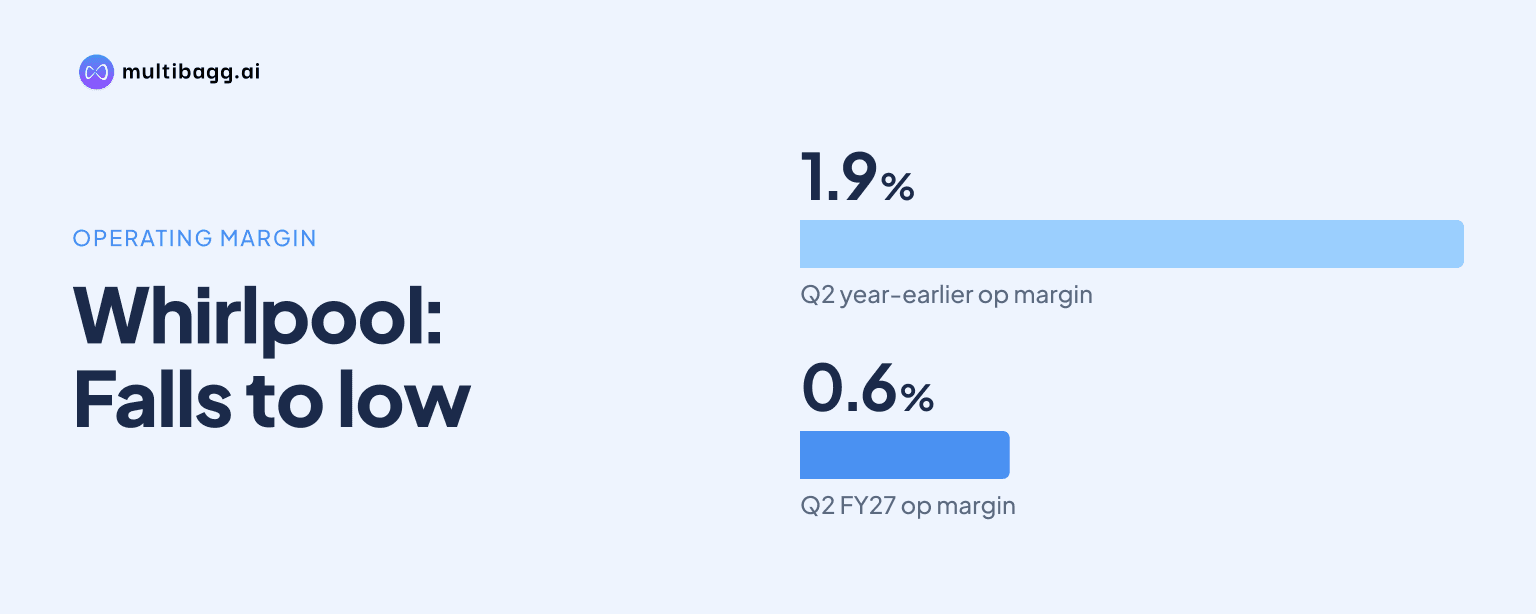
Whirlpool of India Limited’s operating margin fell to 0.6% in Q2 FY27, covering July to September 2026, from 1.9% a year earlier, as war-linked commodity inflation, currency depreciation and energy-rule changes cut gross margin by about 420 basis points despite 14% revenue growth.
Know Whirlpool of India inside out
Results, valuation, peers and who's buying, in one view.
Why did Whirlpool’s Q2 FY27 operating margin fall to 0.6%?
Whirlpool said the Middle East war was the largest factor behind the Q2 FY27 margin decline because higher crude-linked input costs affected several materials used across its appliance portfolio. These included polystyrene, methylene diphenyl diisocyanate, polyol, polypropylene and acrylonitrile butadiene styrene, which management said were materially exposed to crude-oil pricing.
Currency depreciation added to costs for imported components and parts, according to Whirlpool. Management said these two pressures were absent in the comparable Q2 FY26 period, when it maintained gross margin despite a difficult market; in FY26, the regulatory burden had been largely limited to e-waste requirements.
The regulatory cost increased in FY27 because refrigerator and air-conditioner energy changes affected businesses representing nearly two-thirds of Whirlpool’s operations. Management ranked the war impact first in importance and the energy-related regulatory transition second, saying the combination had a material effect on gross margin.
Whirlpool also identified two smaller Q2 FY27 costs: expenses related to its ownership transition from 51% ownership by Whirlpool Corporation to majority ownership by Indian stock-market investors, and investment behind the August launch of its Luxuriem four-door refrigerator range. These factors took operating margin to 0.6%, 300 basis points below the 3.6% recorded in Q2 FY25.
How did Whirlpool grow revenue while profitability declined?
Whirlpool’s revenue grew 14% in Q2 FY27, extending a four-quarter sequence of 4%, 7%, 11% and 14% growth after revenue declines of 3% and 5% in Q1 and Q2 FY26. Management attributed the latest-quarter increase principally to price increases implemented across categories in April and May 2026, which were fully reflected by September.
Premiumisation was the second stated revenue driver, alongside broadly holding volume share in a growing but competitive refrigerators-and-washers market. In multi-brand outlets, Whirlpool said its combined refrigerator and washer volume share was about 9 to 10 basis points below the prior year, which management described as effectively holding share during a quarter when the industry grew in double digits.
The contrast is that pricing and mix helped lift reported revenue, but did not offset the cost of materials, imported inputs and compliance changes. Gross margin fell about 420 basis points year on year in Q2 FY27, compared with a 130-basis-point decline in operating margin from 1.9% to 0.6%.
Whirlpool said it had taken a further 5% price increase effective November 1, after the July-to-September quarter, because of significant cost inflation. That action was not part of Q2 FY27 reported revenue, but is among management’s responses to the continuing input-cost environment.
Got a follow-up? Ask IRIS
Which products and categories are shaping Whirlpool’s recovery plan?
Whirlpool is using premium products to address both revenue mix and gaps in its refrigerator range, beginning with the August launch of Luxuriem, a 650-litre-plus four-door refrigerator portfolio. Management said it had lacked products above 500 litres until August, contributing to a more than 50-basis-point year-on-year market-share decline in no-frost refrigerators.
The Luxuriem range includes triple-evaporator cooling and a convertible freezer that management said can switch to refrigerator mode in under 30 minutes. Whirlpool said the entry Luxuriem model is priced below Rs 1 lakh, while certain models include freshness-detection technology that scans ethylene levels every 10 seconds, or more than 8,240 times a day.
In washing machines, Whirlpool reported 30% volume growth in front-load models and introduced a 10-kilogram range to move further into premium products. Its premium Bloom Wash top-load range gained share by triple-digit basis points, although the overall top-load category lost share by triple-digit basis points amid competitive pressure in entry and lower-mid segments.
Other category data show differing momentum. Air-conditioner volume grew 60% from a smaller base, while direct-cool refrigerator auto-defrost models grew 40% year on year. In semi-automatic washing machines, more than 45% of Whirlpool’s business now includes Dynamix technology, and the company said it gained market share by double-digit basis points in that category.
What is Whirlpool doing to counter cost and competitive pressure?
Whirlpool’s immediate responses are pricing, premiumisation, productivity and retail execution. The 5% November 1 price increase followed the April and May 2026 increases that helped produce Q2 FY27 revenue growth of 14%, while productivity initiatives are intended to support cost efficiencies as crude-linked material costs remain elevated.
Product launches are also part of the competitive response. Whirlpool introduced the Stain Wash 9-kilogram Cold model to address top-load competition in entry and lower-mid segments, alongside a glass-top semi-automatic machine with a Dynamix detergent dispenser and the 10-kilogram front-load range.
The company has selectively extended warranties in categories including direct-cool refrigerators, top-load washers and certain cross-scale segments. Management said these measures were designed to reinforce competitiveness and support premium segments, while retail executives remain central to its execution plan.
Whirlpool also reported that net working capital was nearly flat in Q2 FY27. Over the last nine quarters, it said net working capital was negative in five quarters and flat or below in six quarters, with the standalone business excluding Elica better in both June and September.
Conclusion
Whirlpool’s Q2 FY27 outcome shows a split between top-line progress and profitability: revenue rose 14%, but operating margin declined to 0.6% as a roughly 420-basis-point gross-margin fall outweighed pricing and premiumisation. The margin has declined by 300 basis points from 3.6% in Q2 FY25, with management attributing most of that change to war-driven input inflation, currency depreciation and energy-rule costs.
The next items to watch are the effect of the 5% price increase effective November 1, the scale-up of the August Luxuriem launch, and management’s stated expectation that margins can improve as war-related impacts ease and energy-rule costs begin to anniversary. Whirlpool also expects its no-frost refrigerator position to improve over the next 12 to 18 months as Luxuriem and further products expand its premium offering.

