










Williamson Magor review flags going-concern uncertainty
Key highlights
- Williamson Magor’s auditor said deferred tax assets of Rs 108.3981 crore were overstated at 30 September 2026.
- Williamson Magor did not recognise Rs 10.8649 crore of inter-corporate borrowing interest for the September 2026 quarter.
- Williamson Magor reported total equity of negative Rs 199.4163 crore at 30 September 2026.
- Neemrana land-sale proceeds of Rs 90.25 crore are intended for outstanding debenture settlement.
powered by IRIS
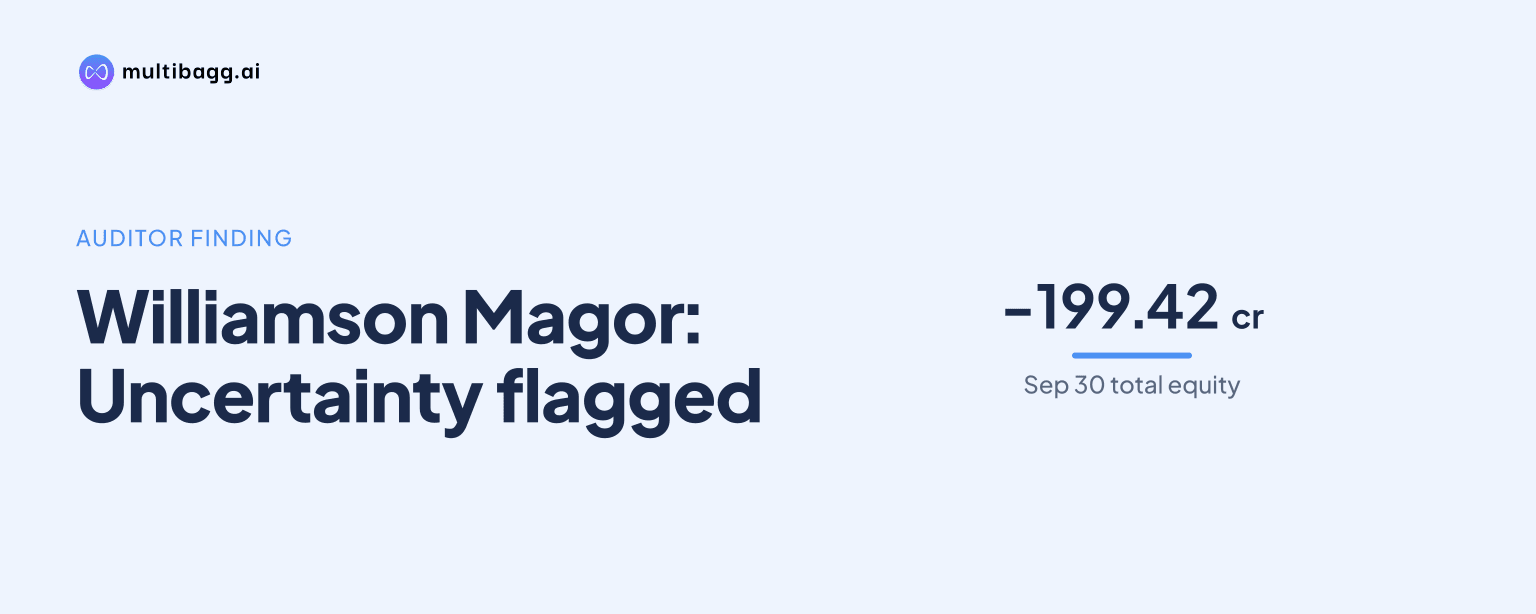
Williamson Magor & Co. Limited received a qualified limited-review conclusion for the quarter and half year ended 30 September 2026, with the auditor citing fully eroded net worth and an overstated deferred-tax asset of Rs 108.3981 crore. The review also identified unrecognised interest expense of Rs 10.8649 crore on inter-corporate borrowings for the September quarter.
Know Williamson Magor & Company inside out
Results, valuation, peers and who's buying, in one view.
What did the Williamson Magor auditor conclude?
Williamson Magor’s statutory auditor issued a qualified conclusion on the standalone unaudited results approved by the board on 12 November 2026. V. Singhi & Associates conducted the review under Standard on Review Engagements 2410, which the report says provides moderate assurance and is more limited than an audit.
The qualification covered seven matters: going-concern uncertainty, non-recognition of interest, unreconciled balances, defaults on debt securities, defaults on secured and unsecured loans, unavailable bank statements, and deferred-tax-asset recognition. The auditor said that, apart from the effects or possible effects of these matters, nothing had come to its attention to indicate that the statement did not fairly disclose information required under the listing regulations.
The largest quantified issue was the deferred tax asset of Rs 108.3981 crore reported at 30 September 2026. The auditor said the reasonable-certainty condition in Indian Accounting Standard 12, Income Taxes, had not been met; consequently, deferred tax assets and total comprehensive income for the quarter ended 30 September 2026 were overstated by that amount.
Why did the review question Williamson Magor’s going-concern basis?
Williamson Magor’s going-concern basis was questioned because its net worth had been fully eroded at 30 September 2026, according to the auditor’s reference to Note 5. The auditor said Williamson Magor’s ability to continue as a going concern depends on continuing finance availability and future profitability, creating material uncertainty and significant doubt over that ability.
The auditor also said Williamson Magor had not restored its non-banking financial company, or NBFC, registration by the reporting date. It described Williamson Magor as non-compliant with Reserve Bank of India instructions to follow norms applicable to an NBFC entity, and said use of the going-concern assumption was not adequately supported under Indian Accounting Standard 1, Presentation of Financial Statements.
The standalone balance sheet reported total equity of negative Rs 199.4163 crore at 30 September 2026, compared with negative Rs 215.9061 crore at 31 March 2026. Although negative equity reduced by Rs 16.4898 crore over the six months, total financial liabilities remained Rs 614.9514 crore at 30 September 2026.
How much interest did Williamson Magor leave unrecorded?
Williamson Magor did not recognise Rs 10.8649 crore of interest expense on inter-corporate borrowings for the quarter ended 30 September 2026, the auditor said. The auditor stated that finance cost, total comprehensive loss and the liability for interest were each understated by the same amount.
Williamson Magor also neither recognised nor ascertained finance cost on secured borrowings from HDFC Bank Limited from April 2021 to September 2026 because the matter is under dispute or negotiation. The auditor said this treatment departed from Indian Accounting Standard 109, Financial Instruments, and the accrual basis of accounting.
The review separately drew attention to defaults in payment of interest and repayment of principal on loans from secured and unsecured lenders. It also referred to defaults on principal and interest for non-convertible debentures issued to IL&FS Financial Services Limited, while noting that a settlement procedure had not been completed in its entirety.
A sale certificate for Neemrana land was issued to the auction purchaser on 9 May 2026, with proceeds of Rs 90.25 crore. Williamson Magor said those proceeds will be used to settle outstanding debenture dues, with further accounting adjustments to be recorded only after completion of the settlement procedure.
Got a follow-up? Ask IRIS
What balances could not be verified at Williamson Magor?
Williamson Magor had certain trade and other receivable balances and liabilities, including amounts payable to loan creditors, that lacked reconciliation and confirmation at 30 September 2026. The auditor said any resulting adjustments and their effects were not available and therefore could not be commented on in the review.
The standalone balance sheet showed trade receivables of Rs 9.3282 crore and other receivables of Rs 62.7523 crore at 30 September 2026. Other receivables increased from Rs 61.5685 crore at 31 March 2026, while trade receivables were unchanged at Rs 9.3282 crore, but the review did not quantify a potential adjustment from confirmation or reconciliation.
The auditor also could not independently verify the HDFC Bank balance and related transactions for the first six months of the financial year because the relevant statement was unavailable. It said it relied on management information, explanations and proposed notional entries after it could not obtain the statement from the bank branch because the account was not operational.
Cash and cash equivalents were reported at Rs 26.95 lakh at 30 September 2026, while other bank balances were Rs 1.37 lakh. The unavailable HDFC Bank statement did not establish a quantified discrepancy, but it prevented independent verification of the balance and related transactions for the six-month period.
How did Williamson Magor’s reported balance sheet change?
Williamson Magor reported total assets of Rs 416.7608 crore at 30 September 2026, up from Rs 401.9525 crore at 31 March 2026. This Rs 14.8083 crore increase occurred even as the deferred tax asset declined by Rs 18.1151 crore from Rs 126.5132 crore at the preceding year-end.
Total financial liabilities decreased by Rs 1.6437 crore to Rs 614.9514 crore over the same period. Borrowings other than debt securities were Rs 515.5278 crore at 30 September 2026, against Rs 515.9608 crore at 31 March 2026, while debt securities were unchanged at Rs 33.5091 crore.
The reported improvement in total equity to negative Rs 199.4163 crore included the financial statements’ recognition of the Rs 108.3981 crore deferred tax asset. The auditor’s conclusion specifically says that asset, and September-quarter total comprehensive income, were overstated by Rs 108.3981 crore because the required reasonable certainty had not been demonstrated.
Conclusion
The qualified review identifies both measured accounting departures and matters the auditor could not independently verify in Williamson Magor’s standalone September 2026 results. The two quantified findings are an overstated deferred tax asset of Rs 108.3981 crore and unrecognised quarterly interest expense of Rs 10.8649 crore, alongside fully eroded net worth, debt-payment defaults and unreconciled balances.
The next disclosed matters to watch are completion of the IL&FS debenture settlement using the Rs 90.25 crore Neemrana land-sale proceeds, restoration of Williamson Magor’s NBFC registration, and the availability of continued finance and future profitability. Resolution of the HDFC Bank-record issue, the interest dispute dating from April 2021, and unconfirmed receivable and creditor balances would also address matters raised in the 12 November 2026 review.