










Vodafone Idea Limited expands 5G to 400 cities in Q2FY27
Key highlights
- Vi expanded 5G coverage to 400 cities and towns across 17 key circles in Q2FY27.
- Vi added nearly 9,000 broadband towers in Q2FY27, taking the total to 213,616.
- Vi's 4G population coverage reached almost 88% in September 2026, with a plan to exceed 95% in 17 circles.
- Vi's daily data usage rose 27.1% year on year to 93.6 petabytes in Q2FY27.
powered by IRIS
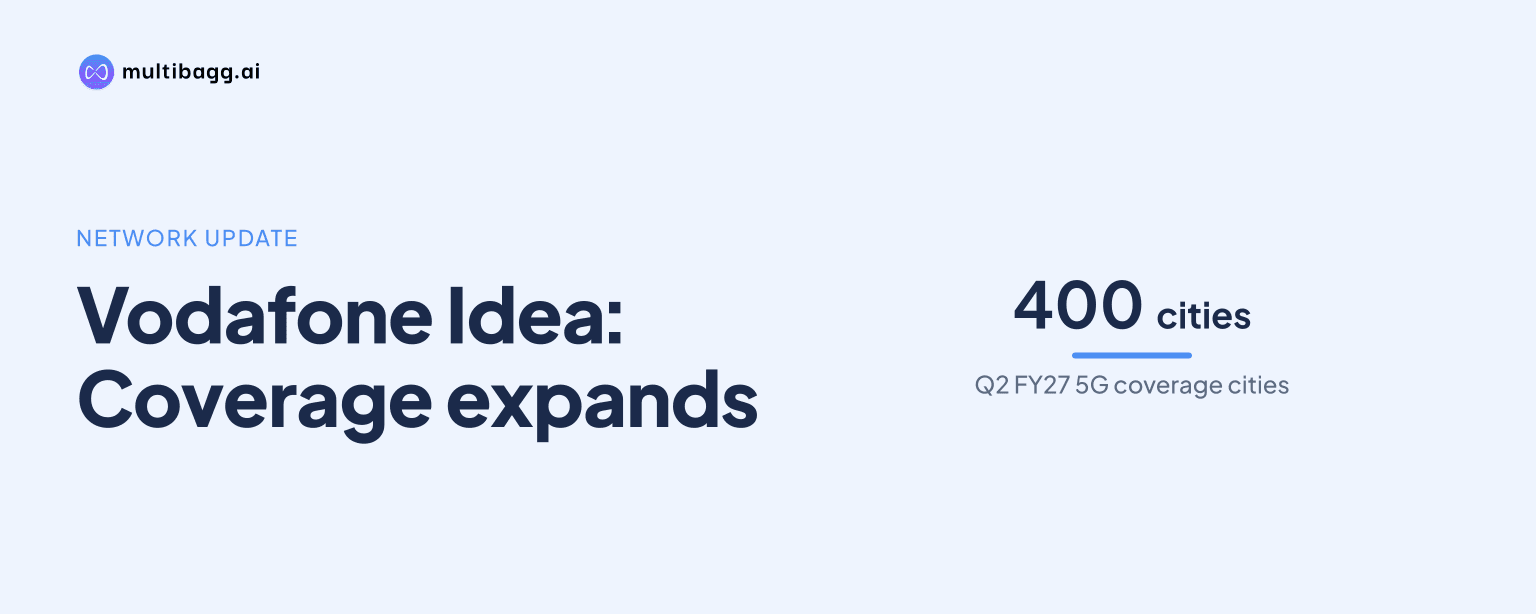
Vodafone Idea Limited expanded its 5G coverage to 400 Indian cities and towns in Q2FY27, while adding nearly 9,000 unique broadband towers and reaching 213,616 at September 30, 2026. Vi reported 4G population coverage of almost 88% and daily data usage of 93.6 petabytes, up 27.1% year on year.
Know Vodafone Idea inside out
Results, valuation, peers and who's buying, in one view.
How far has Vi expanded 5G and 4G coverage?
Vi expanded 5G services to 400 cities and towns across the 17 key circles where it holds 5G spectrum during Q2FY27. The company also holds millimetre-wave spectrum in 16 circles, although its quarterly release measured the ongoing 5G rollout across the 17 circles where it holds 5G spectrum.
Vi reported 4G population coverage of almost 88% as of September 2026 after extending 4G coverage to an additional 45 million people since Q2FY26. Management said planned investments are expected to lift 4G population coverage in the 17 key circles to more than 95%, setting out the next disclosed coverage objective.
Vi said its deployment programme combines new 4G sites with upgrades to its core and transmission network. The company said these investments are intended to improve indoor coverage and add network capacity, alongside broadening 5G availability in the 400 cities and towns where services have been launched.
What did Vi add to its broadband tower network in Q2FY27?
Vi added nearly 9,000 unique broadband towers in Q2FY27, its highest quarterly addition in the last nine quarters. Its total unique broadband tower count reached 213,616 at the end of Q2FY27, compared with 204,893 at the end of Q1FY27 and 191,096 at the end of Q2FY26.
The closing tower count represents an increase of 8,723 from Q1FY27, consistent with Vi's description of nearly 9,000 additions during the quarter. Over the 12 months to Q2FY27, the count increased by 22,520 towers from 191,096, while the company described the increase as more than 22,500 towers.
Capital expenditure, or capex, more than doubled sequentially to Rs 3,946 crore in Q2FY27, increasing 104.5% from Q1FY27. Vi said it had placed capex orders worth more than Rs 13,200 crore towards its three-year capex guidance, of which nearly Rs 6,000 crore had been executed by the November 12, 2026 release.
Got a follow-up? Ask IRIS
How did Vi's customers and data use change during the rollout?
Vi's subscriber base rose to 194.4 million in Q2FY27 from 193.1 million in Q1FY27, an increase of 1.3 million in the quarter. Its postpaid subscriber base reached 33.9 million from 31.9 million in Q1FY27, which Vi described as its highest sequential postpaid increase in the last nine quarters.
Vi closed Q2FY27 with 131.0 million 4G and 5G subscribers, compared with 127.8 million in Q2FY26 and 130.1 million in Q1FY27. The higher-speed subscriber base therefore increased by 3.2 million year on year and by 0.9 million sequentially, while the overall subscriber base remained below the 196.7 million reported in Q2FY26.
Vi's data usage rose to 93.6 petabytes per day in Q2FY27 from 73.6 petabytes per day in Q2FY26, a year-on-year increase of 27.1%. Customer average revenue per user, or ARPU, increased to Rs 198 from Rs 180 over the same period, a 9.7% increase that Vi attributed primarily to customer upgrades.
How is Vi funding its network expansion?
Vi reported total funding secured of more than Rs 10,500 crore through H1FY27, including warrants and fund-based and non-fund-based facilities. More than Rs 4,000 crore of incremental bank funding was arranged in Q2FY27, while bank debt stood at Rs 943 crore and cash and bank balances stood at Rs 5,470 crore as of September 30, 2026.
Revenue from operations increased 6.2% year on year and 1.7% quarter on quarter to Rs 11,884 crore in Q2FY27. Cash earnings before interest, tax, depreciation and amortisation, or cash EBITDA, measured before Indian Accounting Standard 116 lease-accounting effects, increased 11.2% year on year to Rs 2,498 crore; its margin was 21.0%, compared with 20.1% in Q2FY26.
Loss adjusted for exceptional items narrowed to Rs 5,513 crore in Q2FY27 from Rs 5,562 crore in Q2FY26. Reported loss, however, was Rs 5,975 crore compared with Rs 5,524 crore a year earlier, which Vi attributed to an adverse mark-to-market impact on treasury assets.
Management said progress in funding discussions gave it confidence to place additional orders and sustain the pace of network expansion. The release did not disclose the value or timing of a future funding arrangement, leaving further order placement conditional on the stated funding discussions.
Conclusion
Vi's Q2FY27 disclosure links a larger network footprint with increased use of its services: 213,616 unique broadband towers, 400 5G cities and towns, and 131.0 million 4G/5G subscribers. Daily data usage rose 27.1% to 93.6 petabytes, while ARPU increased 9.7% to Rs 198 and quarterly capex reached Rs 3,946 crore.
The next disclosed milestones are additional capex orders under the more than Rs 13,200 crore order programme and planned 4G population coverage above 95% in the 17 key circles. Funding remains an item to watch because Vi had secured more than Rs 10,500 crore through H1FY27 but said additional orders depend on progress in its funding discussions.