










Vi sets Rs 45,000 crore plan for 17-circle parity by FY29
Key highlights
- Vi has guided Rs 45,000 crore of network rollout capex through FY29.
- Vi targets coverage parity in 17 key circles by FY29.
- Vi plans seamless 5G coverage across urban markets by FY29.
- Vi’s ARPU rose from Rs 166 in Q2FY25 to Rs 198 in Q2FY27.
powered by IRIS
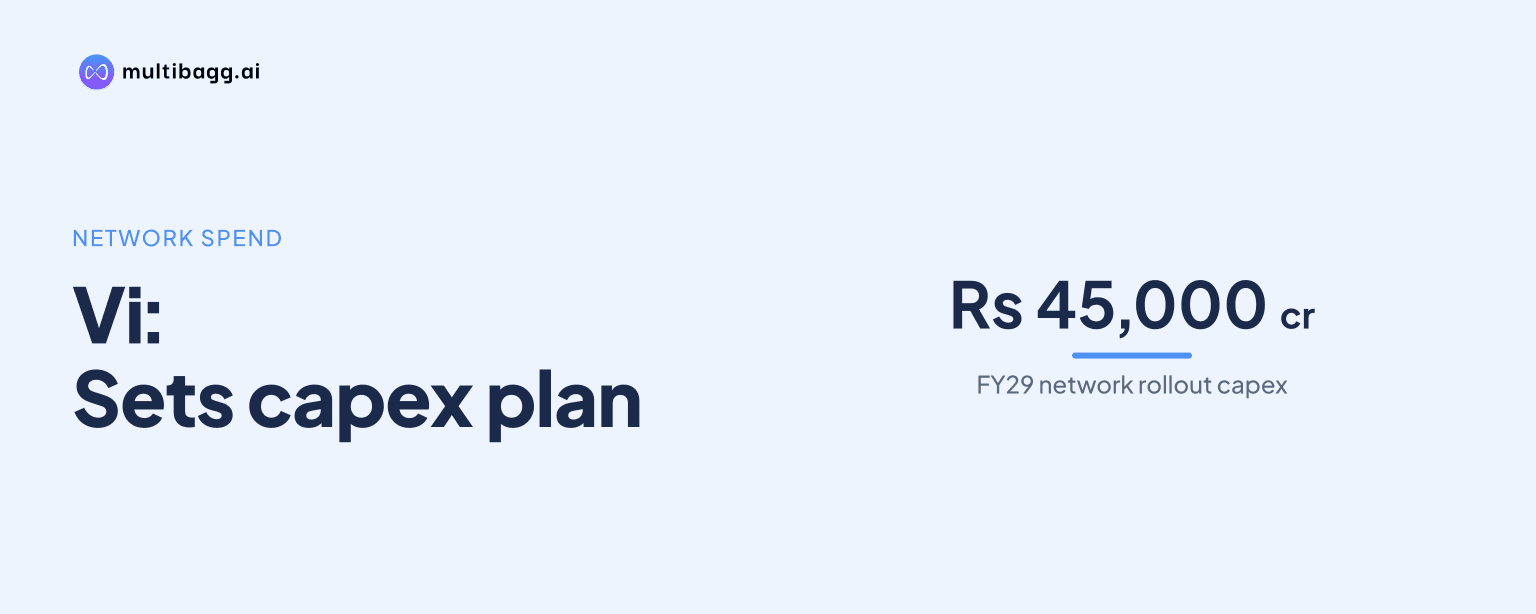
Vi plans Rs 45,000 crore of network capital expenditure by FY29 to regain coverage parity in 17 key circles, provide specified 2G and 4G coverage in five others, and offer a seamless 5G experience across urban markets. The targets are presented as the outcomes of Vi’s 17–5–5 network play.
Know Vodafone Idea inside out
Results, valuation, peers and who's buying, in one view.
What does Vi’s 17–5–5 network play commit to by FY29?
Vi’s stated FY29 outcome is coverage parity in 17 key circles, backed by Rs 45,000 crore of capex guidance for network rollout. A circle is Vi’s operating geography for telecom services. The presentation does not identify the 17 circles or state the benchmark against which coverage parity will be measured.
The second part of the plan covers five other circles. In those circles, Vi targets 100% 2G equals 4G coverage on national highways, key state highways, airports and places of tourist interest. Second-generation, or 2G, is a legacy mobile-network technology, while fourth-generation, or 4G, is a later mobile-data technology; the slide limits this 100% outcome to the listed routes and locations rather than describing full-circle parity.
The final “5” is 5G, or fifth-generation mobile technology. Vi says it intends to provide a seamless 5G experience across urban markets by FY29. The presentation does not specify the number of urban markets, the amount of 5G spectrum, network-speed measures, or rollout milestones before FY29.
What does Vi’s Rs 45,000 crore capex guidance cover?
Vi’s Rs 45,000 crore figure is guidance for network rollout under the 17–5–5 plan, with outcomes expected by FY29. Capital expenditure, or capex, is spending on long-lived operating assets such as network infrastructure. Vi presents the amount as a plan-level envelope and does not split it between the 17 key circles, the five other circles, 4G upgrades, 5G deployment or individual financial years.
The outcome targets place the same Rs 45,000 crore programme against three network objectives: parity in 17 circles, 100% 2G equals 4G coverage at specified locations in five circles, and urban 5G continuity. The disclosed figure cannot be used to calculate a per-circle or per-technology allocation because the presentation supplies neither allocation percentages nor a count of urban markets.
Vi labels the plan “17–5–5,” combining the 17-circle target, the five-circle route-and-location target and 5G in urban markets. The plan therefore distinguishes broad coverage parity from targeted 4G availability in the five other circles. It also separates the urban 5G objective from the highway, airport and tourist-location objective rather than stating that every target applies nationwide.
Got a follow-up? Ask IRIS
How does the network plan fit Vi’s operating strategy?
Vi places the 17–5–5 network play within a wider “1-2-3 Strategy”: sustained subscriber addition, double-digit revenue growth and cash earnings before interest, tax, depreciation and amortisation, or cash EBITDA, reaching three times its level in three years. The presentation names network expansion, brand reappraisal, average revenue per user growth levers, service differentiation and enterprise scale as components of that strategy.
The subscriber base shown in the presentation was 194.4 million, including 63.4 million non-4G or non-5G subscribers. That identifies users who are not yet on newer network technologies, although Vi does not provide a FY29 subscriber target or state how many of the 63.4 million users it expects to migrate by then.
Vi’s average revenue per user, or ARPU, rose from Rs 166 in Q2FY25 to Rs 198 in Q2FY27, while 4G and 5G subscribers increased from 125.9 million to 131.0 million over the same labelled periods. Vi says ARPU is expanding as the 4G and 5G subscriber mix improves, and its chart notes both tariff-hike impact and organic ARPU growth.
Vi’s data-use measure also rose from 15.4 gigabytes per 4G and 5G subscriber in Q2FY25 to 23.0 gigabytes in Q2FY27. Gigabyte, or GB, is a measure of data volume. The 4G and 5G share of subscribers increased from 61.4% to 67.4%, providing the period comparison that Vi uses to link mix improvement with engagement and ARPU.
What market conditions does Vi identify for network investment?
Vi describes India as a market with 82.00% overall wireless teledensity and 60.72% rural teledensity, based on Telecom Regulatory Authority of India subscription data dated 27 October 2026. Teledensity measures telephone connections relative to population. The gap between the overall and rural figures is 21.28 percentage points, and Vi presents low penetration as a source of market potential.
Wireless broadband subscribers numbered 964.98 million, compared with 48.89 million wired broadband subscribers, a ratio of about 20 times in the presentation. Vi notes that wireless includes mobile and fixed wireless access, or FWA, while the cited overall teledensity and broadband figures exclude machine-to-machine, or M2M, connections; rural teledensity includes M2M connections.
The presentation also cites more than 800 million Unified Payments Interface, or UPI, transactions daily, worth more than Rs 1,00,000 crore, in October 2026. It says 70% of individuals in India used the internet as of 2025, compared with 20% in 2018. These figures are industry context rather than Vi operating metrics, and the slides do not quantify how much of this demand Vi expects to capture by FY29.
Conclusion
Vi’s FY29 network plan puts a disclosed Rs 45,000 crore capex envelope behind three separate coverage outcomes: parity in 17 key circles, route-and-location 2G equals 4G coverage in five other circles, and seamless 5G across urban markets. The strategy is linked to subscriber addition, double-digit revenue growth and a three-times cash EBITDA ambition, while Vi’s Q2FY25-to-Q2FY27 data show ARPU increasing by Rs 32 and 4G/5G users increasing by 5.1 million.
The next item to watch is execution toward the FY29 outcome point, particularly whether Vi identifies the 17 key circles, the five other circles, urban-market coverage milestones or annual capex allocations. Investors can also track the disclosed measures that connect the network plan to commercial outcomes: the 63.4 million non-4G/5G subscribers, 4G/5G subscriber share, data use per subscriber and ARPU.