










Vi reaches 400 cities with 5G amid Rs 4,000 crore funding
Key highlights
- Vi expanded 5G coverage to 400 Indian cities and towns across 17 key circles in Q2FY27.
- Vi arranged over Rs 4,000 crore of incremental bank funding in Q2FY27 and over Rs 10,500 crore of total funding through H1FY27.
- Vi added nearly 9,000 towers in Q2FY27, taking total unique towers to 216,560.
- Vi's 4G population coverage reached 87.8% and data usage reached 93.6 petabytes per day in Q2FY27.
powered by IRIS
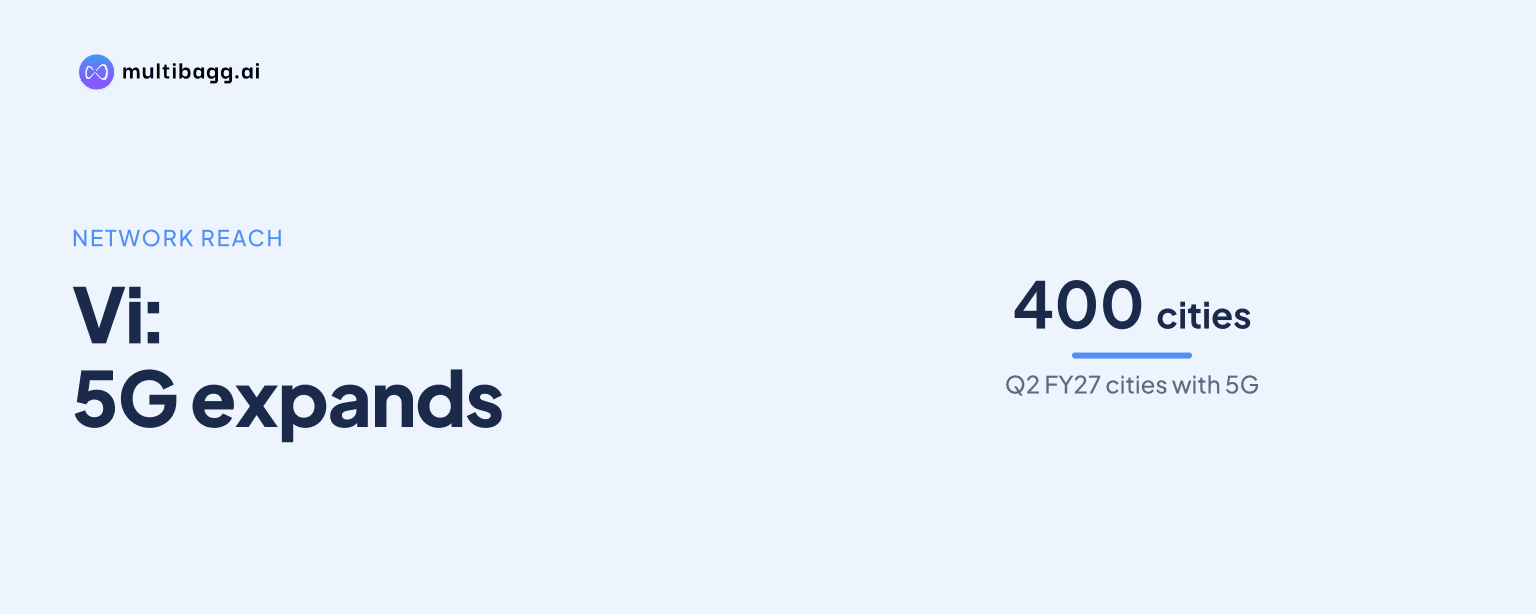
Vodafone Idea Limited expanded 5G coverage to 400 Indian cities and towns in Q2FY27 while arranging more than Rs 4,000 crore of incremental bank funding during the quarter. Vi also placed capex orders exceeding Rs 13,200 crore against its three-year guidance and added nearly 9,000 towers, its highest quarterly addition in nine quarters.
Know Vodafone Idea inside out
Results, valuation, peers and who's buying, in one view.
What funding did Vi arrange in Q2FY27?
Vi arranged more than Rs 4,000 crore of incremental bank funding in Q2FY27, within total funding secured of over Rs 10,500 crore through H1FY27. The H1 funding total included warrants as well as fund-based and non-fund-based facilities, so the disclosure does not state that the entire amount was incremental bank borrowing or immediately available cash.
Vi reported capex of Rs 3,946 crore in Q2FY27 and said it had placed capex orders worth over Rs 13,200 crore towards its three-year capex guidance. As of September 30, 2026, Vi reported bank debt of Rs 943 crore and cash and bank balances of Rs 5,470 crore. These figures set out the funding, spending and reported liquidity position at the quarter-end, without specifying the timing of drawdowns under every facility.
How quickly did Vi expand its network in Q2FY27?
Vi expanded 5G coverage to 400 cities and towns across the 17 key circles where it holds 5G spectrum in Q2FY27. The rollout occurred alongside 4G site additions and upgrades to the core and transmission network, rather than as a standalone 5G deployment programme.
Vi added nearly 9,000 towers in the second quarter, which management described as the highest quarterly addition in the last nine quarters. Its total unique tower count rose to 216,560 at the end of Q2FY27 from 209,269 at the end of Q1FY27, while total unique broadband towers rose to 213,616 from 204,893 over the same three-month comparison.
Vi added more than 22,500 new unique broadband towers over the last 12 months. Total broadband sites reached 610,521 in Q2FY27, compared with 580,883 in Q1FY27 and 527,012 in Q2FY26, showing that the latest quarter’s tower programme was accompanied by a broader increase in broadband network points.
How did Vi's 4G coverage and customer usage change?
Vi's 4G population coverage increased to 87.8% in Q2FY27 from 87.0% in Q1FY27 and 84.4% in Q2FY26. The network covered 431,445 census towns and villages at quarter-end, compared with 429,730 in the preceding quarter and 398,779 a year earlier.
Management said Vi extended 4G coverage to an additional 45 million people since Q2FY26. Its disclosed plan is to lift 4G population coverage in the 17 key circles to more than 95% through planned investments; this target applies to those circles, whereas the reported 87.8% figure is Vi's overall 4G population coverage measure.
Customer usage rose as the network expanded. Data usage reached 93.6 petabytes per day in Q2FY27, up from 88.4 petabytes per day in Q1FY27 and 73.6 petabytes per day in Q2FY26, a year-on-year increase of 27.1%. Average data use per 4G/5G subscriber was 23.0 gigabytes, compared with 21.7 gigabytes in Q1FY27 and 18.5 gigabytes a year earlier.
Got a follow-up? Ask IRIS
What happened to Vi's subscribers and revenue in Q2FY27?
Vi's total subscriber base increased to 194.4 million in Q2FY27 from 193.1 million in Q1FY27, while its 4G/5G subscriber base reached 131.0 million from 130.1 million. Compared with Q2FY26, 4G/5G subscribers increased from 127.8 million, and postpaid subscribers increased from 27.9 million to 33.9 million.
Customer average revenue per user, excluding machine-to-machine connections, was Rs 198 in Q2FY27, up from Rs 195 in Q1FY27 and Rs 180 in Q2FY26. Vi attributed the 9.7% year-on-year increase to customer upgrades. Blended average revenue per user reached Rs 178, while blended churn was 4.0%, compared with 3.8% in the preceding quarter.
Revenue from operations was Rs 11,884 crore in Q2FY27, rising 1.7% quarter on quarter and 6.2% year on year. Cash earnings before interest, tax, depreciation and amortisation, excluding the Indian Accounting Standard 116 lease-accounting effect, were Rs 2,498 crore, up 11.2% from Q2FY26. Reported earnings before interest, tax, depreciation and amortisation were Rs 4,981 crore, down from Rs 5,034 crore in Q1FY27, with the margin declining to 41.9% from 43.1%.
Why does the Q2FY27 funding and rollout matter for Vi?
The Q2FY27 disclosures connect Vi’s funding arrangements with a larger network build-out: more than Rs 4,000 crore of incremental bank funding was arranged, Rs 3,946 crore of quarterly capex was incurred, and 5G reached 400 cities and towns. The same quarter brought a rise in 4G population coverage to 87.8%, data usage to 93.6 petabytes per day and the subscriber base to 194.4 million.
The operating gains were accompanied by continuing losses and financing costs. Loss adjusted for exceptional items was Rs 5,513 crore in Q2FY27, compared with Rs 5,562 crore in Q2FY26, while reported loss was Rs 5,975 crore after an adverse mark-to-market impact on treasury assets. Net finance costs were Rs 4,975 crore and depreciation and amortisation was Rs 5,505 crore during the quarter.
Conclusion
Vi’s Q2FY27 update shows a simultaneous increase in funding activity, capex deployment and network expansion. Its 400-city 5G footprint, nearly 9,000 quarterly tower additions and 87.8% 4G population coverage provide measurable evidence of the rollout, while higher data usage and customer average revenue per user show changes in network consumption and customer mix.
The next disclosed milestones are execution of more than Rs 13,200 crore of capex orders and management’s plan to take 4G population coverage in its 17 key circles above 95%. Readers can watch whether subsequent quarters sustain tower additions, convert the 400-city 5G reach into further 4G/5G subscriber growth, and clarify funding utilisation as capex continues.