










Vi identifies 63.4 million subscribers for ARPU upsell potential
Key highlights
- Vi reports 63.4 million non-4G/5G subscribers from a total base of 194.4 million.
- Vi’s ARPU rose to Rs 198 in Q2FY27 from Rs 166 in Q2FY25.
- Unlimited-data users generate about 3.5 times the ARPU of non-ULD users, according to Vi.
- Data use per 4G/5G subscriber increased to 23.0 GB in Q2FY27 from 15.4 GB in Q2FY25.
powered by IRIS
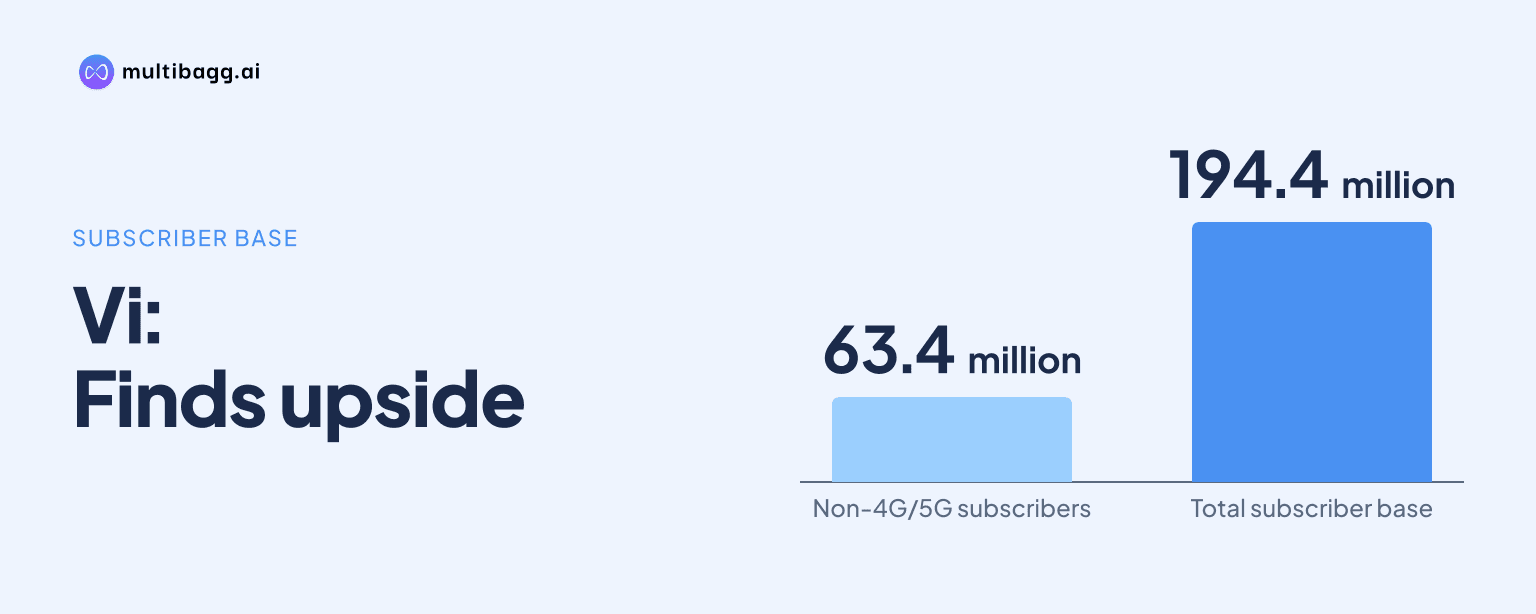
Vi reports that 63.4 million of its 194.4 million subscribers were outside 4G/5G, creating a migration pool alongside unlimited-data users that generate about 3.5 times the average revenue per user of non-unlimited-data users, while reported ARPU reached Rs 198 in Q2FY27.
Know Vodafone Idea inside out
Results, valuation, peers and who's buying, in one view.
How large is Vi’s 4G/5G migration opportunity?
Vi’s disclosed migration pool is 63.4 million subscribers who were not on 4G/5G, out of a total subscriber base of 194.4 million. The presentation separately labels the 4G/5G subscriber base at 131.0 million in Q2FY27, which is consistent with the difference between the total base and the non-4G/5G group. Vi does not disclose a time frame for moving this 63.4 million cohort to newer network technologies.
The non-4G/5G group represented about 32.6% of the 194.4 million total base, calculated from the subscriber figures shown by Vi. Conversely, the presentation records 67.4% of subscribers as 4G/5G users in Q2FY27. This split makes network migration relevant to monetisation because Vi links ARPU expansion to an improving mix of 4G/5G subscribers, although it does not provide a geographic, tariff-plan or handset-level breakdown of the remaining 63.4 million users.
How has Vi’s ARPU and 4G/5G base changed?
Vi’s ARPU, or average revenue per user, increased from Rs 166 in Q2FY25 to Rs 198 in Q2FY27, a rise of Rs 32 over the periods labelled in the presentation. Over the same Q2FY25-to-Q2FY27 comparison, its 4G/5G subscriber base increased from 125.9 million to 131.0 million, adding 5.1 million users. Vi labels the ARPU chart as including the impact of a tariff hike as well as organic ARPU growth.
The charted path shows ARPU at Rs 180 in Q2FY26 between the Rs 166 Q2FY25 and Rs 198 Q2FY27 readings. The 4G/5G subscriber series shown by Vi includes 125.9 million in Q2FY25, 127.8 million in Q1FY26 and 131.0 million in Q2FY27. The figures indicate that revenue per user rose faster than the disclosed 4G/5G subscriber count over those labelled points, while the presentation attributes ARPU expansion to both tariff effects and customer-mix change.
Vi also shows the 4G/5G proportion increasing from 61.4% in Q2FY25 to 65.0% in Q2FY26 and 67.4% in Q2FY27. That is a 6.0-percentage-point increase from the first to the last displayed Q2 period. The presentation pairs this change with data consumption per 4G/5G subscriber rising from 15.4 gigabytes (GB) in Q2FY25 to 18.5 GB in Q2FY26 and 23.0 GB in Q2FY27.
Why do unlimited-data users matter to Vi’s ARPU?
Vi states that unlimited-data, or ULD, users deliver about 3.5 times the ARPU of non-ULD users, for which it sets an index of 1 times. This is the presentation’s clearest indication of the revenue difference between the two usage groups. It does not disclose the absolute ARPU for either group, the number of ULD users, or the price points and data allowances associated with ULD plans.
The 3.5-times comparison identifies a second monetisation mechanism alongside technology migration: moving customers into a higher-value data proposition. Vi presents the ULD comparison on the same page as the increase in data use to 23.0 GB per 4G/5G subscriber in Q2FY27. The presentation therefore connects higher engagement and a more favourable 4G/5G mix with ARPU growth, but does not quantify how much of the Rs 32 ARPU increase came from ULD adoption.
The distinction also matters because 4G/5G adoption and ULD adoption are not presented as the same measure. Vi reports 131.0 million 4G/5G subscribers in Q2FY27, but gives no corresponding ULD subscriber count. As a result, the disclosed data supports the existence of an ARPU gap between ULD and non-ULD customers, while leaving the scale of potential conversion within the 63.4 million non-4G/5G group unresolved.
Got a follow-up? Ask IRIS
What network and service plans could support Vi’s migration strategy?
Vi sets out Rs 45,000 crore of capital-expenditure guidance for network rollout by FY29 under its “17–5–5” network plan. The plan calls for regaining coverage parity in 17 key circles, while five other circles are to have 100% 2G=4G coverage on national highways, key state highways, airports and tourist locations. Vi also states an objective of seamless 5G experience across urban markets.
Those FY29 network objectives provide the disclosed operational backdrop for shifting customers from the 63.4 million non-4G/5G base, but Vi does not state a target number of migrations or an ARPU target tied to the rollout. The plan is framed around coverage parity, 2G=4G coverage in five circles and urban 5G experience. The presentation does not provide circle-level subscriber counts, deployment dates before FY29 or a conversion forecast for the non-4G/5G cohort.
Vi is also expanding customer-service reach to more than 2,800 branded stores across over 650 cities, supported by about 635,000 retailers. Its i@50 programme aims to reduce assisted interactions at touchpoints by 50% and has delivered a 42% reduction in assisted customer complaints to date. Its Zero Interaction Complaints programme reports a 74% reduction in interaction-related complaints across touchpoints, although Vi does not quantify a direct ARPU effect from these initiatives.
Conclusion
Vi’s presentation identifies two measurable routes to higher revenue per user: converting part of the 63.4 million subscribers outside 4G/5G and increasing participation in unlimited-data plans, whose users generate about 3.5 times non-ULD ARPU. The reported rise in ARPU from Rs 166 in Q2FY25 to Rs 198 in Q2FY27 occurred alongside a 6.0-percentage-point increase in the 4G/5G subscriber mix and data use rising to 23.0 GB per 4G/5G subscriber.
The next disclosed milestone is Vi’s FY29 network rollout plan, backed by Rs 45,000 crore of capex guidance and covering 17 key circles, five other circles and urban 5G markets. The key unresolved measures are the pace at which the 63.4 million subscribers migrate, the number that adopt ULD plans, and the respective contribution of tariff changes, mix improvement and organic growth to future ARPU.