










Vodafone Idea Limited Plans ₹45,000 Crore Network Capex to FY29
Key highlights
- VIL plans ₹45,000 crore of network capex until FY29.
- VIL targets double-digit revenue growth and a threefold increase in cash EBITDA over three years.
- The network plan includes 100% 2G-to-4G conversion in additional circles.
- VIL filed its investor presentation on September 15, 2026.
powered by IRIS
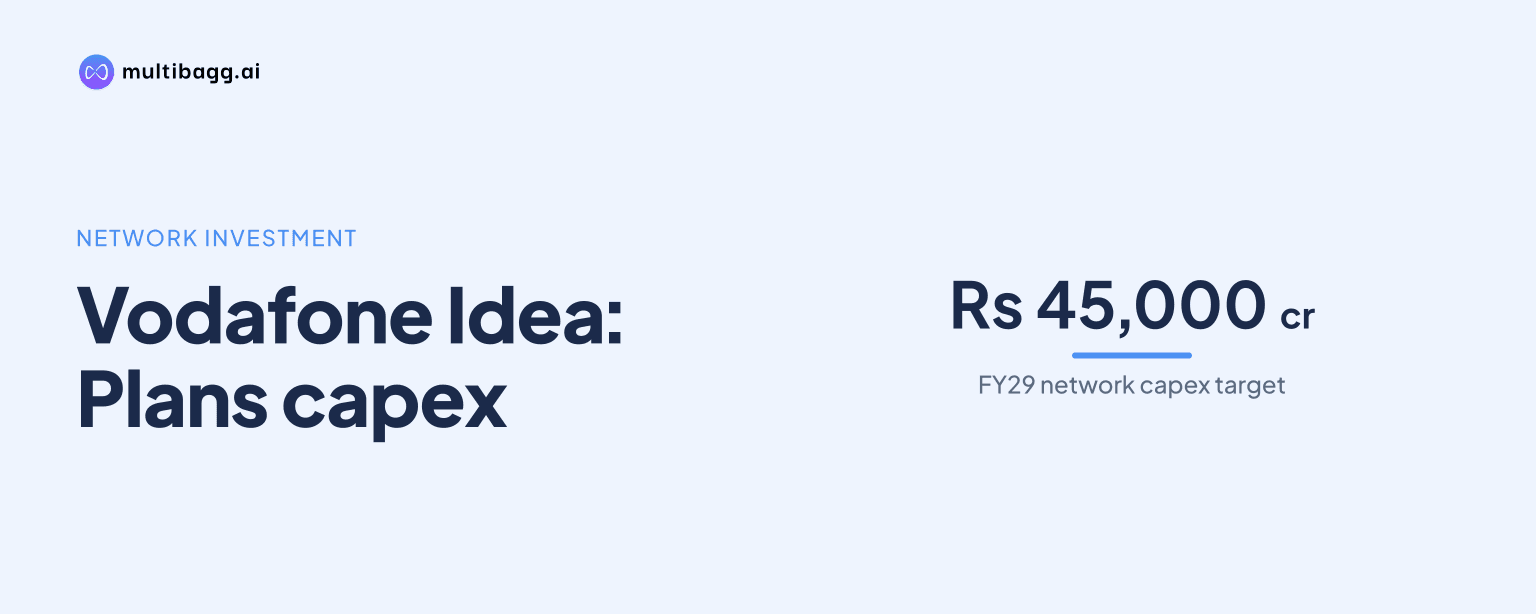
Vodafone Idea Limited plans ₹45,000 crore of network capital expenditure through FY29 under its 1-2-3 Strategy, targeting coverage parity, 5G deployment, sustained subscriber additions, double-digit revenue growth and a threefold increase in cash EBITDA over three years. The plan is important because network investment is central to VIL's stated effort to improve its competitive position in India's telecom market.
Know Vodafone Idea inside out
Results, valuation, peers and who's buying, in one view.
What did VIL announce in its September 2026 presentation?
VIL announced a ₹45,000 crore capital-expenditure programme for network rollout until FY29 in an investor presentation filed on September 15, 2026. The company presented the spending plan as part of its 1-2-3 Strategy, which sets operating and financial objectives over a three-year period.
The strategy has three stated goals: sustained subscriber growth, double-digit revenue growth and tripling cash EBITDA in three years. These are management targets presented to investors, rather than reported financial results for a completed period. The filing does not provide an annual breakup of the proposed capex or disclose the funding mix for the programme.
VIL also said it aims to regain coverage parity. Its network plan includes achieving 100% 2G-to-4G conversion in additional circles and providing what it described as a seamless 5G experience. The company did not identify the additional circles in the material provided or give a circle-wise rollout schedule.
How will the ₹45,000 crore capex plan be used?
The ₹45,000 crore programme is intended for network rollout through FY29, with 5G deployment and coverage improvement forming the main stated priorities. VIL's focus on coverage parity indicates that the investment plan is designed to address network reach alongside technology upgrades.
The commitment to 100% 2G-to-4G conversion in additional circles places network modernisation within the plan. A transition from 2G coverage to 4G coverage can affect the services available to existing subscribers, although the presentation does not quantify the number of sites, customers or circles covered by this target.
The company has also linked the rollout to the goal of delivering a seamless 5G experience. The presentation does not disclose a specific 5G population-coverage target, launch date, spectrum-band detail or number of cities. These omissions leave the pace and geographic sequence of the deployment unspecified in the filing.
What are the main targets in VIL's 1-2-3 Strategy?
VIL's 1-2-3 Strategy combines subscriber, revenue and cash EBITDA ambitions with network-investment priorities. The subscriber objective is sustained additions, while the revenue objective is double-digit growth. The profitability objective is to triple cash EBITDA within three years.
These targets depend on the company executing its network plan while improving customer acquisition and retention. The presentation connects coverage parity, 4G conversion and 5G service quality with the broader commercial objectives, but it does not provide intermediate subscriber, revenue or cash EBITDA milestones.
The filing also outlined a brand reappraisal effort. VIL cited a new brand identity and named Shah Rukh Khan as its brand ambassador. The brand initiative sits alongside the network strategy, indicating that the company is addressing customer-facing positioning as well as infrastructure expansion.
Got a follow-up? Ask IRIS
Why does the network plan matter for telecom investors and customers?
The network plan matters because VIL has made infrastructure improvement a stated foundation for its subscriber, revenue and cash EBITDA goals. For investors, the ₹45,000 crore commitment establishes the scale of investment management intends to make through FY29, while the presentation does not disclose a year-by-year spending pattern or financing details.
For customers, the stated emphasis is on broader 4G availability in additional circles, coverage parity and 5G service. The practical effect will depend on the rollout that VIL completes. No measured improvement in coverage, service quality or subscriber additions was reported in the presentation excerpt.
For the wider telecom industry, the announcement keeps network investment and 5G deployment at the centre of competition. However, the filing does not include market-share estimates, pricing plans or comparative network data. It therefore provides a strategic direction rather than a quantified comparison with other operators.
The company made the disclosure under Regulation 30 and Regulation 46 of the SEBI Listing Regulations through its investor presentation. The formal exchange disclosure gives investors a record of VIL's stated strategic priorities, but the targets remain subject to execution over the period identified by the company.
How does this fit VIL's recent corporate disclosures?
VIL has continued to use investor presentations and exchange filings to communicate with shareholders and the market. Its investor-relations materials are also available through the company's website, alongside financial results, annual reports, shareholding information and other regulatory disclosures.
The September 2026 presentation follows earlier investor-presentation disclosures by the company, including a filing dated June 30, 2026. The current presentation adds a defined capex figure through FY29 and ties that investment to specific strategic objectives covering network quality, subscriber additions, revenue and cash EBITDA.
The plan should be read as a forward-looking management framework. VIL has stated the amount, broad investment period and operating targets, but has not disclosed all the operational details needed to measure progress circle by circle. Future presentations and regulatory filings may provide additional information on rollout execution and financial performance.
Conclusion
VIL's September 2026 presentation sets out a ₹45,000 crore network-investment plan through FY29, alongside a three-year strategy for subscriber growth, double-digit revenue growth and a threefold increase in cash EBITDA. The announcement places coverage parity, additional 4G conversion and 5G deployment at the centre of the company's stated turnaround approach.
The key point to watch next is how VIL translates the FY29 capex plan into disclosed rollout progress and operating results. Investors will also look for details on annual expenditure, funding, the circles selected for 2G-to-4G conversion, 5G deployment milestones and movement against the three-year targets.