










Vi reports 42% fewer assisted complaints in service overhaul
Key highlights
- Vi reports a 42% reduction in assisted customer complaints to date under i@50.
- Vi reports a 74% reduction in interaction-related complaints across all touchpoints under ZIC.
- Vi is expanding to more than 2,800 branded stores across more than 650 cities and cites about 635,000 retailers.
- Vi reported 194.4 million subscribers and 131.0 million 4G/5G subscribers in Q2FY27.
powered by IRIS
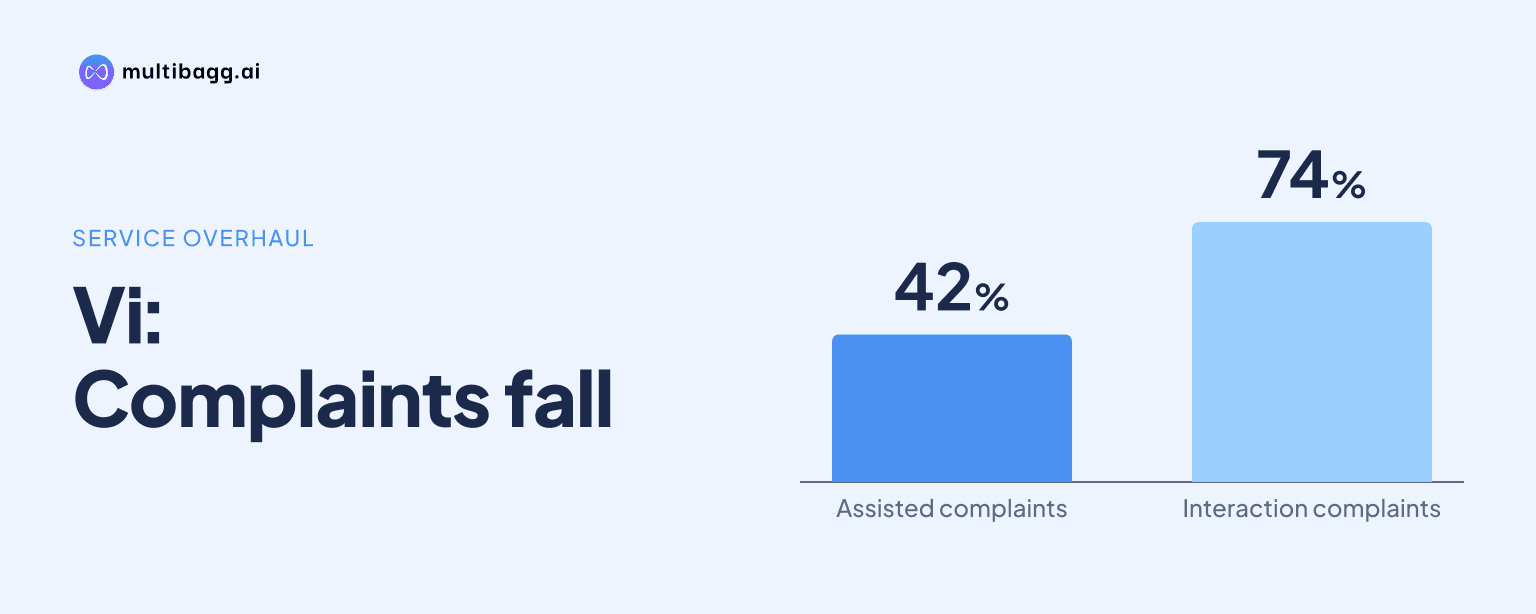
Vi reports that, to date, its i@50 programme has reduced assisted customer complaints by 42%, while Zero Interaction Complaints has reduced interaction-related complaints by 74% across all touchpoints. The service overhaul combines a target to cut assisted interactions by 50% with expansion to more than 2,800 branded stores, about 635,000 retailers and three artificial-intelligence-led initiatives.
Know Vodafone Idea inside out
Results, valuation, peers and who's buying, in one view.
How much has Vi reduced customer-service complaints?
Vi says i@50 has reduced assisted customer complaints by 42% to date. The programme aims to empower customers with faster service by reducing assisted interactions by 50% at touchpoints. The presentation does not disclose the period covered, the number of complaints at the starting point or the number remaining after the reported reduction.
Vi also reports that Zero Interaction Complaints, or ZIC, has cut interaction-related complaints by 74% across all touchpoints. ZIC is intended to eliminate repeat contact for the same issue, whereas i@50 is framed around reducing assisted interactions. The company does not state whether the two measures share a common complaint baseline or whether one result is included in the other.
The disclosed measures therefore track separate service outcomes. The 42% result concerns assisted customer complaints under i@50, while the 74% result concerns interaction-related complaints under ZIC. Vi has not provided complaint volumes, definitions of interaction-related complaints or results by retail, contact-centre, outbound or app channel.
Where does Vi deliver its service promise?
Vi says it is expanding its footprint to more than 2,800 branded stores across more than 650 cities. These stores form part of the company’s stated service-at-touchpoints approach, alongside the contact-centre, outbound and Vi app experiences identified in its artificial-intelligence initiatives.
Vi also cites about 635,000 retailers that provide reach and support its service promise. That count is much larger than the planned branded-store network and shows that the service model extends beyond branded outlets. The presentation does not break down the retailer base by city, service activity, complaint-handling responsibility or retailer format.
The physical and retail footprint serves a subscriber base of 194.4 million in Q2FY27. Subscribers increased from 193.1 million in Q1FY27, while net additions rose from 0.3 million to 1.3 million over the same quarters. Vi does not attribute the Q2FY27 subscriber increase to i@50, ZIC, retail expansion or its AI-led service tools.
Which AI tools is Vi using for service?
Vi identifies Super Agents as an initiative combining generative artificial intelligence, or Gen AI, with emotional intelligence for contact-centre, outbound and Vi app experiences. The presentation describes the intended role in improving service but gives no deployment date, user count, adoption rate or complaint-reduction result for Super Agents.
Voice Biometric is intended to provide secure, frictionless and quicker authentication. The disclosed mechanism concerns identity verification rather than a reported complaint outcome. Vi does not provide figures for authentication time, successful verification, customer usage or the channels in which Voice Biometric has been deployed.
The Self-Healing Network is designed to reduce service disruptions through proactive detection and fixes. This initiative places network issues within the customer-service programme by seeking to address disruptions before a customer needs support. Vi does not disclose the number of sites covered, disruptions detected, fixes completed or time saved through the Self-Healing Network.
Got a follow-up? Ask IRIS
How does the service programme fit Vi’s digital strategy?
Vi’s digital assets create additional channels alongside its more than 2,800 planned branded stores and about 635,000 retailers. Its over-the-top, or OTT, aggregator app offers multiple OTT services and more than 300 television channels under one subscription. The presentation does not say whether the 42% i@50 result or the 74% ZIC result includes complaints associated with that app.
The viShop marketplace offers utility payments and recharges for Fastag and direct-to-home television services, while viFinance offers personal loans, fixed-deposit options and credit cards. Vi says viFinance is planned to expand into other categories over the next one year. No service metric links viShop or viFinance directly to the reported complaint reductions.
The Vi app is specifically named as one of the channels for Super Agents, connecting the Gen AI initiative to a customer-facing digital channel. The company also reported 131.0 million 4G/5G subscribers in Q2FY27, compared with 127.8 million in Q2FY26. The presentation does not quantify how many of those customers use the app, Super Agents or Voice Biometric.
What operating trends accompany Vi’s service overhaul?
Vi reported average revenue per user, or ARPU, of Rs 198 in Q2FY27, compared with Rs 180 in Q2FY26, an increase of 9.7%. Over the same period, 4G/5G subscribers increased by 3.2 million to 131.0 million, and the 4G/5G share of subscribers rose to 67.4% from 65.0%. The presentation does not establish that service automation caused these changes.
Data usage increased to 93.6 petabytes per day in Q2FY27 from 73.6 petabytes per day in Q2FY26, a 27.1% increase. Data usage per 4G/5G subscriber was 23.0 gigabytes in Q2FY27, compared with 18.5 gigabytes in Q2FY26. These figures provide operating context for the company’s focus on app support, authentication and proactive network fixes, rather than a measured result of the service initiatives.
Vi also reported 214,000 broadband sites in Q2FY27, compared with 191,000 in Q2FY26, an increase of more than 22,500 sites. The larger site base is relevant to the Self-Healing Network’s stated objective of proactive detection and fixes. However, the presentation does not disclose how many of the 214,000 sites use self-healing capabilities.
Conclusion
Vi has reported two specific service outcomes: a 42% reduction in assisted customer complaints under i@50 and a 74% reduction in interaction-related complaints under ZIC. Those results sit within a service model spanning more than 2,800 branded stores, about 635,000 retailers, Super Agents, Voice Biometric and a Self-Healing Network, serving 194.4 million subscribers in Q2FY27.
The next disclosed milestones are i@50’s aim to reduce assisted interactions by 50% and viFinance’s planned move into other categories over the next one year. Further updates would be most informative if Vi provides the periods, baselines and channel-level results behind the 42% and 74% reductions, as well as deployment detail for the three AI-led initiatives.