










Xelpmoc says products contribute only 12%-15% of revenue
Key highlights
- Xelpmoc said products contribute about 12% to 15% of revenue, with services supplying the balance.
- About 70% of Xelpmoc revenue comes from overseas markets and is largely driven by earlier services projects.
- RELY served about 400 beds across three operators as of September 30.
- Management said RELY additions in October were excluded from financials through September 30.
powered by IRIS
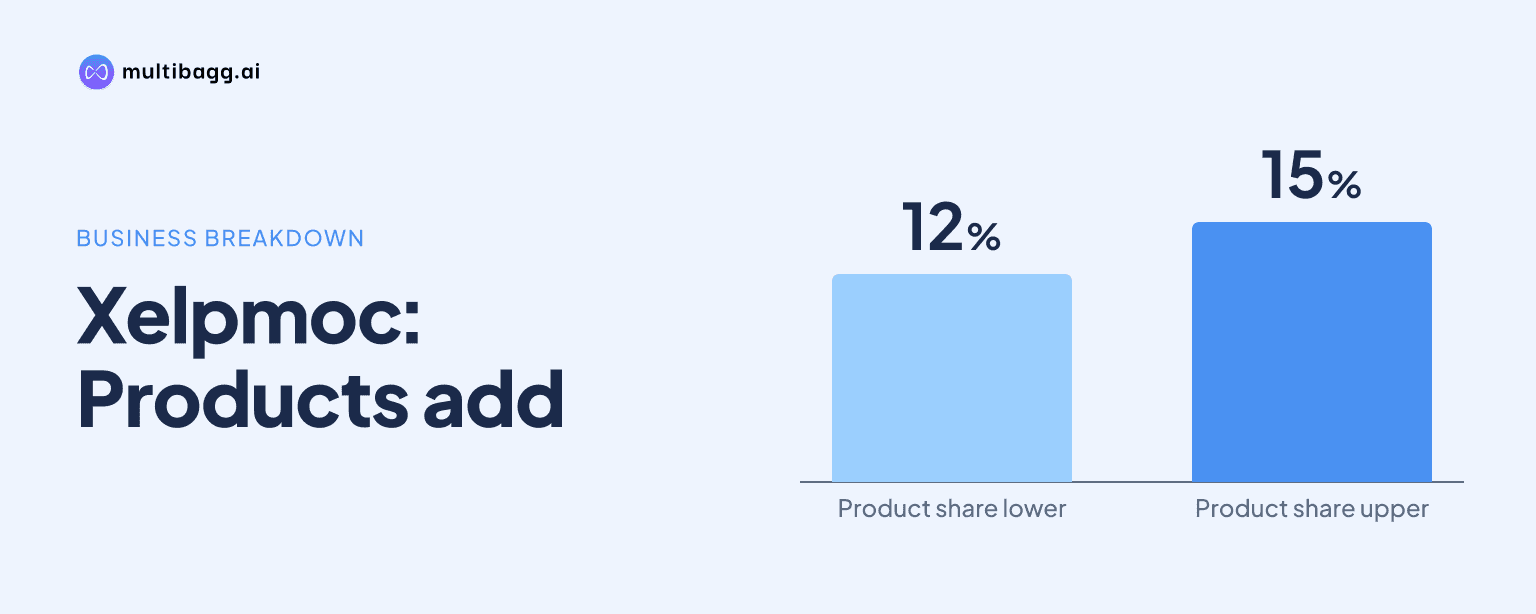
Xelpmoc Design and Tech Limited said on November 17, 2026, that products represented about 12% to 15% of reported revenue, while services generated the balance. Management said RELY's long-term subscriptions, priced per bed or per patient, are intended to increase the product share as the offering gains marketability.
Know Xelpmoc Design and Tech inside out
Results, valuation, peers and who's buying, in one view.
What share of Xelpmoc revenue comes from products?
Products contribute close to 12% to 15% of Xelpmoc revenue, while services account for roughly 85% to 88%, according to management's response to an investor question on November 17, 2026. Management described the current revenue base as largely service-led despite its investment in RELY and DocuXray. The product contribution includes deployments of artificial intelligence, or AI, in the United Kingdom and at a couple of organisations in India.
The reported mix contrasts with Xelpmoc's intended product-led direction. Management said 70% of revenue comes from overseas markets and that this revenue is largely driven by services projects started earlier. The company did not disclose total revenue, product revenue in rupees, or separate revenue contributions from RELY and DocuXray during the call.
Why has Xelpmoc revenue stayed stable for several quarters?
Management said the revenue base remained largely driven by earlier services projects while products were still at an early commercial stage. Services work depends on the scope of individual contracts, whereas RELY is structured as recurring revenue per bed or per patient. That difference means product development and customer onboarding may not produce the same revenue pattern as an established project-based services contract.
For RELY, management said initial pilots and user-acceptance testing, or UAT, take time before customers go live. For DocuXray, it said pilots are taking time to convert because prospective corporate customers are assessing data privacy, workflows and related processes. Management said engagement with potential DocuXray customers improved “drastically” between the first and second quarters, without giving customer counts, contract values or a conversion timetable.
How could RELY change Xelpmoc's revenue mix?
RELY could increase the product share because it is sold through long-term subscriptions charged on a per-bed or per-patient basis, management said. This differs from services contracts, whose revenue depends on their scope. Management said the mix would shift from services toward products once products gain marketability, but it gave no product-revenue target or date for that shift.
As of September 30, RELY was serving about 400 beds across three operators, according to management. It said several discussions held in August and September resulted in customers being onboarded in the first and second weeks of October, so those additions were not included in financials through September 30. Management said the number should improve in December and March as live customer references make subsequent onboarding easier, although it did not provide bed targets for either period.
Got a follow-up? Ask IRIS
What is the commercial position of DocuXray?
DocuXray remains in a pilot-conversion phase, with privacy and workflow reviews extending the sales process, management said. The product is designed around document interpretation and extraction of information from space or context. Management said that fundamental layer can remain common across use cases, while the training required changes by document type and sector, from payslips and bank statements to legal documents.
Management also said DocuXray was being rigorously tested in some sectors for privacy, security and data claims, in addition to proof-of-concept, or POC, functionality. It cited legal technology as an area where it has worked for five or six years and said it was also doing work in real estate. Management said five or six sector opportunities were open and that two or three could succeed, but it did not identify those sectors or say when commercial contracts might result.
Will Xelpmoc continue accepting services contracts?
Xelpmoc will continue serving existing services customers even as its concentration moves toward products, management said. It explicitly said it is not refusing work from customers already receiving the services model. This means the stated product focus does not amount to an announced exit from services, which still represent about 85% to 88% of the current revenue mix.
All employees and activities sit within one Xelpmoc entity rather than in a separate RELY company or division, management said. Within that entity, it has a dedicated product-focused team and separate technology personnel working on RELY. It also said people have taken responsibility for go-to-market work on both DocuXray and RELY, while a marketing person had been added as a focused role for the first time in a long period.
Conclusion
Xelpmoc's disclosed revenue mix remains led by services, with products contributing only about 12% to 15% despite the development of RELY and DocuXray. The comparison matters because services revenue is linked to project scope, while RELY is designed to generate recurring revenue through per-bed or per-patient subscriptions. The company has not disclosed the rupee contribution of either product, so the pace of any mix change cannot be calculated from the call.
The next disclosed markers are management's expected improvement in RELY beds and customers in December and March, following onboarding activity in October. Readers can also watch whether DocuXray pilots convert after privacy, security and workflow assessments. Management said it expects the benefits of portfolio investment to become visible after three or four quarters, once the company is profitable and self-sustaining, but it did not provide a financial target or deadline.