










Yasho retains above-20% EBITDA aspiration after cost rise
Key highlights
- Yasho said freight and energy caused roughly 200 of the about 300 basis points of Q2 FY27 EBITDA-margin decline.
- Freight expense doubled from Rs 10 crore in Q1 FY27 to Rs 20 crore in Q2 FY27, while gas added Rs 1.8 crore of cost.
- Yasho retained its aspiration to maintain EBITDA above 20% but did not commit to margins of 23% to 25%.
- Exports represented 70% of Q2 FY27 revenue, compared with about 65% in Q1 FY27 and about 63% in FY26.
powered by IRIS
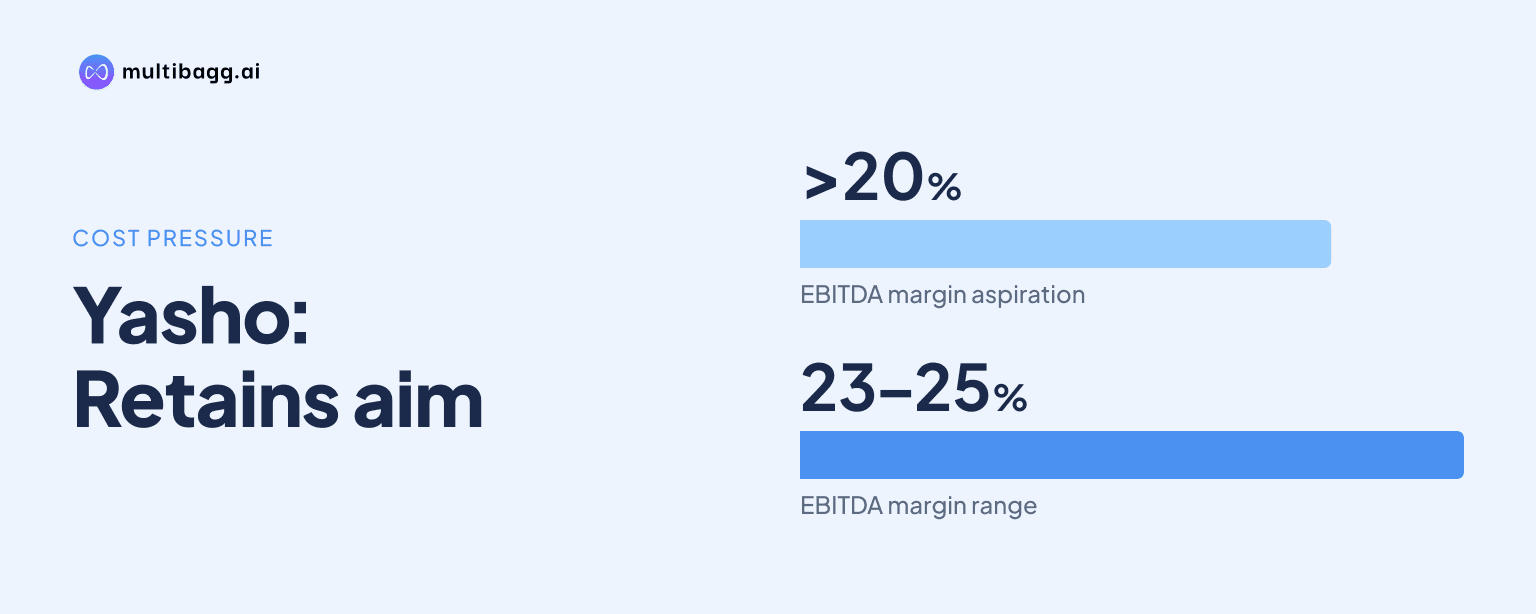
Yasho Industries Limited said Q2 FY27 EBITDA margin fell by about 300 basis points, including roughly 200 basis points from freight and energy, but management retained its aspiration to maintain EBITDA above 20%. Freight expense doubled sequentially to Rs 20 crore, while higher gas prices added Rs 1.8 crore of expenditure during the quarter.
Know Yasho Industries inside out
Results, valuation, peers and who's buying, in one view.
What caused Yasho's Q2 FY27 margin decline?
Yasho said freight and energy costs were the principal cause of the approximately 300-basis-point quarter-on-quarter EBITDA-margin decline in Q2 FY27. A basis point is one-hundredth of a percentage point. Management attributed about 200 basis points of the movement to freight and energy, while saying the remaining roughly 100 basis points could reflect product mix across a portfolio of more than 150 products.
The disclosed cost changes illustrate the pressure. Freight increased from Rs 10 crore in Q1 FY27 to Rs 20 crore in Q2 FY27, and gas prices created an additional Rs 1.8 crore of expenditure in Q2 FY27. Management said it had to absorb those spot cost changes when customer purchase orders had already been accepted at fixed prices.
The margin compression came despite higher year-on-year earnings. Q2 FY27 total income rose to Rs 347.92 crore from Rs 183.6 crore in Q2 FY26, while EBITDA increased to Rs 72.92 crore from Rs 33.42 crore. Management linked earnings growth over the longer comparison to volume and fixed-cost absorption, but said the Q2 FY27 sequential margin decline reflected the immediate freight and energy shock.
How much higher cost can Yasho pass to customers?
Yasho said it can include prevailing costs in spot and quarter-to-quarter business, but cannot immediately revise prices under fixed customer contracts. Management cited contracts signed in June for six months through December as an example of commitments where prices cannot be changed despite subsequent increases in freight or energy expenses.
Management expected the additional costs to start being passed on from the current quarter, although it gave no recovery amount or timetable. On newly negotiated spot business, Yasho said pricing is agreed using current costs. The eventual margin effect therefore depends on freight movements and the proportion of revenue covered by fixed contracts rather than repriced orders.
Raw-material costs have also increased. Management estimated an overall 10% to 15% rise in its raw-material prices from March to September, while noting that the change varies by chemical, from no increase in some inputs to much larger increases in others. It separately said product prices increased 10% to 15% in the preceding six months, with product mix also affecting revenue.
Got a follow-up? Ask IRIS
Why does Yasho's export mix affect EBITDA margin?
Yasho's 70% export revenue share in Q2 FY27 makes logistics costs material to its margin calculation. The export share increased from about 65% in Q1 FY27 and about 63% in FY26. Management said overseas customers may have access to different raw-material cost levels, requiring caution in passing every cost increase through to customers.
Management said freight is included in reported revenue, meaning higher sales can partly reflect logistics charges that must later be deducted in assessing profitability. From Q1 FY27 to Q2 FY27, management said value growth was about 13% and volume growth about 7%. The difference does not by itself indicate equivalent underlying margin improvement because freight was higher in Q2 FY27.
Industrial chemicals accounted for approximately 90% of H1 FY27 revenue, while capacity utilisation reached 66% in Q2 FY27. Management said demand was not slowing and that Yasho was gaining business with existing and new customers at its price range. Those operating conditions support volume growth, but the 70% export mix leaves margin exposed to freight costs and contract repricing timing.
Can higher utilisation raise Yasho's EBITDA margin?
Yasho said higher utilisation can improve fixed-cost absorption, but management did not provide a margin target above 20%. It described 20% as the lower side of its intended outcome and said its aspiration was to achieve 20% to 21% or more. It declined to endorse analyst estimates of 23% to 25% because freight conditions remain volatile.
Q2 FY27 utilisation was 66%, and management said it expected stronger utilisation in Q3 and Q4, historically higher-sales quarters for Yasho. Its FY27 utilisation expectation was 70%. Management identified lower fixed cost per unit from higher volumes as a major contributor to EBITDA-margin expansion, although it said gross margin was broadly constant and product mix may have contributed about 1%.
Yasho has committed Rs 250 crore of FY27 capital expenditure for two manufacturing buildings at Pakhajan, funded by Rs 100 crore of internal accruals and Rs 150 crore of sanctioned term loans. Management expects the two-building project to begin commercialisation in the last quarter of FY28 or early Q1 FY29, with first-year Phase 2 utilisation of 50% to 60%.
Conclusion
Yasho's Q2 FY27 comments set a clearer profitability threshold rather than a fixed quarterly margin promise. The company attributed roughly 200 of the 300 basis points of margin decline to freight and energy costs, after freight doubled to Rs 20 crore and gas added Rs 1.8 crore. Its stated aspiration remains EBITDA above 20%, while it balances cost recovery with export-market competitiveness.
The next disclosures to watch are whether spot and quarterly contracts recover the Q2 FY27 cost increase, and whether Q3 and Q4 utilisation improves from 66% toward management's 70% FY27 expectation. Management also expects trial production under its supply agreement in Q4 FY27 and commercialisation in Q1 FY28, while the two-building Pakhajan project is planned for commercialisation in late FY28 or early Q1 FY29.