










ORIGEM early stores reach break-even, target Rs 4 crore sales
Key highlights
- ORIGEM uses Rs 18 lakh to Rs 19 lakh of monthly revenue per store as its break-even range.
- Kharghar, Turner Road, Wave One Noida and Central 50 Noida have reached monthly break-even, according to management.
- Central 50 Noida crossed Rs 30 lakh of monthly sales in August and October.
- An ORIGEM store of scale requires Rs 3 crore to Rs 3.3 crore of investment, including Rs 2 crore to Rs 2.3 crore of inventory.
powered by IRIS
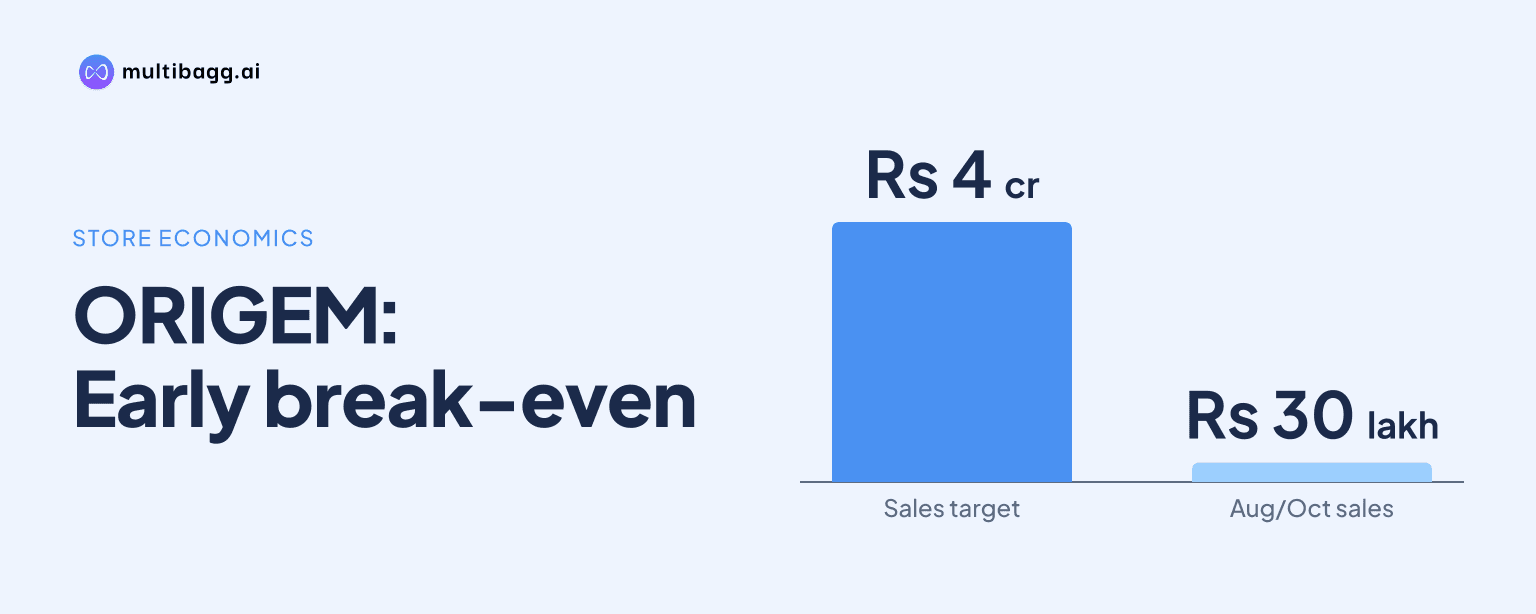
ORIGEM said four early stores had reached monthly break-even in FY27, while Central 50 in Noida crossed Rs 30 lakh of monthly sales in August and October. Management uses Rs 18 lakh to Rs 19 lakh in monthly revenue as the break-even benchmark and targets Rs 4 crore to Rs 5 crore in annual sales from mature outlets.
Know Goldiam International inside out
Results, valuation, peers and who's buying, in one view.
What monthly sales does ORIGEM need to break even?
ORIGEM said a store needs about Rs 18 lakh to Rs 19 lakh of monthly revenue to break even when rent is about Rs 5 lakh or lower per month. Management’s preferred monthly rental range is predominantly Rs 3 lakh to Rs 5 lakh, although selected locations may cost Rs 6 lakh to Rs 6.5 lakh. That rent framework is the basis for its store-level revenue threshold.
The company refined that framework after its first Mumbai outlets. The initial group included larger, higher-rent stores in Borivali, Bandra and Andheri, a hotel shop-in-shop, and smaller locations such as Kharghar and Mulund. Management said the store size and rental profile closer to Kharghar and Mulund was better suited to the operating model than the early larger-format sites.
The store-level measure differs from the reported chain result. Management confirmed that ORIGEM recorded about Rs 11.5 crore of revenue and a Rs 3.5 crore loss at the profit after tax level in the second quarter. The chain figure included newer outlets and brand-building costs, while the Rs 18 lakh to Rs 19 lakh reference applies to revenue per store per month.
Which ORIGEM stores have crossed monthly break-even?
ORIGEM said Kharghar, Turner Road, Wave One Noida and Central 50 Noida had reached monthly break-even. Kharghar and Turner Road began with monthly sales of roughly Rs 4 lakh to Rs 9 lakh, then crossed the revenue level needed to break even. Management said both stores had also delivered profit during festive periods including August, October and the then-current November.
Wave One and Central 50 also progressed from lower opening sales. One Noida outlet began in single-digit lakhs of monthly sales, while the other initially recorded about Rs 12 lakh to Rs 13 lakh. Management said both were subsequently generating Rs 20 lakh to Rs 25 lakh of monthly sales routinely, above the stated Rs 18 lakh to Rs 19 lakh break-even range.
Central 50 provided the clearest disclosed evidence of sales above that threshold. Management said the outlet crossed Rs 30 lakh in August and October, and it had visibility to cross Rs 30 lakh in November, although September was an exception. It described Central 50 as being within reach of the Rs 4 crore to Rs 5 crore annual-sales objective, without saying that it had sustained Rs 30 lakh a month for a full year.
How much does an ORIGEM store cost to open?
ORIGEM estimated total investment of Rs 3 crore to Rs 3.3 crore to open a store of scale, including inventory at cost. Fit-outs, furniture and other store infrastructure account for Rs 45 lakh to Rs 55 lakh, while the rental deposit is about Rs 30 lakh to Rs 40 lakh. Management therefore puts the deposit and physical store set-up together at about Rs 1 crore per outlet.
Inventory is the largest component, at Rs 2 crore to Rs 2.3 crore per store. Management said a larger high-street outlet can cost about 10% more than the average estimate, while a smaller mall store can cost about 20% less. Those variations make the location, store-size and rental decisions material to the required capital per opening.
For Goldiam’s business-to-business operations, management said significant capital expenditure was not required because inventory and working capital, rather than plant investment, were the relevant uses of capital. It said inventory had already increased substantially and that circulation of this inventory was now more important. In contrast, ORIGEM capital expenditure rises directly with the number of new stores, with management noting that qualified institutional placement funds were available for expansion.
Got a follow-up? Ask IRIS
Can ORIGEM reach Rs 4 crore to Rs 5 crore of annual sales?
ORIGEM’s internal target is for stores currently generating Rs 2 crore to Rs 2.5 crore annually to reach Rs 4 crore to Rs 5 crore in three years. Management described that range as its conservative basis for approving ORIGEM investments. It also said stores at that level should generate significant profit and cash payback, but did not disclose an expected margin or payback period.
Management did not provide a formal same-store sales growth rate, or SSSG, for ORIGEM. In response to an analyst’s 20% example, it said some young stores had achieved close to 100% growth as sales moved from single-digit lakhs a month toward roughly Rs 16 lakh, Rs 18 lakh or Rs 20 lakh. Management noted that such growth reflected a small starting base rather than a mature-store growth rate.
The Rs 4 crore to Rs 5 crore range is not ORIGEM’s stated long-term ceiling. Management cited like-minded everyday fine-jewellery businesses, operating in a similar average selling price range but selling natural-diamond products, that had exceeded Rs 8 crore to Rs 12 crore of annual sales per store. For ORIGEM, however, the disclosed planning threshold remains Rs 4 crore to Rs 5 crore.
How is ORIGEM changing its store expansion approach?
ORIGEM is prioritising A-tier mall and high-street locations that meet its requirements on store size and rent. Management said it hoped to launch a Jayanagar, Bengaluru, outlet in December and expected to open in HSR Layout, Bengaluru, early in the following year. The two locations are intended to test the high-street format in a city where ORIGEM already operates mall stores.
ORIGEM already has Bengaluru locations at Phoenix Marketcity, Nexus Koramangala and Nexus Whitefield. Management said the new high-street stores would allow it to test and adapt that format in markets where lab-grown jewellery has existing demand. It had earlier identified availability of suitable A-tier mall sites and appropriate high-street spaces as the two constraints on the pace of openings.
Management said newer outlets at Phoenix Palladium in Mumbai, South City Mall in Kolkata, Nexus Hyderabad, Sujana Mall in Hyderabad and Bengaluru mall locations were reaching break-even faster than earlier stores. It attributed the faster ramp to greater establishment of the ORIGEM brand, but did not disclose store-level revenue for these sites. It said it would set out a detailed FY27 and FY28 store-opening strategy during its fourth-quarter conference call.
Conclusion
ORIGEM’s disclosures show a more defined retail model: predominantly Rs 3 lakh to Rs 5 lakh in monthly rent supports a stated Rs 18 lakh to Rs 19 lakh monthly break-even range, and four early stores have reached that level. Central 50’s sales above Rs 30 lakh in August and October offer the closest disclosed evidence that older stores can move toward the Rs 4 crore to Rs 5 crore annual-sales target.
The next items to watch are the planned Jayanagar and HSR Layout openings, the results from the Bengaluru high-street test, and management’s promised fourth-quarter explanation of its FY27 and FY28 opening plan. Progress by stores now generating Rs 2 crore to Rs 2.5 crore annually toward the three-year Rs 4 crore to Rs 5 crore target will also test the repeatability of the model.