










Yatharth raises capacity goal to 7,000–8,000 beds in 3–5 years
Key highlights
- Yatharth targets 7,000–8,000 beds in three to five years, versus 5,000 beds in three years previously.
- Yatharth identifies about 3,255 announced beds, including 1,820 current operational-census beds.
- The proposed pipeline includes 450 brownfield beds at Greater Noida and Noida Extension.
- Yatharth targets completion of its 250-bed Gurugram hospital by H1 FY28.
powered by IRIS
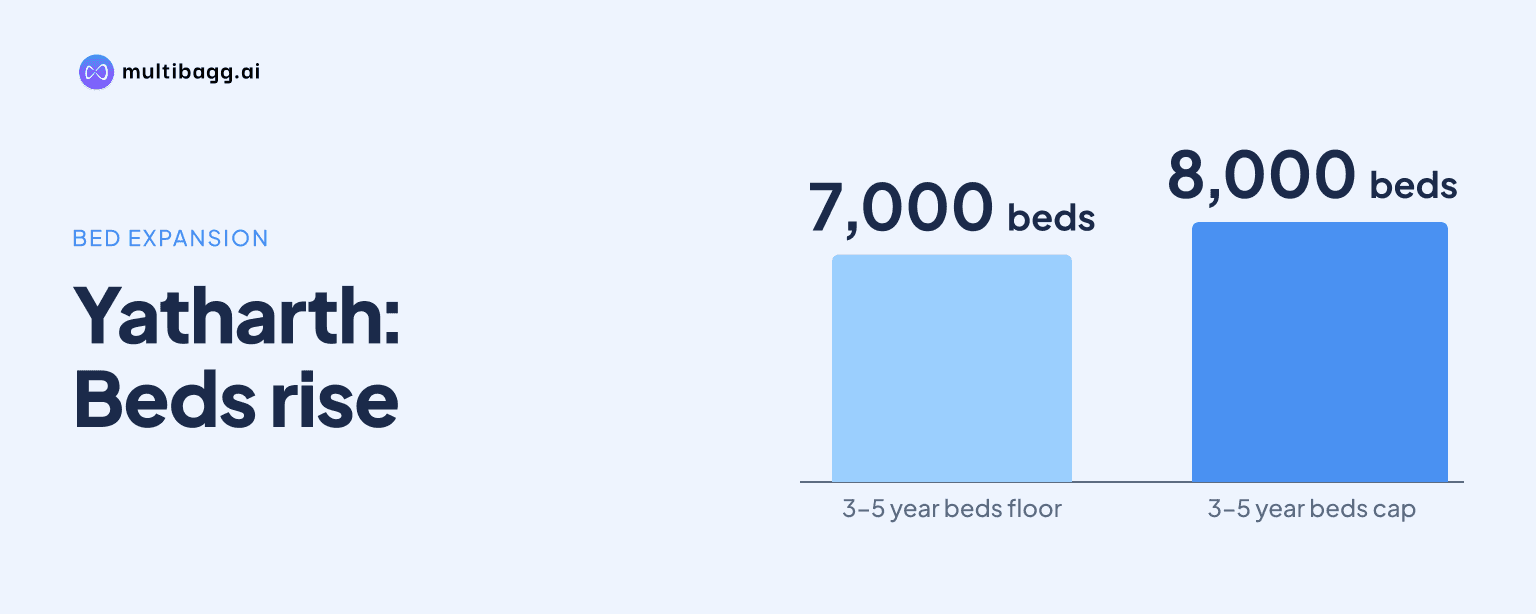
Yatharth is targeting 7,000–8,000 beds within three to five years, compared with its earlier 5,000-bed objective in three years, with management describing Advent as supporting a 40–60% target uplift. The presentation identifies about 3,255 beds of announced capacity, including operating, non-census, uncommissioned and proposed beds.
Know Yatharth Hospital & Trauma Care Services inside out
Results, valuation, peers and who's buying, in one view.
How has Yatharth changed its capacity target?
Yatharth has raised its capacity ambition from 5,000 beds in three years to 7,000–8,000 beds in three to five years. Management’s roadmap starts from 1,405 beds in FY23, reaches about 3,255 announced beds, and then shows 1,745 further beds needed to reach the earlier 5,000-bed target.
The revised 7,000–8,000-bed range requires a further 2,000–3,000 beds beyond the 5,000-bed objective. Management labels this extra capacity as Advent additions and describes the resulting increase over the prior target as 40–60%. The presentation does not specify individual hospitals, acquisition targets or commissioning dates for capacity beyond the 5,000-bed stage.
Yatharth describes the move from 1,405 FY23 beds to 3,255 announced beds as a 2.3-times expansion. The listed additions include 200 beds at Greater Faridabad in May 2024, 300 beds in New Delhi in July 2025, 400 beds at Faridabad in September 2025, 250 beds in Agra in February 2026, 250 beds in Gurugram by H1 FY28, and 450 proposed brownfield beds over the next 24 months.
What makes up Yatharth’s 3,255 announced beds?
Yatharth’s 3,255 announced-bed figure combines 1,820 current operational-census beds, 362 non-census beds, 373 beds yet to be operational and 700 proposed expansion beds. This means the announced-capacity measure extends beyond the beds currently used as the occupancy census across the network.
The largest category is the 1,820 current operational-census beds across eight listed hospitals. The remaining 1,435 beds consist of beds outside that census, beds awaiting operationalisation and proposed projects. The presentation separately describes the network as having 2,805 beds across nine hospitals, showing that capacity measures vary according to whether future and non-census beds are included.
The 700 proposed beds comprise 200 at Greater Noida, 250 at Noida Extension and 250 at Gurugram. The 450 beds at Greater Noida and Noida Extension are brownfield additions to existing hospitals, while Gurugram is an upcoming hospital and a new cluster for Yatharth. The presentation gives a target of H1 FY28 for Gurugram but does not give a commissioning date for the two brownfield projects.
Where are Yatharth’s announced additions concentrated?
Yatharth’s announced additions are concentrated in the Delhi National Capital Region, or NCR, through the Noida, Faridabad, New Delhi and Gurugram clusters. Noida is the largest stated cluster, with three hospitals, 1,100 beds and a further 450 beds underway, according to the cluster strategy page.
In the detailed capacity table, Noida, Greater Noida and Noida Extension have 935 current operational-census beds and 165 non-census beds. Greater Noida has 200 proposed beds and Noida Extension has 250, linking the 450-bed brownfield programme to hospitals that already operate in the Noida cluster. Noida itself reported 93% occupancy on 215 current operational-census beds.
Faridabad has two hospitals and 600 beds on the cluster page, while the detailed table shows 350 current operational-census beds at Greater Faridabad and Faridabad Sector-20. Those two hospitals also have 105 non-census beds and 145 beds yet to be operational. Greater Faridabad opened with 200 beds in May 2024, and Faridabad Sector-20 added 400 beds in September 2025.
New Delhi and Agra each have a stated 250-bed or larger facility but still have material capacity to operationalise. New Delhi has 150 current operational-census beds and 120 beds yet to be operational at its 300-bed Model Town hospital, while Agra has 110 current operational-census beds and 108 beds yet to be operational at its 250-bed hospital. Gurugram has no current census beds in the table because its entire 250-bed contribution remains proposed.
Got a follow-up? Ask IRIS
How much does Yatharth’s plan depend on occupancy and commissioning?
Yatharth’s route to 3,255 announced beds depends on commissioning 373 identified beds as well as completing 700 proposed beds. Management says new hospitals are ramped up gradually, and therefore presents occupancy against current operational-census beds rather than against each hospital’s total potential capacity.
Occupancy ranged from 41% at New Delhi to 93% at Noida in the reported current census. Jhansi-Orchha was at 92% on 275 current operational-census beds, while Greater Noida was at 78% on 330 beds and Noida Extension was at 61% on 390 beds. The 52-percentage-point spread between Noida and New Delhi indicates differing stages of maturity across the network.
The two hospitals receiving the 450-bed brownfield plan also have occupancy below Noida’s reported level. Greater Noida’s 78% occupancy accompanies a 200-bed proposed addition, while Noida Extension’s 61% occupancy accompanies a 250-bed proposed addition. Management’s growth flywheel explicitly places occupancy ramp-up after capacity expansion, on both new and existing capacity.
Newer facilities account for all 373 beds classified as yet to be operational: 25 at Greater Faridabad, 120 at New Delhi, 120 at Faridabad Sector-20 and 108 at Agra. Their reported occupancy ranges from 58% in Agra to 77% at Greater Faridabad, with Faridabad Sector-20 at 59%. These figures distinguish operationalisation of physical capacity from subsequent patient-volume ramp-up.
What operating plan does Yatharth disclose for larger scale?
Yatharth describes a sequence in which capacity expansion is followed by higher occupancy, changes in payer mix, higher-end specialties, improved average revenue per occupied bed, or ARPOB, and margin, with cash then funding the next bed. The capacity routes listed are greenfield and brownfield strategic acquisitions, although the presentation does not quantify acquisition spending or financing terms.
The clinical plan includes robotics, oncology and transplant programmes across clusters. Yatharth reported more than 1,300 robotic surgeries using eight robots across the group and more than 280 transplants. It also reported Da Vinci robots at four hospitals, orthopaedic robots at five hospitals, one linear accelerator, or LINAC, machine, and two LINAC machines in the pipeline.
Management says it intends to optimise the payer mix toward cash and third-party administrator, or TPA, patients, with greater focus on international patients. The presentation gives current group ARPOB of about Rs 36,000 and indicates that newer hospitals may lift the mix as they scale. It does not disclose a group-wide ARPOB, margin, revenue or earnings target linked to the 7,000–8,000-bed ambition.
Conclusion
Yatharth has increased its capacity endpoint to 7,000–8,000 beds over three to five years, while the disclosed roadmap currently identifies about 3,255 announced beds. The plan combines capacity already in the operating census with 362 non-census beds, 373 beds still to become operational and 700 proposed beds, particularly in the Noida cluster and at Gurugram.
The next disclosed milestones are the 450 brownfield beds at Greater Noida and Noida Extension over the next 24 months and the 250-bed Gurugram hospital targeted by H1 FY28. Management also needs to identify the 1,745 additional beds required to reach 5,000 and the further 2,000–3,000 beds associated with the Advent-supported 7,000–8,000-bed plan.