










Yatharth Q2 revenue rises 52% as PAT growth slows to 17%
Key highlights
- Yatharth reported Q2 FY27 revenue of Rs 431.4 crore, up 52% year on year.
- Q2 FY27 EBITDA rose 50% to Rs 102 crore, while EBITDA margin was 23.6%.
- Q2 FY27 PAT increased 17% to Rs 48.5 crore as depreciation rose 75% to Rs 33.1 crore.
- New hospitals contributed Rs 120.5 crore, or 28%, of Q2 FY27 revenue.
powered by IRIS
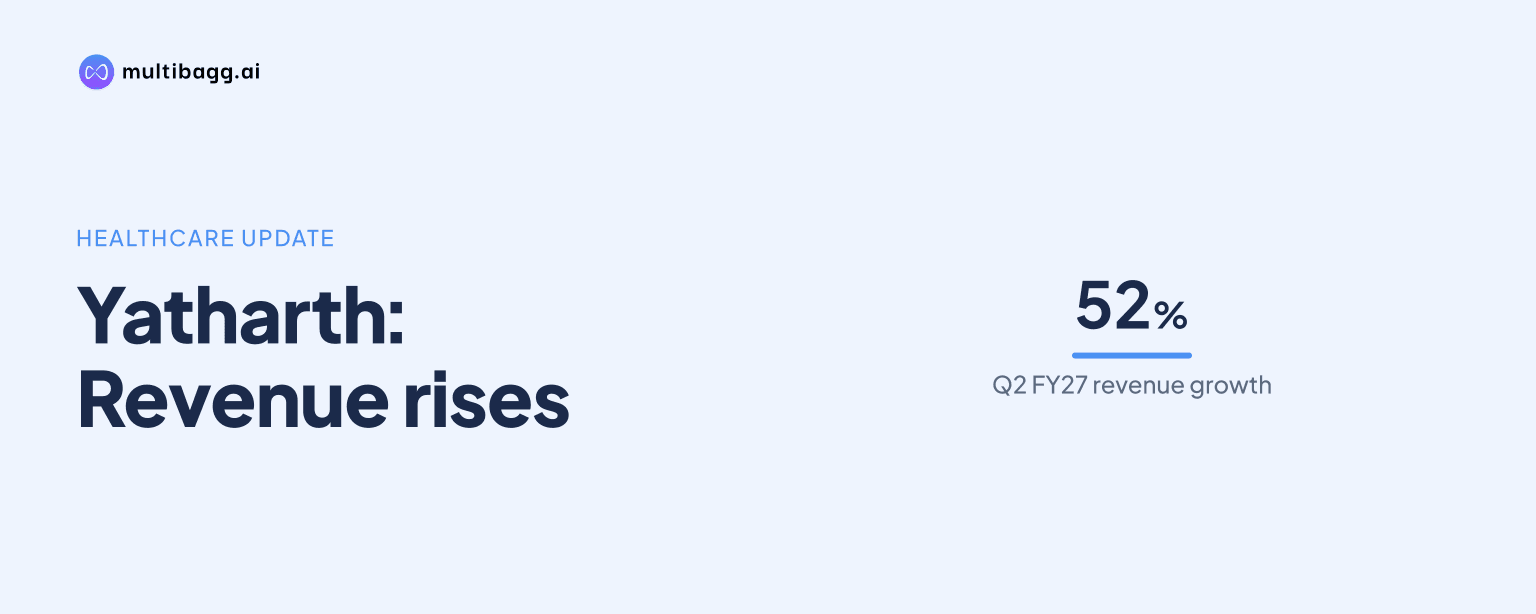
In Q2 FY27, Yatharth Hospitals increased revenue from operations 52% year on year to Rs 431.4 crore, while profit after tax rose 17% to Rs 48.5 crore, as depreciation and amortisation increased 75% to Rs 33.1 crore and financial cost rose to Rs 8.3 crore.
Know Yatharth Hospital & Trauma Care Services inside out
Results, valuation, peers and who's buying, in one view.
What drove Yatharth’s Q2 FY27 revenue growth?
Yatharth’s revenue growth was driven by higher activity at existing hospitals and a larger contribution from newer facilities. Revenue from operations rose from Rs 283 crore in Q2 FY26 to Rs 431.4 crore in Q2 FY27, an increase of Rs 148.4 crore, and was 10% above Rs 392.7 crore in Q1 FY27. For H1 FY27, revenue was Rs 824.1 crore, up 52% from Rs 542.3 crore in H1 FY26.
New hospitals contributed Rs 120.5 crore of Q2 FY27 revenue, while management said existing hospitals delivered 24% year-on-year revenue growth. New hospitals accounted for 28% of revenue in Q2 FY27, compared with 11% in Q2 FY26 and 27% in Q1 FY27. Yatharth defines new hospitals as Greater Faridabad, New Delhi Model Town, Faridabad Sector-20 and Agra.
Inpatient department, or IPD, revenue rose to Rs 373.9 crore in Q2 FY27 from Rs 251 crore a year earlier, while outpatient department, or OPD, revenue increased to Rs 57.5 crore from Rs 32 crore. IPD volume reached 36,000 and OPD volume was 158,000, taking total patient volume to 194,000 versus 130,000 in Q2 FY26. Most of the Rs 431.4 crore quarterly revenue therefore remained inpatient-led.
Why did Yatharth’s PAT grow more slowly than revenue?
Yatharth’s PAT grew more slowly because depreciation, financial cost, operating expenses and tax increased alongside the 52% increase in revenue. Earnings before interest, tax, depreciation and amortisation, or EBITDA, rose 50% to Rs 102 crore, but depreciation and amortisation increased by Rs 14.2 crore and financial cost increased by Rs 8 crore. Profit before tax, or PBT, consequently rose 20% to Rs 65.6 crore before PAT reached Rs 48.5 crore.
EBITDA margin was 23.6% in Q2 FY27, compared with 24.1% in Q2 FY26, a decline of 42 basis points, although it improved by 30 basis points from 23.3% in Q1 FY27. Management reported an adjusted EBITDA margin of 28.2% for Q2 FY27 after excluding ramp-up losses at Model Town and Faridabad Sector-20. Employee expenses rose 57% to Rs 84.3 crore and other expenses also rose 57% to Rs 167.6 crore.
The quarter-on-quarter comparison also shows the effect of these charges. EBITDA increased by Rs 10.3 crore from Rs 91.7 crore in Q1 FY27, while depreciation and amortisation rose by Rs 4.9 crore and financial cost rose by Rs 1.7 crore. PAT therefore increased 7% quarter on quarter from Rs 45.4 crore. Other income was Rs 5 crore in Q2 FY27, below Rs 5.9 crore a year earlier.
Got a follow-up? Ask IRIS
How did Yatharth’s hospital operating metrics change?
Yatharth improved occupancy, average revenue per occupied bed and discharge speed in Q2 FY27. Occupancy rose to 72% from 66% in Q2 FY26 and 68% in Q1 FY27, based on 1,820 operational census beds. Average revenue per occupied bed, or ARPOB, increased to Rs 35,948 from Rs 32,426 a year earlier, while average length of stay, or ALOS, fell to 3.3 days from 4 days.
Total bed capacity was 2,555 in Q2 FY27, up from 2,305 a year earlier, while operational census beds rose from 1,535 to 1,820. Management said New Delhi, Faridabad Sector-20, Agra and Gurugram had not fully ramped up, and census beds will increase progressively. H1 FY27 occupancy was 70%, compared with 66% in H1 FY26, and H1 FY27 ARPOB was Rs 35,371 versus Rs 32,500.
The operating gains coincided with a changed revenue distribution across the network. Noida Extension represented 26% of Q2 FY27 revenue, down from 33% in Q2 FY26, while Greater Noida’s share declined to 23% from 29%. Faridabad Sector-20 contributed 9%, New Delhi 6% and Agra 5%, increasing the share of newer facilities in the network’s revenue mix.
Which newer hospitals are adding revenue and what is planned next?
Faridabad Sector-20 was the largest specified newer contributor, generating Rs 40 crore in Q2 FY27, or about 9% of group revenue, and it was EBITDA profitable. Its latest monthly revenue was about Rs 15 crore, ARPOB was about Rs 40,000 and management said it achieved EBITDA breakeven in nine months. The 400-bed hospital has a Da-Vinci X surgical robot and started its transplant programme in H1 FY27.
Model Town, New Delhi generated Rs 26 crore, or about 6% of Q2 FY27 revenue, with latest monthly revenue of about Rs 10 crore and ARPOB of about Rs 50,000. Management expects EBITDA breakeven at Model Town in H2, while transplant programme approval is underway and radiation oncology is in the pipeline. Agra added Rs 20 crore, or about 5% of group revenue, was EBITDA profitable and had completed more than 200 robotic surgeries to date.
Yatharth also disclosed a 250-bed Gurugram hospital in Sector 40 that is under construction and expected to be operational in H1 FY28. The company acquired a 100% stake for Rs 100 crore and disclosed another Rs 100 crore outlay, including medical equipment, for total proposed expenditure of Rs 200 crore. Management indicated ARPOB potential of about Rs 50,000 or more for this facility.
Conclusion
Yatharth’s Q2 FY27 results show revenue and EBITDA expanding 52% and 50%, respectively, as new hospitals raised their revenue share to 28% and existing hospitals grew revenue 24%. The gap between EBITDA and PAT growth reflects the 75% rise in depreciation and amortisation, the increase in financial cost from Rs 0.3 crore to Rs 8.3 crore, and 57% increases in both employee and other expenses.
The next disclosed milestones are Model Town’s expected EBITDA breakeven in H2, planned radiation oncology at Faridabad Sector-20 from H2 FY27, and Gurugram’s expected operationalisation in H1 FY28. Yatharth also disclosed that Advent’s proposed Rs 3,150 crore primary capital investment for a 24.9% minority stake is awaiting regulatory approvals.