










Zaggle AI accounts-payable cuts EPC onboarding to 15 minutes
Key highlights
- Zaggle said vendor onboarding at an EPC client fell from more than 4 days to 15 minutes.
- The EPC deployment automated 14 statutory validations for a vendor base of more than 10,000 businesses.
- The client processes about 40,000 invoices annually, with processing staff reduced from more than 15 people to 3.
- A separate Zaggle deployment targets about 60% touchless invoice processing and a 50% reduction in exception-resolution time.
powered by IRIS
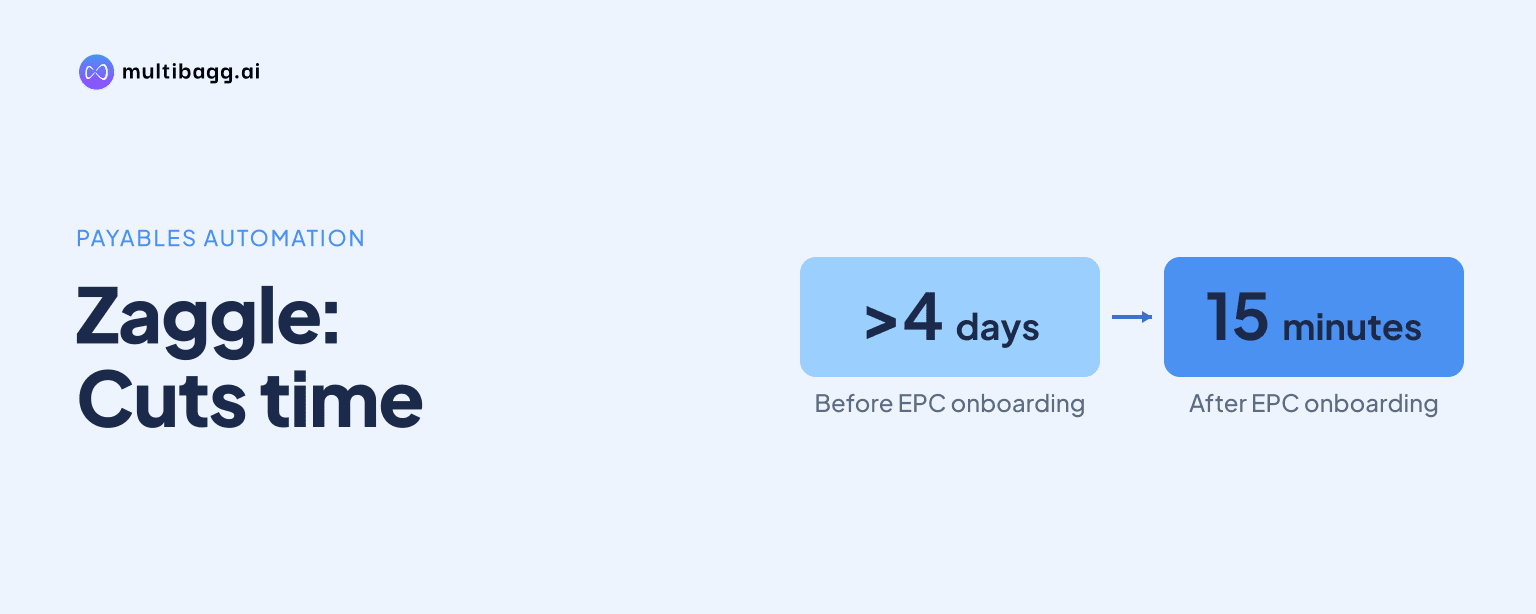
Zaggle said in Q2 FY27 that its artificial-intelligence (AI) accounts-payable deployment reduced vendor onboarding for a large engineering, procurement and construction (EPC) client from more than four days to 15 minutes, while automating 14 statutory validations. The client manages more than 10,000 vendors and processes about 40,000 invoices annually.
Know Zaggle Prepaid Ocean Services inside out
Results, valuation, peers and who's buying, in one view.
How did Zaggle reduce EPC vendor onboarding to 15 minutes?
Zaggle reduced the EPC client’s vendor-onboarding process to 15 minutes by automating 14 statutory checks through its accounts-payable stack. The prior manual process took more than four days to add one small vendor. The client’s vendor ecosystem exceeds 10,000 businesses, most classified as micro, small and medium enterprises (MSMEs), making the onboarding bottleneck material across manufacturing and project sites.
Zaggle’s implementation combines its core accounts-payable platform with copilots for onboarding, request for quotation (RFX) drafting, negotiation and collusion detection. It also uses agents for document verification and statutory validation. Management said the RFX module has preset templates, questionnaire builders and a weighted multi-attribute auction mechanism, indicating that the deployment addresses vendor selection as well as the subsequent invoice and payment workflow.
What changed in Zaggle’s invoice-processing workflow?
Zaggle said the EPC client’s invoice process is now AI-powered for both data extraction and three-way matching, replacing a manual, email-driven system. Procurement, invoicing and payments had operated on separate systems, which management said made statutory compliance for tax and MSME payments harder to enforce. The new workflow links these stages through the accounts-payable stack rather than leaving reconciliation to separate teams.
The staffing requirement fell from more than 15 people to three people after the automation, according to management. Zaggle said the smaller team manages the full invoice-processing load, freeing employee bandwidth and associated resource cost. Digitising the workflow has also given the client near real-time visibility of working capital, while duplicate payments and delayed MSME payments have reduced considerably, although Zaggle did not quantify either reduction.
Which AI tools has Zaggle deployed for enterprise accounts payable?
Zaggle has deployed document-verification and statutory-validation agents at the EPC client, alongside AI copilots for four supplier-facing activities. Those activities are vendor onboarding, RFX drafting, negotiation and collusion detection. The company described this as an extension of its core accounts-payable stack, rather than a stand-alone invoice-reading tool, because it covers vendor setup, sourcing and payment controls.
In a separate phase-one deployment at a large manufacturing and metals-and-minerals client, Zaggle said it embedded seven specialised AI agents in the accounts-payable workflow. These agents cover invoice ingestion, document extraction, fraud and duplicate validation, auto-categorisation, purchase-order (PO) matching, goods-receipt-note (GRN) matching and tax deducted at source (TDS) compliance. That deployment went live ahead of time, according to management, and provides the broader product architecture behind its enterprise AI offering.
Got a follow-up? Ask IRIS
What operating results does Zaggle expect from its AI accounts-payable platform?
Zaggle said its manufacturing and metals-and-minerals deployment is designed to achieve about 60% touchless invoice processing, meaning processing with zero human intervention, and a 50% reduction in exception-resolution time. Management also cited 100% end-to-end reconciliation across goods and services tax (GST) and TDS compliance. These are intended operational outcomes of that client implementation, not reported financial results for Zaggle.
The same deployment automated four finance workflows: three- and four-way matching across POs, invoices, GRNs and delivery challans; liquidated-damages calculations at logistics touchpoints; vendor payment holds based on shipment compliance; and real-time rule-based TDS and GST logic. Zaggle said the matching process uses more than 24 validation checks. Compared with the EPC engagement, which reports 14 automated statutory validations and a staffing reduction to three people, the manufacturing deployment provides more detailed targets for touchless processing and tax reconciliation.
How does Zaggle’s AI rollout fit its wider product plan?
Zaggle said AI-led internal initiatives have generated about 10% to 15% people-cost efficiency and reduced time to launch new product modules by roughly 50%. Management said it has reinvested that capacity in a modular microservices architecture and in refreshing existing modules. The company also said faster customer go-lives can support faster revenue realisation, though it did not assign revenue to the EPC deployment.
The accounts-payable capability has been strengthened by the Dice acquisition, which closed in the middle of Q1 FY27. Zaggle said about 65% to 70% of Dice contracts had been novated by Q2 FY27, with the balance expected in Q3. Management said Dice adds automated spend analytics, intelligent approval workflows and predictive expense management, while the company is also targeting AI-powered rollouts among its previously onboarded Zoyer customers.
Conclusion
Zaggle’s disclosed EPC deployment provides a concrete measure of its enterprise AI use: onboarding moved from more than four days to 15 minutes, 14 statutory validations were automated, and invoice processing shifted from more than 15 people to three. Alongside the separate seven-agent manufacturing deployment, the examples show Zaggle applying AI to supplier onboarding, invoice matching, compliance checks and payment controls rather than only to document extraction.
The next disclosed milestone is Zaggle’s Investor Day, which management plans to hold on December 10 in Mumbai to present its AI capabilities and roadmap. The remaining Dice contracts are expected to be novated in Q3 FY27, and management may provide further quantified outcomes from enterprise accounts-payable deployments.