










Zaggle Q2 revenue rose 34% as profit after tax fell 30%
Key highlights
- Zaggle’s Q2FY27 consolidated revenue rose 34.2% to Rs 579.9 crore.
- Zaggle’s Q2FY27 PAT fell 30.1% to Rs 24.5 crore from Rs 35 crore.
- Point-redemption and gift-card costs increased to Rs 349.2 crore from Rs 235.3 crore in Q2FY27.
- Zaggle’s Q2FY27 adjusted EBITDA margin on gross revenue declined to 7.7% from 10.8%.
powered by IRIS
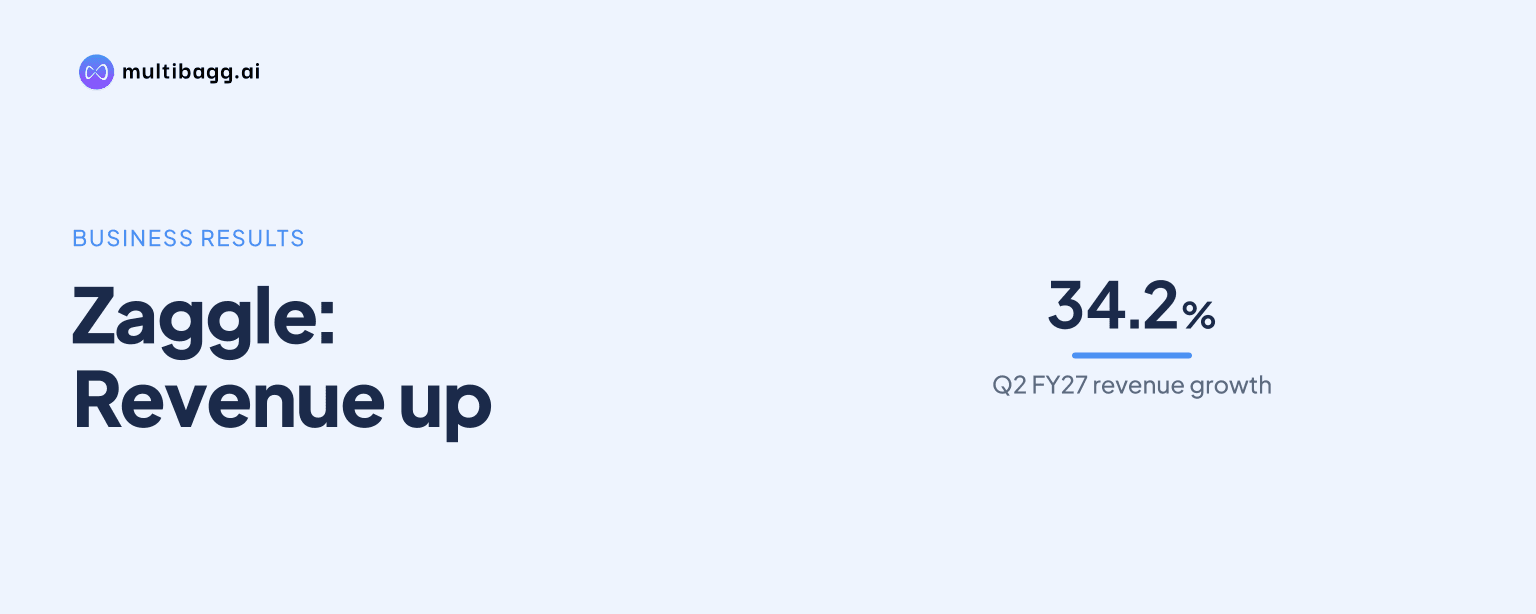
In Q2FY27, Zaggle Prepaid Ocean Services Limited reported consolidated revenue growth of 34.2% to Rs 579.9 crore, while profit after tax fell 30.1% to Rs 24.5 crore as point-redemption costs and operating expenses increased. Adjusted EBITDA declined 4.2% to Rs 44.6 crore and its gross-revenue margin fell to 7.7% from 10.8%.
Know Zaggle Prepaid Ocean Services inside out
Results, valuation, peers and who's buying, in one view.
Why did Zaggle’s Q2 profit fall despite revenue growth?
Zaggle’s Q2 profit fell because costs rose faster than gross profit despite a Rs 147.7 crore increase in revenue. Cost of point redemption and gift cards rose to Rs 349.2 crore from Rs 235.3 crore, an increase of Rs 113.9 crore, while gross profit increased 17.4% to Rs 230.7 crore. Gross-profit growth was therefore below the 34.2% rise in reported revenue.
Profit after tax, or PAT, declined to Rs 24.5 crore from Rs 35 crore, while profit before tax declined 31.1% to Rs 32.4 crore from Rs 47 crore. Gross profit margin narrowed to 39.8% from 45.4%, and PAT margin fell to 4.2% from 8.1%. The decline shows that higher reported revenue did not translate proportionately into profit after redemption and operating costs.
Which costs increased in Zaggle’s Q2FY27?
Zaggle reported increases in point-redemption costs, employee benefits, incentives and cashback, and other expenses during Q2FY27. Employee benefits expense rose to Rs 18 crore from Rs 16.4 crore, which management attributed primarily to employees added through the Dice acquisition. Incentive and cashback expense increased to Rs 129.3 crore from Rs 115.9 crore.
Other expenses doubled to Rs 41.1 crore from Rs 20.5 crore. Management attributed the increase largely to marketing for events, user-acquisition spending for Zagg.Money, and higher technology and artificial intelligence-related costs. Depreciation and amortisation rose to Rs 15.2 crore from Rs 7.5 crore, while finance cost increased to Rs 2.3 crore from Rs 1.4 crore.
Adjusted earnings before interest, tax, depreciation and amortisation, or adjusted EBITDA, fell 4.2% to Rs 44.6 crore. The presentation defines adjusted EBITDA after reducing employee stock option plan expense and adding the EBITDA share of its associate. Adjusted EBITDA margin on gross revenue fell to 7.7% from 10.8%, while its margin on the company’s net-revenue basis fell to 19.3% from 23.6%.
How did redemption costs affect Zaggle’s revenue mix?
Zaggle’s Propel points revenue rose sharply in Q2FY27, but most of that reported revenue was offset by redemption and gift-card costs. Propel platform revenue increased 49.5% to Rs 368.6 crore from Rs 246.5 crore, while related point-redemption and gift-card costs rose to Rs 349.2 crore from Rs 235.3 crore. On the presentation’s net-reporting basis, Propel points revenue was Rs 19.4 crore, compared with Rs 11.3 crore a year earlier.
The company asks investors to assess revenue after deducting Propel redemption and gift-card costs because Propel points are reported on a gross basis under Indian Accounting Standards, or Ind AS. Software fees rose to Rs 15.9 crore from Rs 11.8 crore and program fees increased to Rs 195.4 crore from Rs 173.9 crore. Total net revenue was Rs 230.7 crore in Q2FY27, versus Rs 196.9 crore in Q2FY26.
Cashback represented 66.2% of program fees in Q2FY27, according to the company, marginally better than Q1FY27 and below 69% in Q4FY26. Zaggle said Propel points accrue as channel incentives and can be redeemed through network cards, where revenue is classified under program fees, or through brand vouchers, where it is classified under Propel points.
Got a follow-up? Ask IRIS
What drove Zaggle’s revenue growth in Q2FY27?
Zaggle’s 34.2% quarterly revenue growth came from higher Propel platform revenue, program fees and software fees, as well as festive-period activity and Dice-related software-as-a-service revenue. Propel platform revenue grew 49.5%, compared with 12.4% growth in program fees and 35.2% growth in software fees. Management said software-as-a-service revenue reached its highest quarterly level, largely because of revenue recognition from novated Dice customer contracts.
The company served 4,236 customers in Q2FY27, compared with 3,674 in Q2FY26, while revenue per customer rose to Rs 14 lakh from Rs 12 lakh. Aggregate users on the platform increased to 4.1 million from 3.5 million. Revenue per employee rose 25.5% to Rs 1.28 crore from Rs 1.02 crore, based on the company’s reported operational metric.
H1FY27 revenue rose 31.3% to Rs 1,003.1 crore from Rs 764.2 crore, a slower growth rate than the second quarter’s 34.2%. PAT for the first half declined 31.3% to Rs 42 crore from Rs 61.1 crore. Adjusted EBITDA was Rs 79.3 crore, marginally below Rs 79.9 crore in H1FY26, and its margin contracted to 7.9% from 10.5%.
What does Zaggle plan to do next?
Zaggle plans to moderate cashback across corporate credit cards and prepaid cards, move volumes towards banks that process invoices faster, and reduce working-capital intensity in its Propel points business. Management also said it is moderating engagement with cash-flow-intensive customers and moving direct volumes away from corporate redemption arrangements with no advance payment and longer working-capital cycles.
The company said about 70% of Dice customer contracts had been novated by Q2FY27, with the remaining contracts expected to be completed in Q3. Management also cited plans to increase adoption of co-branded credit cards and Unified Payments Interface, or UPI, offerings among its salaried user base while maintaining disciplined customer-acquisition costs. It established Zaggle Holdings Limited in Abu Dhabi Global Market as a platform for regional expansion over the medium to long term.
Zaggle said consolidated and standalone operating cash flow turned positive in Q2FY27 and H1FY27, without disclosing the amounts. At September 2026, total assets were Rs 1,645.7 crore, compared with Rs 1,553.7 crore in March 2026. Goodwill rose to Rs 99.4 crore from Rs 50.4 crore and intangible assets increased to Rs 173.9 crore from Rs 123 crore, primarily because of the Dice acquisition.
Conclusion
Zaggle delivered higher reported revenue in Q2FY27, led particularly by Propel platform revenue and Dice-related software-as-a-service contract recognition, but profitability moved in the opposite direction. Point-redemption costs rose faster than revenue, while employee, marketing, user-acquisition and technology costs contributed to lower gross, adjusted EBITDA and PAT margins.
The next disclosures to watch are completion of the remaining Dice contract novations in Q3, management’s cashback moderation and reduction of cash-flow-intensive Propel arrangements, and whether moving volumes to faster-paying banks improves the working-capital cycle. Management has also identified cash-flow generation, acquisition integration and artificial intelligence deployment across its platforms as focus areas.