










Zee's FIFA subscriptions rose 30%, linear gains await FY28
Key highlights
- Zee reported 30% year-on-year subscription revenue growth in Q2 FY27.
- ZEE5 digital revenue more than doubled year on year to Rs 630 crore in Q2 FY27.
- Zee retained 35% to 40% of subscribers acquired through FIFA packs.
- Management said the full linear-TV sports benefit should be visible in FY28.
powered by IRIS
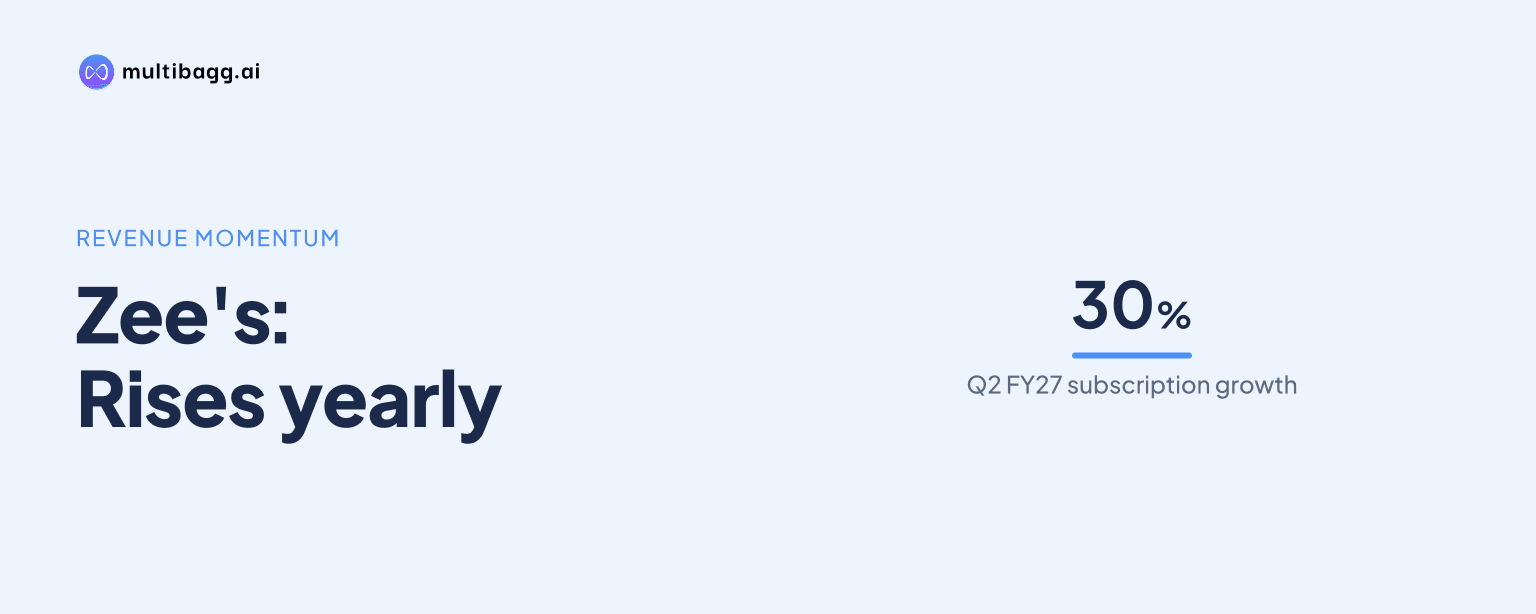
Zee Entertainment Enterprises Limited reported 30% year-on-year subscription revenue growth in Q2 FY27, with FIFA monetised mainly through subscriptions, while management said existing linear-TV distribution agreements mean the full sports-rights benefit should become visible only in FY28.
Know Zee Entertainment Enterprises inside out
Results, valuation, peers and who's buying, in one view.
How did FIFA lift Zee's subscription revenue in Q2 FY27?
FIFA contributed principally through subscriptions on both linear television and digital platforms, rather than advertising, management said. Chief Executive Officer Punit Goenka said football has limited airtime available for advertising monetisation, and Zee did not disclose FIFA's exact revenue contribution during Q2 FY27.
Zee said subscription revenue increased 30% year on year, driven by higher average revenue per user, or ARPU, subscriber growth in the digital business and increased pricing in linear television. An analyst noted that subscription growth had been 16% in the previous quarter, making the Q2 FY27 increase a faster reported rate. Management did not provide separate subscription-revenue figures for ZEE5 and linear television.
Digital revenue more than doubled year on year and rose 37% sequentially to Rs 630 crore in Q2 FY27, which management described as the vertical's highest quarterly revenue. Zee attributed the result to content across languages and revised FIFA pricing on ZEE5, while continuing to invest in marketing, sports and other digital-led initiatives.
FIFA also expanded viewing reach despite match timings in India, according to management. Total tournament reach grew about 41% versus the previous FIFA World Cup and exceeded 400 million across platforms, while about 83% of total FIFA viewing was live on ZEE5. Those figures support management's emphasis on subscription packs as the main commercial mechanism.
Why will Zee's linear-TV sports benefit arrive in FY28?
The full standalone linear-TV subscription effect of FIFA and other sports rights should be visible in the next financial year, FY28, because existing distribution agreements were already in place, management said. Mukund Galgali said linear subscription terms are negotiated annually, so acquiring sports properties does not automatically change pricing under current contracts.
Zee has partnered with FIFA through 2034 and acquired Indian rights for Bundesliga and Serie A for the next five years, management said. Galgali said the addition of these properties should help directionally when distribution arrangements are renegotiated. Management did not quantify a prospective increase in linear subscription fees or specify contract renewal dates.
Linear television was stable in Q2 FY27, rather than the immediate driver of subscription growth from FIFA. When an analyst asked whether linear subscription growth was in the mid- to high-single-digit range, Galgali said the numbers were stable. This contrasts with digital revenue of Rs 630 crore, where revised pricing and FIFA-linked subscriptions helped produce the highest quarterly revenue for that vertical.
The timing distinction leaves ZEE5 as the nearer-term channel for sports monetisation. FIFA, Bundesliga and Serie A can strengthen Zee's case in future linear negotiations, but the eventual financial effect depends on distributor agreements that management said were already negotiated for FY27.
Are FIFA-acquired ZEE5 subscribers staying after the tournament?
Zee said it retained 35% to 40% of subscribers acquired through FIFA after the tournament ended in Q2 FY27. Management said these customers renewed for another quarter or a longer term, creating an accrual benefit expected to continue through Q3 and Q4.
Most FIFA packs were quarterly plans, with a smaller portion sold as annual plans, management said. The benefit in later quarters therefore comes from post-tournament renewals rather than from the original FIFA pack remaining active. Zee did not disclose the number of FIFA-acquired subscribers or the revenue associated with retained customers.
Management did not provide a percentage target for Q3 or Q4 subscription growth. It said growth would not remain as high as the 30% recorded in Q2 FY27, but should follow an accelerated trajectory compared with earlier normalised levels from the second half of FY27. That outlook is management's assessment based on the reported 35% to 40% retention rate.
Zee also linked retention to its entertainment pipeline on ZEE5. The company released 34 shows and movies in Q2 FY27, including nine original series, and management described the Q3 and Q4 lineup as exciting. The stated plan is to keep football-acquired users engaged with content across languages after the tournament.
Got a follow-up? Ask IRIS
What did FIFA and digital investment cost Zee in Q2 FY27?
Zee reported earnings before interest, tax, depreciation and amortisation, or EBITDA, of Rs 70.8 crore and an EBITDA margin of 3.2% in Q2 FY27. Management said programming costs increased because of FIFA, a wider content offering and higher hourly content, while overall operating costs rose 18% year on year, chiefly due to advertising and publicity spending.
The digital business delivered EBITDA of Rs 41.6 crore after spending on sports, marketing and new initiatives, according to management. Zee also invested in changes to ZEE5's mobile and connected-TV user experience, artificial-intelligence-led content discovery and a personalisation engine intended to simplify content consumption.
Management said the reported EBITDA margin would have been in the mid- to high-single digits excluding higher spending on new initiatives. That is a management-adjusted view rather than a reported measure. Reported profit after tax was Rs 45.6 crore in Q2 FY27.
Advertising revenue was flat year on year in Q2 FY27 despite the festive season shifting to Q3, but it rose 20% sequentially. Management said FIFA, Sa Re Ga Ma Pa and fresh launches supported advertiser demand, while maintaining that football itself offers limited commercial airtime compared with its subscription opportunity.
What does Zee expect for the rest of FY27?
Zee expects FIFA subscriber renewals and its ZEE5 content slate to support subscription growth in Q3 and Q4, although management said the rate will not match Q2 FY27's 30%. The company described the retention of 35% to 40% of FIFA-acquired subscribers as the basis for an accelerated growth trajectory during the second half.
The company is also funding Bullet, KidZ and Trinetra AI, an end-to-end artificial-intelligence filmmaking and content-intelligence platform aimed at the micro-drama segment. Management said these businesses remain in investment mode, a factor alongside FIFA spending in the 18% year-on-year increase in Q2 FY27 operating costs.
Zee's linear network share stood at 20% as of week 24, its highest share in seven years, according to management. It also said monthly omni reach across genres exceeded 800 million, although the industry was awaiting the restart of its measurement system. Neither metric quantifies the future linear subscription uplift from sports rights.
Conclusion
Zee's Q2 FY27 performance shows that FIFA was primarily a subscription and digital-revenue tool: subscription revenue rose 30% year on year, digital revenue reached Rs 630 crore and management reported retention of 35% to 40% among FIFA-acquired subscribers. The same strategy raised programming, marketing and publicity costs, leaving reported EBITDA margin at 3.2%.
The next disclosed milestones are Q3 and Q4 renewal trends and the planned ZEE5 content lineup, which management expects to support second-half subscription growth. For FY28, the unresolved measure is whether annual distribution negotiations convert the FIFA, Bundesliga and Serie A rights portfolio into higher linear-TV subscription revenue.