










Zenith Steel Pipes auditors find going-concern support lacking
Key highlights
- Auditors said Zenith Steel Pipes’ going-concern accounting was not adequately supported at September 30, 2026.
- Auditors could not verify Zenith Steel Pipes inventory of Rs 8.98 crore at September 30, 2026.
- Zenith Steel Pipes reported consolidated total equity of negative Rs 248.2113 crore at September 30, 2026.
- The next Debt Recovery Tribunal hearing in the Khopoli recovery case is scheduled for February 25, 2027.
powered by IRIS
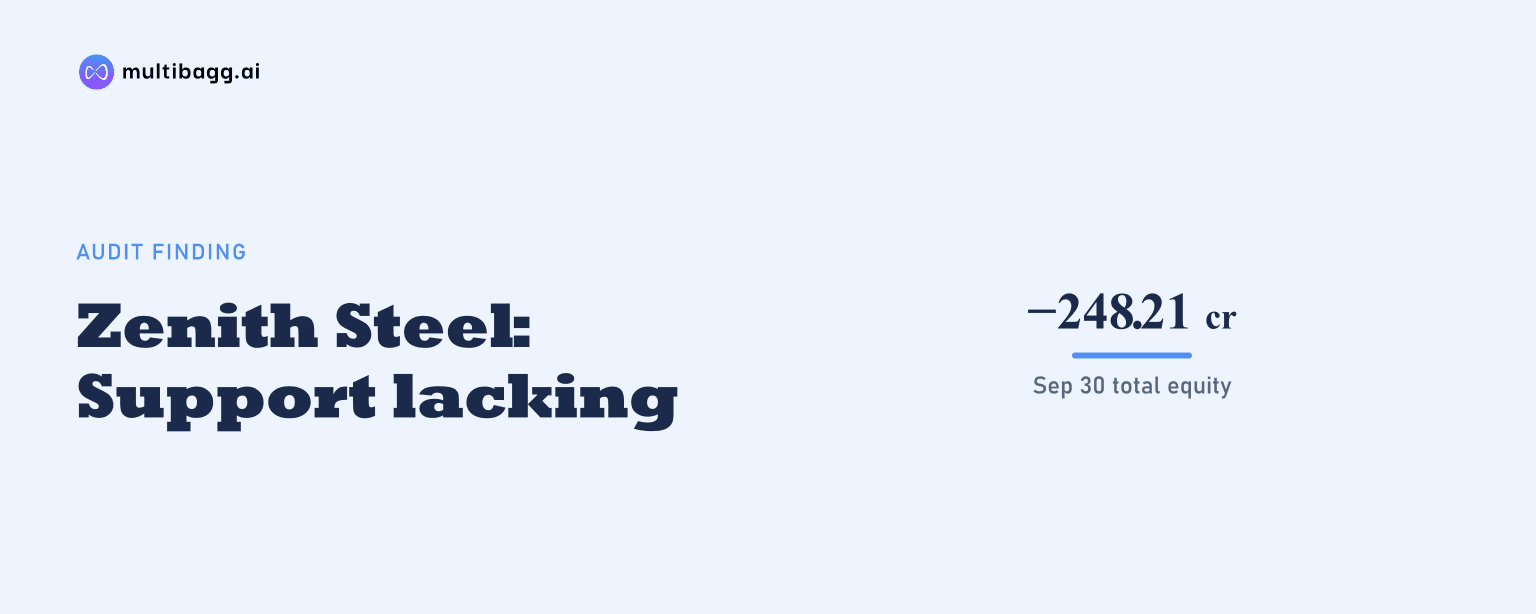
Zenith Steel Pipes & Industries Limited received a qualified limited-review conclusion for the quarter and half-year ended September 30, 2026, after auditors said its going-concern accounting was not adequately supported amid fully eroded net worth. The reviewers also cited deposit-rule breaches and could not verify inventory carrying value of Rs 8.98 crore.
Know Zenith Steel Pipes & Industries inside out
Results, valuation, peers and who's buying, in one view.
Why did auditors qualify Zenith Steel Pipes’ September 2026 results?
Auditors qualified Zenith Steel Pipes’ standalone results because the company had not complied with Section 74 of the Companies Act, 2013 and applicable Companies (Acceptance of Deposits) Rules, 2014. The exceptions included non-repayment of public deposits and interest by their due dates, failure to maintain prescribed liquid assets, and non-compliance with Company Law Board orders relating to these matters.
Devam & Associates LLP said the deposit-related exceptions constituted material non-compliance and could result in regulatory implications for Zenith Steel Pipes. Its report, dated November 4, 2026, was a limited review conducted under Standard on Review Engagements 2410, a process based primarily on enquiries and analytical procedures rather than a full audit.
Subject to the matters in its qualification, the reviewer said nothing had come to its attention indicating that the September 30, 2026 statement failed to disclose information required under Regulation 33 of the Securities and Exchange Board of India Listing Obligations and Disclosure Requirements Regulations, 2015. That conclusion does not remove the evidence limitations and compliance issues separately identified by the auditors.
Why is Zenith Steel Pipes’ going-concern accounting not adequately supported?
Zenith Steel Pipes’ going-concern accounting was not adequately supported because accumulated losses exceeded its share capital and reserves, and its net worth was fully eroded as of September 30, 2026, according to the review report. Auditors said those conditions created a material uncertainty that could cast significant doubt on the company’s ability to continue as a going concern.
Management nevertheless prepared the September 2026 results on a going-concern basis. It said it was reviving manufacturing units, engaging with key suppliers and customers, pursuing operational-efficiency measures, and evaluating business options intended to increase operating income and support projected future cash flows.
The consolidated balance sheet reported total equity of negative Rs 248.2113 crore at September 30, 2026, compared with negative Rs 248.9319 crore at March 31, 2026. The deficit narrowed by Rs 0.7206 crore, while total current liabilities rose by Rs 4.1531 crore to Rs 360.122 crore and current borrowings remained Rs 182.8242 crore.
Management said its assessment depended on successful implementation of the proposed measures and the absence of unforeseen adverse developments. The auditors did not conclude that the planned revival would succeed; they concluded that the material uncertainty existed and that the accounting basis was not adequately supported.
Which Zenith Steel Pipes balances could auditors not verify?
Auditors could not obtain sufficient appropriate evidence for Zenith Steel Pipes’ trade payables, trade receivables, loans, advances, deposits, intergroup balances, current liabilities and borrowings from others as of September 30, 2026. The company had not sent direct balance-confirmation requests to counterparties, citing pending reconciliations and disputes.
As a result, auditors said they could not verify the accuracy, completeness, recoverability or payability of these balances, or determine whether accounting adjustments were necessary. Management said the balances were recorded according to its books and that it did not expect material discrepancies upon settlement.
The review also covered certain current bank accounts that were non-operating and frozen by regulatory authorities. Without relevant bank statements and year-end balance confirmations, auditors said they could not establish the completeness or accuracy of the reported balances, or assess any resulting effect on the quarter and half-year ended September 30, 2026.
A separate reconciliation involved Ess Jay Global Ventures Private Limited and Mango Capital LLC. Zenith Steel Pipes said it was pursuing a legally permitted net settlement and had determined a net receivable of Rs 1.50 crore, following correspondence and legal notices exchanged between June and October 2023.
Got a follow-up? Ask IRIS
What did auditors say about Zenith Steel Pipes’ inventory?
Auditors could not verify Zenith Steel Pipes’ inventory of Rs 8.98 crore at September 30, 2026 because they were not provided adequate information and supporting documentation. The unavailable evidence covered quantities, condition and cost allocation, meaning the possible impact on inventory, profit or loss and financial position was not ascertainable.
Management said it valued raw materials, work in progress, finished goods, stores, spares and scrap under the weighted-average-cost method prescribed by Indian Accounting Standard 2, or Ind AS 2. It said finished goods, work in progress and scrap were manually valued using cost sheets and estimates because labour, overheads and utilities created variable manufacturing costs.
Consolidated inventory rose to Rs 8.9798 crore at September 30, 2026 from Rs 5.9451 crore at March 31, 2026, an increase of Rs 3.0347 crore. Management said it was strengthening internal controls and system-based inventory tracking for future periods, but the review report gave no completion date for those measures.
What debt and legal matters remain for Zenith Steel Pipes?
Zenith Steel Pipes’ Khopoli assets remain subject to recovery action originally initiated by a consortium of banks for dues of Rs 193.19 crore outstanding on January 31, 2014. The consortium took symbolic possession of the Khopoli immovable assets on May 29, 2014 and sought physical possession through legal proceedings.
The debt was assigned by the consortium to Invent Assets Securitization and Reconstruction Private Limited on March 31, 2018, and was assigned to India SME Asset Reconstruction Company Ltd during the half-year ended September 30, 2026. At an October 19, 2026 hearing before the Debt Recovery Tribunal, Pune, Zenith Steel Pipes sought an adjournment, and the next hearing was scheduled for February 25, 2027.
Under a memorandum of understanding, Tribus Real Estate Private Limited was authorised to negotiate a one-time settlement, or other written settlement terms, for bank borrowings of Rs 158.9492 crore as of December 31, 2025. Tribus had repaid Rs 65.9992 crore by March 24, 2026, leaving Rs 92.95 crore unpaid on that date.
Management said a proposed development arrangement for the Khopoli land and building was under discussion and was expected to generate funds for these obligations if concluded. The filing does not specify a completion date for that arrangement, and the recovery matter remained before the tribunal at the reporting date.
Conclusion
The September 2026 limited review identifies connected risks for Zenith Steel Pipes: public-deposit compliance failures, balances lacking third-party confirmation, evidence gaps over frozen bank accounts and inventory of Rs 8.98 crore, and fully eroded net worth. Auditors therefore found material uncertainty over continuity and said the going-concern basis was not adequately supported.
The next disclosed event is the February 25, 2027 Debt Recovery Tribunal hearing on the Khopoli recovery case. Later results may also show whether the proposed Khopoli development arrangement, the Tribus settlement process with Rs 92.95 crore unpaid at March 24, 2026, and planned system-based inventory controls produce documented outcomes.