










A-One Steels objection fails NCLT's 10% shareholding test
Key highlights
- The NCLT dismissed the 20 November 2026 application because the applicant pleaded an 8.5% stake against Section 230(4)'s 10% requirement.
- The challenge targeted a 1:413 exchange ratio, but the NCLT made no finding on the ratio's fairness or valuation basis.
- A claimed combined holding of 11.02% could not be used because the additional shareholders were not parties or independent objectors.
- A-One Steels was stated to have reported FY 2025-26 revenue of Rs 3,396.09 crore, compared with Rs 3,004.30 crore in FY 2024-25.
powered by IRIS
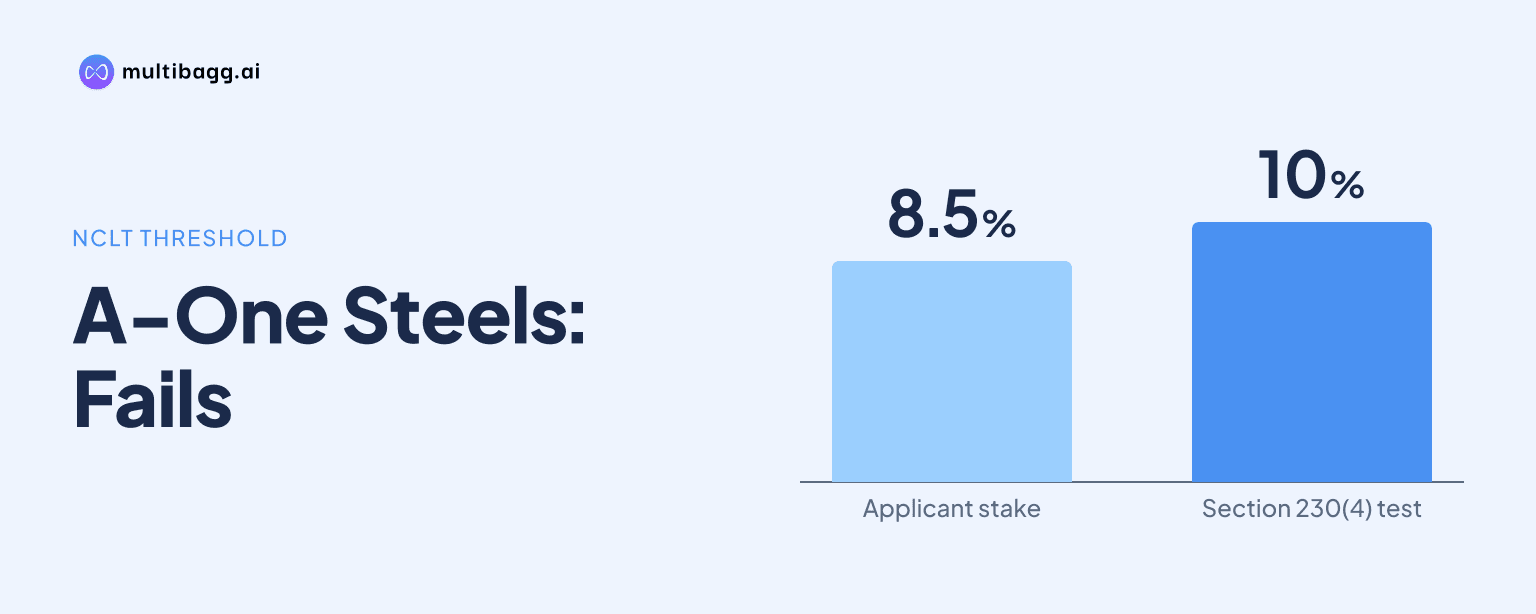
A-One Steels India Limited's amalgamation challenge was dismissed by the National Company Law Tribunal, Hyderabad Bench-1, on 20 November 2026 because the applicant's pleaded 8.5% holding in Basai Steels and Power Private Limited was below the 10% threshold in Section 230(4) of the Companies Act, 2013. The tribunal did not decide whether the 1:413 exchange ratio was fair.
Know A-One Steels India inside out
Results, valuation, peers and who's buying, in one view.
Why did the NCLT dismiss the A-One Steels objection?
The NCLT dismissed the application as not maintainable because K. Ravi Shankar's own pleaded holding of 8.5% did not meet Section 230(4)'s 10% shareholding requirement for objections to an arrangement. The provision also permits creditor objections only where outstanding debt equals at least 5% of total outstanding debt under the latest audited financial statement.
The applicant claimed 10,03,50,000 shares in Basai Steels and Power Private Limited, comprising 16,00,000 originally allotted shares and 9,87,50,000 allegedly transferred shares. Basai Steels and Power Private Limited disputed the larger claim, saying its register of members and an auditor's certificate dated 14 March 2026 showed 16,00,000 shares, or about 0.14%, but the NCLT said resolving that dispute was unnecessary because 8.5% was already below 10%.
The tribunal looked at the substance of the 10 September 2026 filing rather than its Rule 11 label. Although framed as a request for fair valuation directions, it challenged the 1:413 exchange ratio, alleged fraud and mala fides, and sought to stop or hold the scheme, making it an objection to the arrangement under Section 230(4).
Can Rule 11 waive A-One Steels' 10% threshold?
No. The NCLT held that Rule 11 of the National Company Law Tribunal Rules, 2016 cannot waive or relax the 10% limit expressly imposed by Section 230(4). It found that the words “shall be made only by” restrict objections to shareholders and creditors meeting the defined thresholds.
The applicant argued that the valuation issue was genuine and that inherent powers should be available, drawing an analogy with Section 244 of the Companies Act. The tribunal reached the opposite conclusion: Section 244 expressly permits a waiver for certain applications under Section 241, while Section 230(4) contains no comparable waiver mechanism.
The order referred to the J.J. Irani Committee report dated 31 May 2005, which recommended a threshold after noting that small shareholders could file objections that delayed schemes. The NCLT said Parliament's adoption of a percentage-based test meant the absolute number of shares, including a claimed 10,03,50,000 shares, could not replace the 10% requirement.
The tribunal also applied the Supreme Court's 2024 GLAS Trust Company LLC ruling on inherent powers. Rule 11 preserves the tribunal's inherent powers in relation to its rules, the NCLT said, but cannot be used to override an express condition in the Companies Act.
Could other shareholders lift A-One Steels above 10%?
No. The NCLT held that a consent affidavit from the legal heirs of late Gopal Agarwal could not cure the applicant's lack of locus after the application had been filed. The heirs were not parties to the proceeding, had not lodged their own objection, and had not filed an impleadment application.
In his rejoinder, the applicant said that adding the heirs' 2,96,50,000 shares to his claimed 10,03,50,000 shares would create a combined 13,00,00,000-share holding, or 11.02% of the 1,17,91,50,000 paid-up shares. The tribunal ruled that maintainability must be tested when the application is filed, not through a new case advanced in a rejoinder.
The proposed 11.02% also depended on the disputed transfer of 9,87,50,000 shares to the applicant. The NCLT said that excluding those shares, the applicant and the heirs would together hold about 2.65%, which remained below the statutory 10% threshold.
The order recorded that the applicant said he was filing a separate waiver application but that no such application had been filed. It therefore rejected aggregation through consent and left the disputed ownership claim to CP No. 35/241/HDB/2025 and the criminal proceedings cited in the case.
Got a follow-up? Ask IRIS
What did the NCLT decide about the 1:413 exchange ratio?
The NCLT made no finding on the fairness of the 1:413 exchange ratio because the applicant lacked standing to object. It expressly did not examine the valuation, publication, alleged jurisdictional issues, fraud allegations or ownership dispute, and reserved all of those matters for appropriate proceedings.
The applicant had contended that a Rs 1 share in Basai Steels and Power Private Limited was valued at Rs 0.8767 while a Rs 10 share in A-One Steels was valued at Rs 362.07. He also alleged undervaluation of Basai Steels and Power Private Limited's 163.82-acre Bellary site and plant, and sought a fresh valuation by an independent registered valuer; none of these claims was adjudicated.
Basai Steels and Power Private Limited submitted that an independent registered valuer had fixed the ratio using relative fair values. It said A-One Steels' 78.14% holding, or 92,13,50,000 shares, in Basai Steels and Power Private Limited would be cancelled without an allotment under the scheme.
Basai Steels and Power Private Limited also submitted that A-One Steels was valued using discounted cash flow and sum-of-the-parts methods, while Basai Steels and Power Private Limited was valued through adjusted net asset value. The NCLT did not assess whether those methods or the resulting ratio were appropriate.
What does the ruling mean for A-One Steels' amalgamation?
The ruling means this shareholder application cannot require a new valuation or halt the amalgamation through Section 230(4). It does not validate the 1:413 ratio, determine ownership of the disputed 9,87,50,000 shares, or decide CP No. 35/241/HDB/2025 and the referenced criminal proceedings.
According to Basai Steels and Power Private Limited's submission, 21 shareholders holding 1,02,00,99,000 shares voted through remote electronic voting, with 100% of votes cast supporting the scheme. Unsecured creditors who voted approved it by 91.14% in value, though those voting results did not remove the NCLT's obligation to apply the statutory objection threshold.
A-One Steels was described in the respondent's submission as reporting revenue from operations of Rs 3,396.09 crore and profit after tax of Rs 110.96 crore in FY 2025-26. That compared with revenue of Rs 3,004.30 crore and profit after tax of Rs 46.72 crore in FY 2024-25, while Basai Steels and Power Private Limited was described as having a Rs 5.40 crore loss in FY 2024-25.
Conclusion
The decision establishes that a request to alter, delay or obtain a fresh valuation for a scheme remains a Section 230(4) objection regardless of its Rule 11 form. The applicant's pleaded 8.5% holding fell 1.5 percentage points short of the 10% threshold, and later consent from non-party shareholders could not retrospectively establish locus.
The next disclosed implementation step is for the transferor company to submit the certified scheme order in Form INC-28 to the relevant Registrar of Companies within 30 days of receiving it. The unresolved matters to watch are the claim to 9,87,50,000 shares, CP No. 35/241/HDB/2025, the cited criminal proceedings, and final tribunal orders in the pending matters involving Basai Steels and Power Private Limited.