










Zicom Electronic Security Systems Gets ₹17.75 Crore NCLT Approval
Key highlights
- NCLT approved Zicom’s ₹17.755 crore resolution plan on 24 September 2026.
- The revised plan secured 75.46% Committee of Creditors support, with voting concluded on 18 February 2026.
- Zicom’s reported fair value was ₹17.84 crore and its liquidation value was ₹14.95 crore.
- Zicom’s CIRP began on 29 July 2022 after an IDBI Bank insolvency petition was admitted.
powered by IRIS
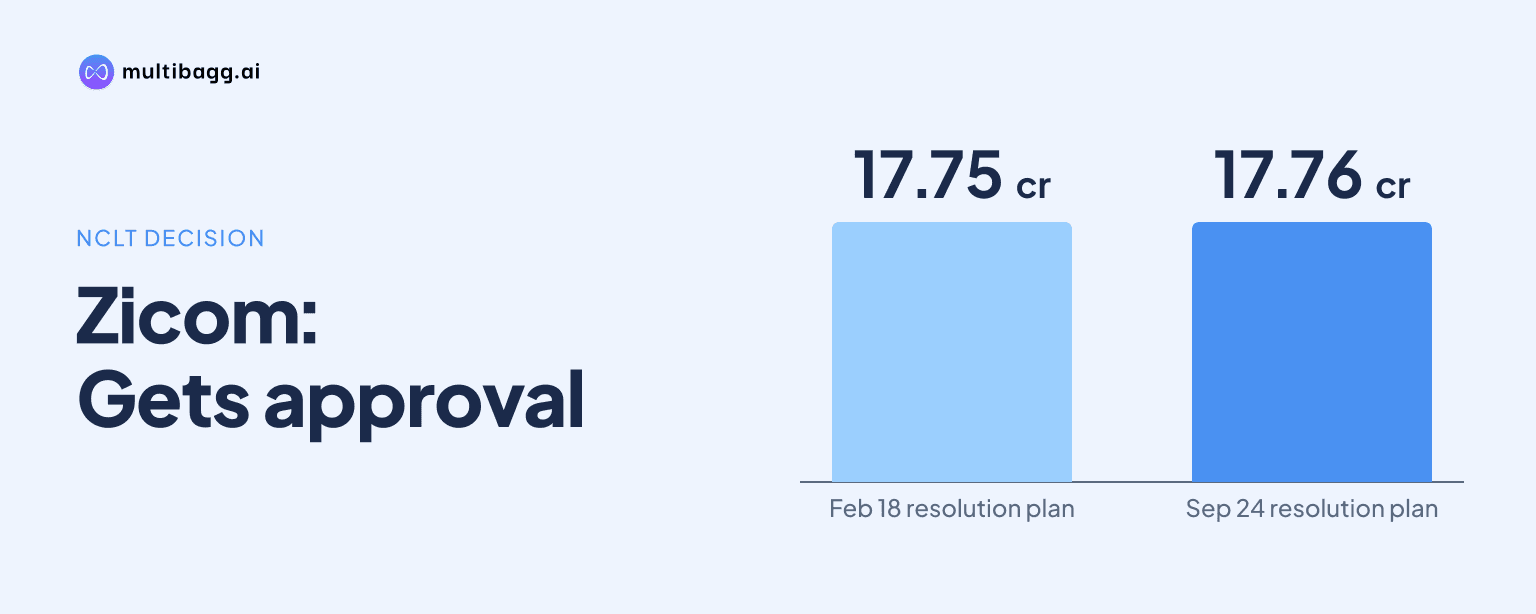
On 24 September 2026, the National Company Law Tribunal approved a ₹17.75 crore resolution plan for Zicom Electronic Security Systems Limited after the revised proposal secured 75.46% Committee of Creditors support. The approval brings the company’s insolvency resolution process, which began in July 2022, to the plan-implementation stage under the Insolvency and Bankruptcy Code.
Know Zicom Electronic Security Systems inside out
Results, valuation, peers and who's buying, in one view.
What did the NCLT approve for Zicom?
The National Company Law Tribunal, Mumbai bench approved the resolution plan submitted by Advaita Trading Private Limited for Zicom. The approved plan has a total value of ₹17.75 crore, based on the reported value of ₹17,75,54,841, and takes effect from the date of the order.
The tribunal held that the plan would bind the corporate debtor and other stakeholders covered by the Insolvency and Bankruptcy Code, or IBC. Its order means that the corporate insolvency resolution process, or CIRP, has moved beyond creditor voting and tribunal scrutiny to implementation of the approved proposal.
Zicom entered CIRP after the NCLT admitted an insolvency petition filed by IDBI Bank on 29 July 2022 under Section 7 of the IBC. The process therefore extended for more than four years before the final plan approval order was delivered.
Why was the resolution plan reconsidered by creditors?
The plan was reconsidered because the tribunal had earlier sent it back to the Committee of Creditors, or CoC, for further examination of the successful resolution applicant’s experience and the plan’s feasibility and viability. The CoC subsequently reviewed modified terms and approved the revised plan with a 75.46% voting share.
The resolution professional filed the approval application on 3 April 2026. The application covered the resolution plan dated 24 December 2025 and addenda dated 29 January 2026 and 26 March 2026. Voting on the revised plan concluded on 18 February 2026.
The CIRP timeline had also required an extension. In an order delivered on 11 December 2025, the tribunal granted a 30-day extension from 4 December 2025 for completion of the process, rather than the 45 days sought by the resolution professional. It directed the CoC and resolution professional to use the extended period to complete the CIRP.
How did the approved plan meet IBC requirements?
The NCLT found that the revised plan met the mandatory requirements of Section 30(2) of the IBC and the applicable CIRP Regulations. The bench of Prabhat Kumar, Technical Member, and Sushil Mahadeorao Kochey, Judicial Member recorded that the modified proposal had the required CoC approval.
The order noted that CIRP costs would be paid in priority to other debts. It also found that the plan addressed operational creditors’ claims in accordance with Section 30(2)(b) and the relevant regulations.
The tribunal reiterated the limited scope of judicial review once creditors have approved a resolution plan with the required voting threshold. Its role at that stage is to assess statutory compliance rather than replace the commercial judgment of the CoC on the plan’s merits.
Got a follow-up? Ask IRIS
What do Zicom’s plan value and valuations show?
Zicom’s approved plan value was slightly below the reported fair value but above the liquidation value. The comparison is relevant because it shows the financial benchmarks available to the CoC while assessing the revised proposal and its distribution framework.
The plan value was about ₹2.81 crore higher than Zicom’s liquidation value, based on the reported figures. It was approximately ₹0.08 crore below the fair value. These comparisons do not by themselves determine recoveries for individual creditors, since recoveries depend on the approved distribution mechanism and respective claims.
How does the order affect creditors and implementation?
The approval allows Zicom’s resolution plan to be implemented, with a monitoring committee constitution application also placed on record before the NCLT. For creditors, the practical next step is execution of the approved plan and distribution in accordance with its terms and the tribunal’s directions.
Central Bank of India, identified as a dissenting financial creditor, had raised concerns over the distribution mechanism and the amount payable to it in relation to its security interest. The tribunal stated that this issue would be governed by a separate order passed on the same day, so the plan approval did not remove that specific distribution matter from separate consideration.
The record also refers to a pending appeal by the suspended management before the National Company Law Appellate Tribunal against an NCLT order dated 25 April 2025. The disclosed position was that any receivables from that matter would be distributed among financial creditors. No outcome of that appeal was stated in the material available with the approval order.
Conclusion
The NCLT’s approval of Advaita Trading’s ₹17.75 crore proposal gives Zicom a tribunal-approved route out of its CIRP after creditors reconsidered and backed the revised plan with 75.46% votes. The order is grounded in compliance with Section 30(2) of the IBC, priority payment of CIRP costs, and the CoC’s commercial approval of the revised terms.
Attention will now shift to implementation through the monitoring framework, the separate decision concerning Central Bank of India’s distribution objection, and developments in the pending appellate matter involving the suspended management. These matters will determine the remaining procedural steps and any creditor distributions linked to the approved plan.