










ACE plans conditional Rs 400 crore tower-crane expansion
Key highlights
- ACE may spend at least Rs 400 crore on tower-crane capacity after a decision due by end-November or during December.
- ACE expects its Rs 40 crore to Rs 50 crore defence-machines and new-products plant to begin operating in January or February.
- ACE said crane and construction-equipment utilisation rose from about 55% at Q2-end to about 70% to 75% currently.
- ACE said about Rs 100 crore of inventory growth related to defence orders should fully normalise by Q4.
powered by IRIS
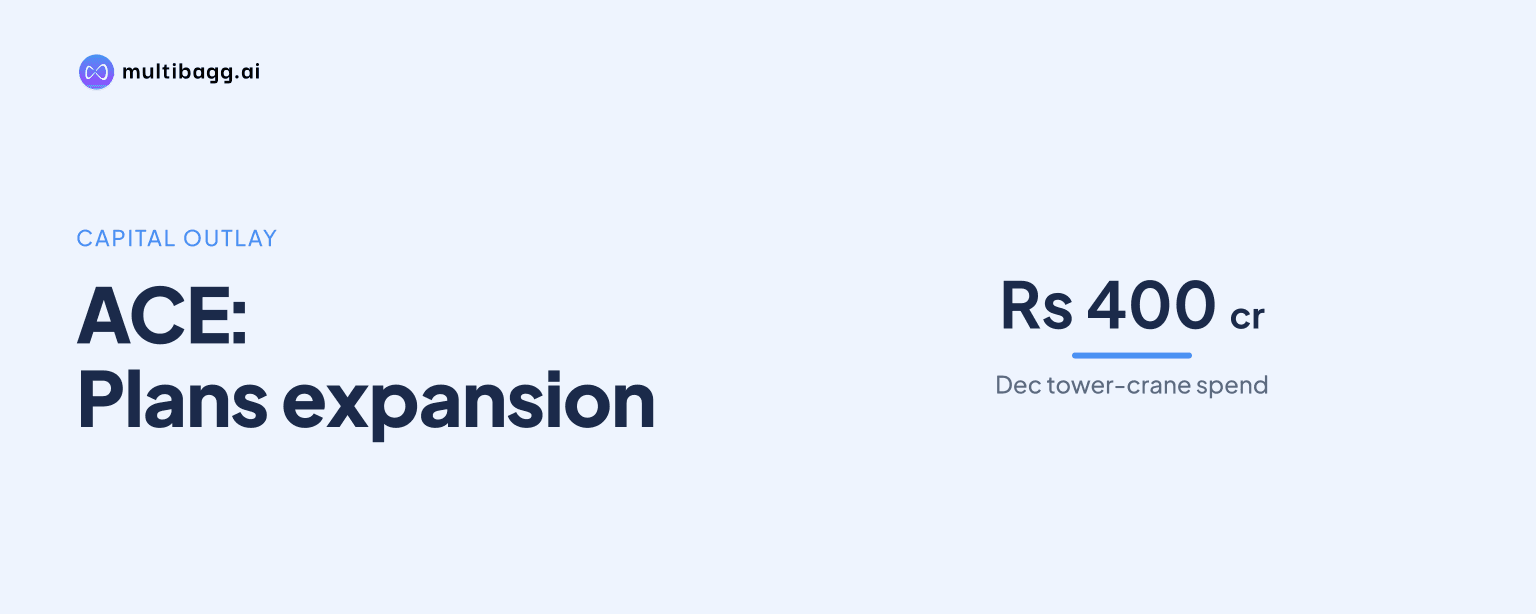
ACE said it may commit at least Rs 400 crore to expand tower-crane capacity after deciding by end-November or in December, while a Rs 40 crore to Rs 50 crore plant for defence machines and new products is expected to begin operating in January or February. The tower-crane expenditure remains conditional.
Know Action Construction Equipment inside out
Results, valuation, peers and who's buying, in one view.
What tower-crane expansion is ACE considering?
ACE is considering at least Rs 400 crore of additional capital expenditure to increase tower-crane capacity. The company has already procured land for the project at a cost of about Rs 50 crore, but management said the further capacity spending would begin only after it assesses overall conditions.
Management had delayed the tower-crane proposal from March or April because of the geopolitical situation. It said a decision would be taken by end-November or during December, with construction potentially starting in Q4 or moving to Q1 of the following year.
ACE said all planning for the capacity expansion has been put in place, but did not say that the Rs 400 crore expenditure had been approved. The distinction matters because the land acquisition is complete, whereas the timing and execution of the manufacturing investment are still unresolved.
Why is ACE considering dedicated tower-crane capacity?
ACE said tower-crane capacity is not fungible with other product lines, making a dedicated expansion relevant despite capacity elsewhere in the business. Fabrication and painting facilities are fungible across mobile products to about 50%, according to management, but tower cranes cannot use production capacity intended for other machinery.
At the end of Q2, ACE put utilisation in its cranes and construction-equipment business at about 55%, compared with about 25% to 30% in the agricultural segment. In a later response, management said current crane and construction-equipment utilisation had risen to about 70% to 75%, a material increase from the Q2 level.
ACE estimated that its existing facilities, including a plant line due for commissioning, could support Rs 5,500 crore to Rs 6,000 crore of revenue. Management nevertheless separated that aggregate capacity estimate from tower cranes because product-specific production lines are not interchangeable.
The company said it expected revenue growth of at least 18% to 20% in the current year, which it estimated would leave overall blended utilisation at about 60% to 70%. The proposed tower-crane investment therefore reflects the constraints of that specific category rather than a claim that all existing facilities are full.
What capital expenditure is ACE planning this year?
ACE is building a new plant within its existing premises for defence machines and new products, with an expected cost of Rs 40 crore to Rs 50 crore. Management had sought to have the plant ready in December but said January or February was now the more likely operating timeline.
The company also identified Rs 30 crore to Rs 40 crore for robotics, automation and continuous-improvement work, along with about Rs 20 crore of maintenance capital expenditure. These three specified items amount to Rs 80 crore to Rs 100 crore, excluding the proposed tower-crane project.
ACE said another roughly Rs 130 crore could be spent in the current year if the registry and final payments for a contracted larger land parcel are completed. Management said regulatory matters were still pending, and this possible land payment is separate from the roughly Rs 50 crore land already acquired for tower-crane capacity.
Got a follow-up? Ask IRIS
How are defence orders affecting ACE's production and working capital?
ACE linked the new plant to defence machines and said its defence order book was a little over Rs 500 crore, to be executed over the next one-and-a-half to two years. Management also said prices on larger defence orders are fixed once agreed, including orders delivered over one or two years, so the company builds an inflation component into its initial quotations.
An analyst cited inventory of about Rs 832 crore, up from Rs 605 crore. ACE said about Rs 100 crore of the increase related to defence orders, including RTFLT and HRV products, where government inspections require raw materials and finished goods to be available in larger batches.
Management expected most of the defence-related inventory increase to normalise by December and the balance to normalise fully by Q4. It described the HRV order as emergency procurement with a shorter delivery requirement, while RTFLT and HRV inspections have longer batch-based material requirements.
ACE said higher inventory also increased goods and services tax, or GST, credits recorded in current assets, because GST paid on additional material can be set off against future sales. More material purchases for defence orders also created corresponding vendor-payment liabilities, connecting the higher inventory, current assets and current liabilities.
Could higher scale change ACE's margin profile?
Management said operating leverage could create a possible 2% to 3% margin benefit once revenue reaches Rs 5,000 crore to Rs 5,500 crore over the next one or two years. This was management's view of the potential effect of scale, not a formal margin forecast.
ACE said the rental segment represents about 50% of its market and that it may pass some operating-leverage benefit to customers to preserve equipment viability for rental operators. Management therefore did not say that the entire prospective 2% to 3% benefit would be retained.
Input costs remain relevant to that outcome. ACE said steel had risen from about Rs 48 to Rs 50 per kilogram earlier in the year to Rs 66 to Rs 67 per kilogram in October, after briefly falling below Rs 60 per kilogram.
ACE said it realised a 7% to 8% price increase in the previous quarter, although increases of up to 10% had been taken. Management said it was considering another price action in early January, or in December if steel costs increased further, while maintaining profitability as its stated priority since April.
Conclusion
ACE has described a layered investment programme with different levels of commitment. The Rs 40 crore to Rs 50 crore defence-focused plant is expected to start in January or February, while robotics, automation and maintenance account for another Rs 50 crore to Rs 60 crore. By contrast, the at-least-Rs 400 crore tower-crane build remains dependent on a management decision, despite about Rs 50 crore already spent on land.
The next event to watch is management's stated decision by end-November or during December on whether tower-crane construction begins in Q4 or shifts to Q1 of the following year. Other disclosed milestones are the defence plant's planned commissioning in January or February and the expected full normalisation of defence-related inventory by Q4.