










Action Construction Equipment Q2 FY27 revenue rises 20.5% to ₹932 crore
Key highlights
- ACE reported Q2 FY27 consolidated total income of ₹932 crore, up 20.5% year-on-year.
- Normalized EBITDA rose 30.2% to ₹180 crore and margin expanded 143 basis points to 19.31%.
- Reported PAT increased 82.4% to ₹164.3 crore, including a ₹50 crore exceptional gain.
- H1 FY27 total income reached ₹1,772 crore, up 20% year-on-year.
powered by IRIS
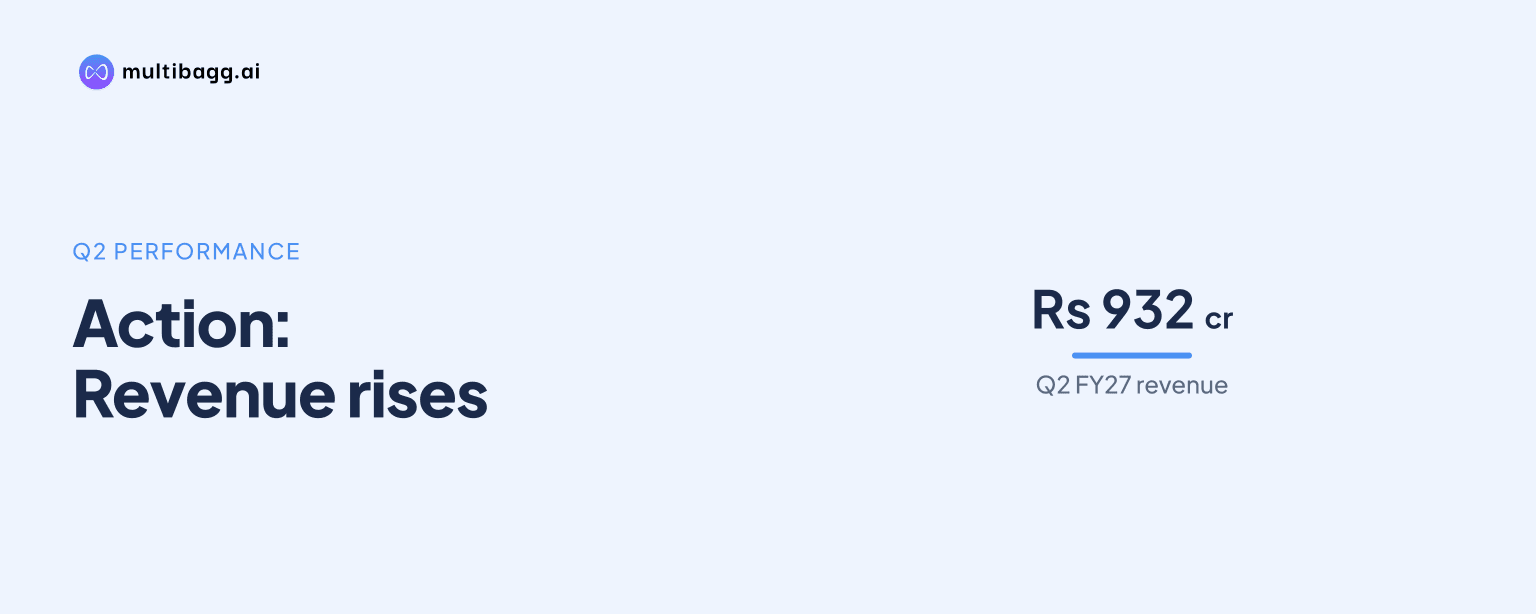
Action Construction Equipment Limited reported consolidated total income of ₹932 crore in Q2 FY27, up 20.5% year-on-year, while reported profit after tax rose 82.4% to ₹164.3 crore, including a ₹50 crore exceptional gain from a slump sale to ACE KATO Private Limited. The performance reflects higher operating income and improved underlying profitability during the September quarter.
Know Action Construction Equipment inside out
Results, valuation, peers and who's buying, in one view.
What did Action Construction Equipment report in Q2 FY27?
Action Construction Equipment Limited, referred to as ACE, reported consolidated total income of ₹932 crore for the quarter ended September 30, 2026, compared with the corresponding quarter a year earlier. Total income increased 10.9% sequentially, according to the earnings-call disclosure. Revenue from operations was ₹886.1 crore, based on the company’s reported quarterly financial summary.
Normalized EBITDA rose 30.2% year-on-year to ₹180 crore. The normalized EBITDA margin expanded by 143 basis points to 19.31%, indicating that operating profit increased faster than total income. Profit before exceptional items and tax rose 35% to ₹167 crore, compared with ₹123.7 crore in the year-earlier period, while normalized PBT margin stood at 17.9%.
Reported PAT was ₹164.3 crore and the reported PAT margin was 17.62%. The company said this number included an exceptional gain of ₹50 crore arising from the slump sale to ACE KATO Private Limited. Consequently, the reported profit growth of 82.4% year-on-year includes both operating improvement and the one-time gain.
Why did ACE’s reported profit increase faster than revenue?
ACE’s reported PAT increased faster than total income because the quarter included a ₹50 crore exceptional gain on the slump sale to ACE KATO Private Limited. The transaction lifted the reported PAT margin by 597 basis points to 17.62%, making the bottom-line growth rate materially higher than the increase in revenue.
The underlying operating performance also improved. Normalized EBITDA grew 30.2%, ahead of the 20.5% rise in total income, and the 143-basis-point margin expansion points to better operating leverage in the quarter. Profit before exceptional items and tax grew 35%, which provides a more direct view of earnings performance before the asset-sale gain.
Some reported summaries cited total expenses of ₹761.29 crore, up 12.46% year-on-year. This was slower than the increase in consolidated total income, consistent with the improvement in normalized EBITDA margin disclosed during the earnings call. The company also noted that steel inflation had re-accelerated and that price increases were lagging those cost movements, a factor relevant to future margin assessment.
Got a follow-up? Ask IRIS
How did the first half and operating environment support the quarter?
ACE reported total income of ₹1,772 crore for the first half of FY27, an increase of 20% year-on-year. H1 normalized EBITDA was ₹352.5 crore, up 24.9%, with a margin of 19.89%. H1 reported PAT rose 51.1% to ₹283.7 crore, while diluted earnings per share stood at ₹23.84.
Management identified government-led capital expenditure, logistics modernisation, Make in India initiatives, rising private-sector participation and higher mechanisation as structural supports for its core equipment categories. These factors are relevant to demand for construction equipment as infrastructure activity and domestic manufacturing investment remain important sector drivers.
The company also stated that building capacity ahead of demand would be important to sustain its market position and address opportunities across product segments. That approach places execution, capacity utilisation and demand visibility at the centre of ACE’s operating strategy rather than relying solely on quarterly sales growth.
What does the Q2 performance mean for ACE investors and the equipment sector?
For investors, the quarter separates into two elements: operating progress and a one-time exceptional item. Revenue growth, EBITDA growth and the margin expansion show improved underlying performance, while the ₹50 crore slump-sale gain boosted reported PAT. Comparing future quarters on normalized EBITDA and pre-exceptional profit measures will therefore be important.
ACE operates in a construction-equipment market tied to infrastructure development, industrial activity, logistics investment and the adoption of mechanised equipment. The company’s commentary indicates that these demand drivers remain supportive, but its reference to steel inflation shows that input-cost trends remain relevant for pricing and profitability.
The company made the audio recording of its Q2 FY27 earnings call available on November 13, 2026, in line with its regulatory disclosure requirements. The call recording is identified by recording ID 10048638. Earlier, ACE had closed its trading window from October 1, 2026, until 48 hours after the declaration of results for designated persons, including directors, key managerial personnel, promoters and other specified persons.
Conclusion
ACE delivered 20.5% year-on-year growth in Q2 FY27 total income to ₹932 crore and expanded normalized EBITDA margin to 19.31%. Reported PAT of ₹164.3 crore was strengthened by a ₹50 crore exceptional gain, while the 30.2% increase in normalized EBITDA and 35% growth in pre-exceptional PBT indicate that operating profit also improved.
Investors will watch whether revenue momentum continues across ACE’s equipment segments, whether steel-cost inflation can be managed through pricing and efficiency, and how the company progresses with its stated capacity-building plans. The next quarterly disclosure will provide a clearer indication of the durability of margin gains without the effect of the Q2 exceptional item.