










ACME plans larger coach-maintenance bids using overseas ties
Key highlights
- ACME cited a recently published passenger-coach maintenance tender worth about Rs 2,500 crore.
- Management said ACME has Korean and Russian tie-ups to support credentials for larger maintenance bids.
- ACME said its Korean partner has 15 years of train-set maintenance experience.
- Management said passenger-coach maintenance contracts can run for 10 to 15 years.
powered by IRIS
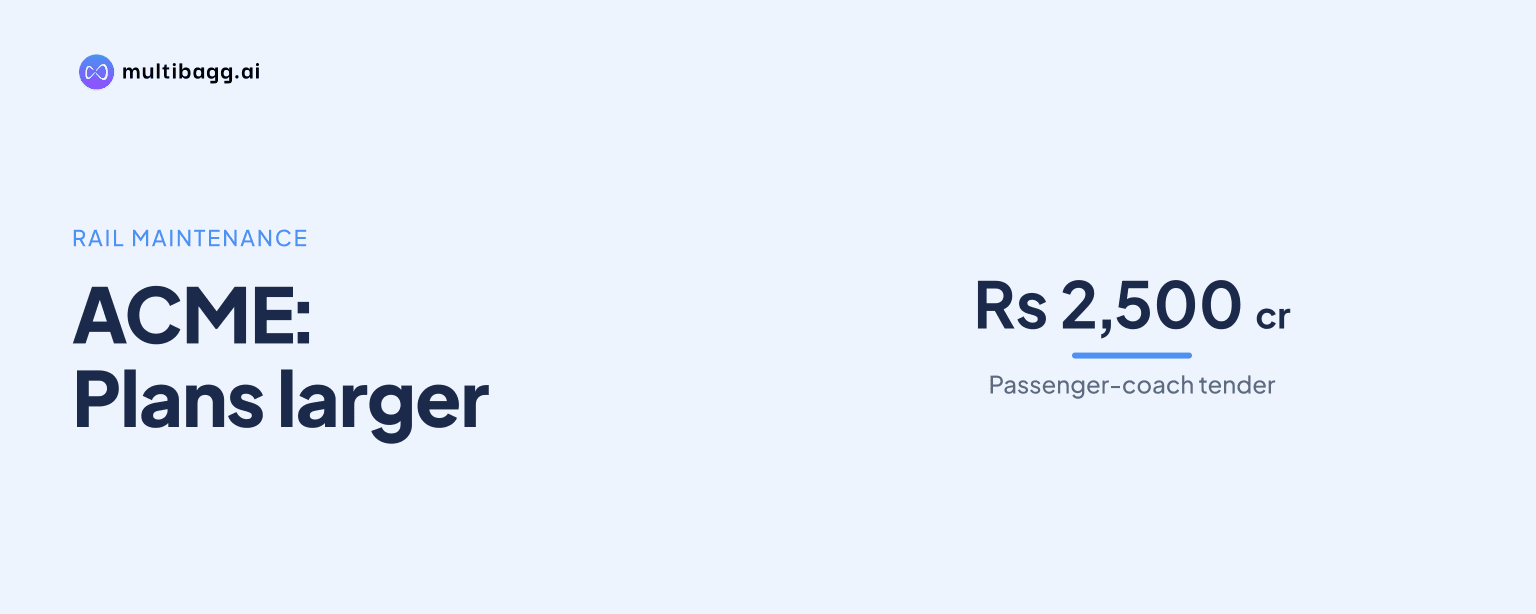
ACME India Industries Limited plans to use Korean and Russian tie-ups to pursue larger passenger-coach maintenance contracts, management said, citing a recently published Rs 2,500 crore passenger-maintenance tender and contract tenures of 10 to 15 years. ACME aims to add recurring, longer-duration maintenance revenue alongside its existing passenger-coach supply, refurbishment and modification work.
Know Acme India Industries inside out
Results, valuation, peers and who's buying, in one view.
How will ACME bid for larger passenger-coach maintenance contracts?
ACME plans to use overseas partners’ credentials for larger passenger-coach maintenance tenders. Managing Director and Chief Executive Officer Suraj Pandey said ACME is already qualified for passenger-coach work because it works on those coaches, while wagon maintenance was a newer activity entered after the company qualified for an immediate railway opportunity.
For higher-value tenders, ACME has tie-ups with companies from Korea and Russia, according to management. Pandey said one Korean partner has 15 years of experience maintaining train sets and that ACME has a joint venture with that partner through which it can bring credentials into tender participation. The call did not disclose the names of the Korean or Russian partners, ownership terms, the scope of the Russian arrangement, or a tender already submitted through those relationships.
Management said the Korean partner maintains systems including electronics, automatic doors, traction equipment, heating, ventilation and air-conditioning systems, interiors and driver desks. ACME linked that capability to the increasing technical requirements of Amrit Bharat, Vande Bharat, Linke Hofmann Busch coaches and Gatimaan Express trains, which management said require several specialised maintenance skills.
The planned relationships differ from ACME’s earlier Airfloa arrangement. Pandey said that was a project-specific special-purpose vehicle and consortium, rather than a long-term joint venture, created because each participant had part of the required credentials. Management said the participants would receive their own credentials after the particular project was completed.
What is the passenger-coach maintenance opportunity identified by ACME?
ACME identified a recently published passenger-maintenance tender worth about Rs 2,500 crore, although it did not disclose a bid value or likely share. Pandey said railways had previously performed coach maintenance internally but now face gaps in manpower and technology as the number and technical complexity of coaches in service have increased.
Management compared annual coach production of about 4,000 to 4,500 coaches four or five years earlier with a current range of 7,000 to 10,000 coaches. The company said this growth in coach production has created newer opportunities for external suppliers and maintenance providers, but it gave no forecast for ACME’s potential maintenance revenue or market share.
ACME said maintenance cannot be indefinitely deferred because periodic hauling, intermediate overhauling and refurbishment are needed to keep coaches fit for service. That is management’s assessment of the maintenance requirement, rather than a disclosed railway award or procurement commitment to ACME.
Got a follow-up? Ask IRIS
What experience does ACME cite in passenger-coach refurbishment?
ACME cites its work in design, prototyping, manufacturing, installation, warranty maintenance, repair and maintenance as the base for pursuing long-tenure contracts. Pandey said ACME operates across the train lifecycle, while other companies may be limited to installation, design or supplies.
The company said its passenger-coach work has developed over multiple years. Management said ACME’s first toilet prototype was made in 2014, followed by further prototypes in 2017 and 2022. President of Finance and Strategy Rajen Dutta said ACME began taking turnkey projects in 2016-17 and that its toilet-prototype development took four to five years.
Management also described an expansion in the midlife-rehabilitation opportunity from 557 coaches to more than 7,000 coaches due for rehabilitation. Pandey said the refurbishment scope and budget had been distributed across zonal railways, but ACME did not disclose the budget value, its market share, or an expected order-conversion timetable.
ACME distinguished cash conversion from margin by product category. Pandey said component supplies generally provide payment after supply but lower margins, while complete refurbishment, toilet modification and technology-oriented products carry higher margins. Dutta said management expects an earnings before interest, tax, depreciation and amortisation margin of 17% to 18%, subject to product mix.
How does maintenance fit ACME’s order and revenue plans?
ACME is developing the maintenance strategy while targeting Rs 1,200 crore to Rs 1,500 crore of order additions over the next 12 months. Pandey said the company was bidding for about Rs 800 crore of tenders within 10 days and expected to bid for roughly another Rs 2,000 crore over the following five to six months, using a 40% to 45% assumed conversion rate.
Management expected Rs 250 crore to Rs 300 crore of additional orders by March 2027, another Rs 250 crore to Rs 300 crore over the following six months, and the balance within the next nine months. These are management targets based on tender opportunities and conversion assumptions, not confirmed orders or passenger-maintenance contract awards.
Pandey said ACME expected about Rs 74 crore of revenue at the time of the call and targeted roughly Rs 380 crore by March 2027, leaving about Rs 310 crore for the second half. From April onward, management expects first-half sales to account for 35% to 40% of annual sales, compared with the 10% to 20% first-half pattern cited by an analyst during the call.
Dutta, responding to a question on FY28, said management was targeting revenue of Rs 525 crore to Rs 550 crore, with a possible 10% to 15% variation based on the timing of new orders. He said 90% to 95% of the second-half turnover guidance was supported by orders in hand, while new orders would require prototype approval before significant execution.
Conclusion
ACME’s proposed move into larger passenger-coach maintenance bids depends on converting its existing coach-work experience and overseas relationships into qualifying credentials. Management identified a Rs 2,500 crore tender and contract periods of 10 to 15 years, which could make maintenance a longer-duration revenue line than individual supply or refurbishment assignments.
The next disclosed milestones are management’s target to add Rs 250 crore to Rs 300 crore of orders by March 2027 and the broader Rs 1,200 crore to Rs 1,500 crore order-addition target over 12 months. Investors will also need to watch for a disclosed passenger-maintenance bid or award, and for details of the Korean and Russian arrangements that ACME plans to use for larger tenders.