










ACME targets ₹1,200-1,500 crore in new railway orders
Key highlights
- ACME targets ₹1,200-1,500 crore of new railway orders over the next 12-15 months.
- ACME said it was bidding for about ₹800 crore of tenders and expects to bid for approximately ₹2,000 crore more within 5-6 months.
- ACME reported a ₹727 crore order book in H1 FY27, about 2.8 times FY26 revenue of ₹264 crore.
- Management said 15,000 toilet-modernisation coaches worth about ₹1,500 crore remain to be tendered over 12 months.
powered by IRIS
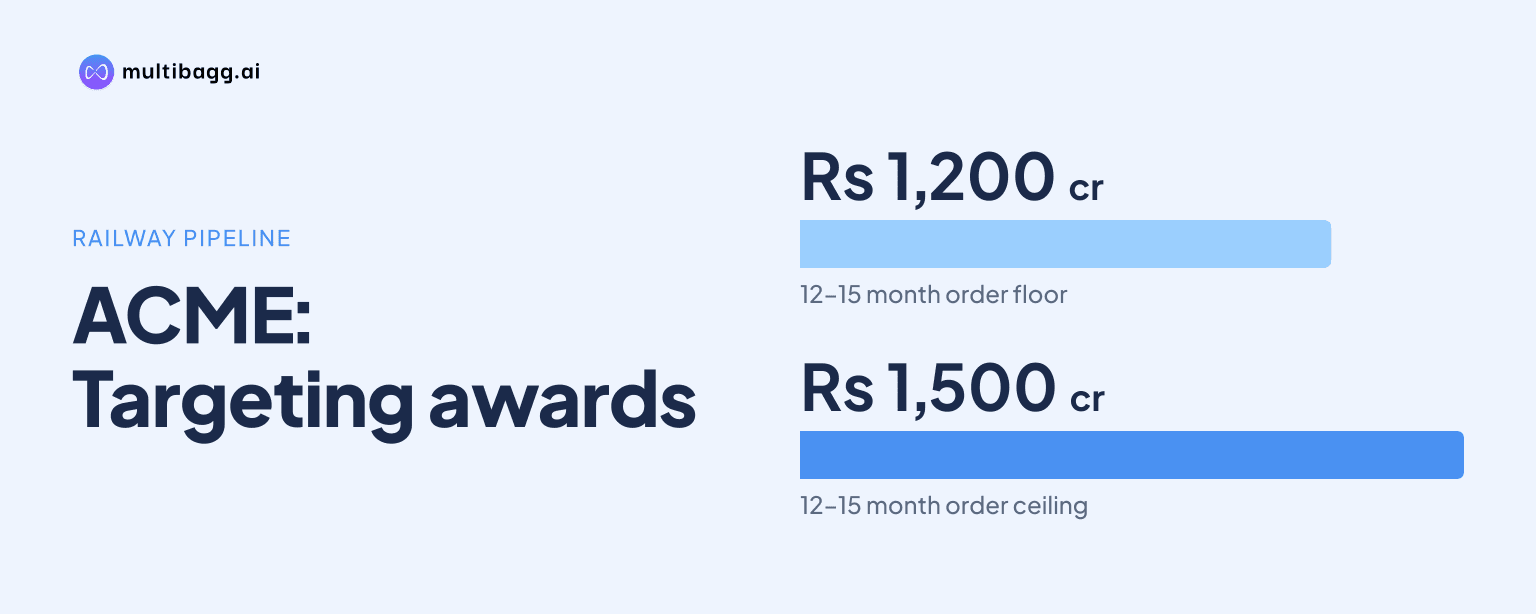
ACME India Industries Limited is targeting ₹1,200 crore to ₹1,500 crore of new railway orders over the next 12-15 months, management said on November 18, 2026. The target is based on about ₹2,800 crore of tenders being bid in stages, while ACME reported a ₹727 crore order book in H1 FY27.
Know Acme India Industries inside out
Results, valuation, peers and who's buying, in one view.
What new railway orders is ACME targeting?
ACME is targeting ₹1,200 crore to ₹1,500 crore of incremental railway orders over 12-15 months, and this is a management target rather than work already awarded. Managing Director and Chief Executive Officer Suraj Pandey linked the target to toilet modernisation, coach refurbishment, component supplies, repair and maintenance, and technology-related products.
Management said ACME was bidding for tenders worth about ₹800 crore within 10 days of the November 18 call and expected to bid for a further approximately ₹2,000 crore over the following five to six months. Pandey said the ₹1,200 crore to ₹1,500 crore target was calculated using an assumed 40% to 45% conversion rate on that bid pipeline, below the “60 plus percent” probability he said the company had historically used for its own assessment.
The expected additions are phased rather than concentrated in one quarter. ACME said it expected to add ₹250 crore to ₹300 crore of orders by March 2027, another ₹250 crore to ₹300 crore in the following six months, and the remainder over the next nine months. Pandey said zonal railway orders are generally ongoing 12-month opportunities, whereas production-unit orders can cover one or two years and are usually awarded between September and December.
Which railway tenders support ACME’s target?
Toilet modernisation is the most specifically quantified near-term tender opportunity supporting ACME’s target. Management said budgets had been distributed for 25,000 coaches, with more than 10,000 already tendered and about 15,000 coaches still to be tendered over the next 12 months. It estimated the remaining toilet-modernisation tenders at ₹1,500 crore.
ACME said it had won orders for 6,300 coaches out of more than 10,000 coaches awarded under the toilet-modernisation programme, representing approximately 63% of those awards. The company also said it had modernised 11,400 toilet units, furnished around 2,500 new coaches and refurbished around 2,000 coaches, across 28 coach variants.
Refurbishment provides a separate pipeline, although management did not assign a specific order-win estimate to it. ACME said Linke Hofmann Busch, or LHB, coach production increased from 540 coaches in 2014 to more than 7,000 in 2025. Management said coaches have an approximately 30-year life and undergo mid-life rehabilitation at about 15 years, when interior materials and components are replaced.
Which businesses could add to ACME’s orders?
ACME expects orders to come from six areas: toilet modernisation, refurbishment, new-coach furnishing, supplies, repair and maintenance, and technology upgrades. Management described more than ₹16,000 crore of addressable opportunity in existing businesses and more than ₹30,000 crore of immediate opportunity in new segments, figures that represent its view of market potential rather than secured orders.
The revenue mix has already moved across segments. New-coach furnishing accounted for 58% of revenue in FY24, supplies accounted for 60% in FY26, and toilet modernisation accounted for 60% in H1 FY27, according to management. ACME said supplies increased from ₹35 crore to almost ₹160 crore over two years after it gained product approvals from coach factories, the Research Designs and Standards Organisation, or RDSO, and other railway bodies.
New-coach furnishing remains tied to rail production plans. Management said Indian Railways runs more than 100,000 passenger coaches and adds slightly more than 7,000 coaches a year. It also cited a plan for 17,000 non-air-conditioned LHB coaches over the next four to five years, alongside Vande Bharat Sleeper and Amrit Bharat train programmes.
Repair and maintenance is newer for ACME. Management said the annual repair-and-maintenance market exceeds ₹24,000 crore and that the company entered it with a first order worth ₹32 crore. It also referred to a recently published passenger-maintenance tender of about ₹2,500 crore, while saying only that ACME saw a possibility of obtaining some work from that tender.
Got a follow-up? Ask IRIS
How does ACME’s order book compare with its revenue?
ACME’s ₹727 crore order book in H1 FY27 was about 2.8 times its FY26 revenue of ₹264 crore, management said. Revenue increased from ₹213 crore in FY24 to ₹264 crore in FY26, while earnings before interest, tax, depreciation and amortisation, or EBITDA, margin rose from 14.1% to 16.2% across the same period.
For FY27, management guided to revenue of about ₹380 crore, compared with ₹73.56 crore reported for H1 FY27. It described H1 FY27 revenue as three times the comparable prior-period level and said the first half has historically contributed 10% to 24% of annual revenue because fixed costs are incurred before most billing occurs in the second half.
Management said it expected H2 FY27 revenue of ₹310 crore to ₹325 crore, supported by orders across railway zones and business segments. The lower end of that range is above the ₹306.44 crore implied by subtracting H1 revenue of ₹73.56 crore from the ₹380 crore full-year guidance, so delivery against both figures will depend on final billing and any update to the full-year target.
What could affect ACME’s order conversion and cash collection?
ACME’s order target depends on tender awards and execution, which management said normally takes two to three years for railway work. It also depends on prototype approvals, coach availability and the timing of production-unit tenders. Management said a new competitor would generally need three to four years to establish a factory, certifications, product prototypes and approvals.
Payment terms vary by product category. For supply-only contracts, ACME said it receives 95% payment after supply and the remaining 5% within 10 to 15 days after acceptance. For toilet-modernisation contracts, payment at the material-supply stage can range from 60% to 80%, while some contracts pay only after a coach is completed.
Across its contract portfolio, ACME said it receives an average 50% to 60% of payment on supply, with the balance due after execution and workshop turn-out. Management put the raw-material-to-payment cycle at around four to five months and attributed receivable days of around 250 to 300 days partly to prototype approvals and delays in coach availability.
Conclusion
ACME’s ₹1,200 crore to ₹1,500 crore order target is substantially larger than its FY26 revenue of ₹264 crore, but it remains dependent on tender wins from a stated ₹2,800 crore bid pipeline. The ₹727 crore H1 FY27 order book, the 6,300 toilet-modernisation coach orders cited by management and a shift towards supplies and maintenance provide the disclosed basis for that outlook.
The next measures to watch are the ₹250 crore to ₹300 crore of order additions management expects by March 2027, the tendering of the remaining 15,000 toilet-modernisation coaches, and FY27 revenue against the ₹380 crore guidance. Management also expects the H1 revenue share to rise to 30% to 40% from April 2027 as supply and toilet-modernisation billing becomes more regular.