










Advait Energy Transitions expects 40%-60% BESS use in year one
Key highlights
- Advait Energy Transitions expects 40%-60% first-year use of its planned 2.5-GWh BESS plant.
- The 40%-60% range equals 1-1.5 GWh of utilised capacity in the first year.
- Management said 1 GWh at full revenue utilisation could generate Rs 1,000-1,100 crore, depending on project scope.
- Advait Energy Transitions said Rs 101 crore was incurred in H1 FY27 capex and Rs 140 crore is planned for H2 FY27.
powered by IRIS
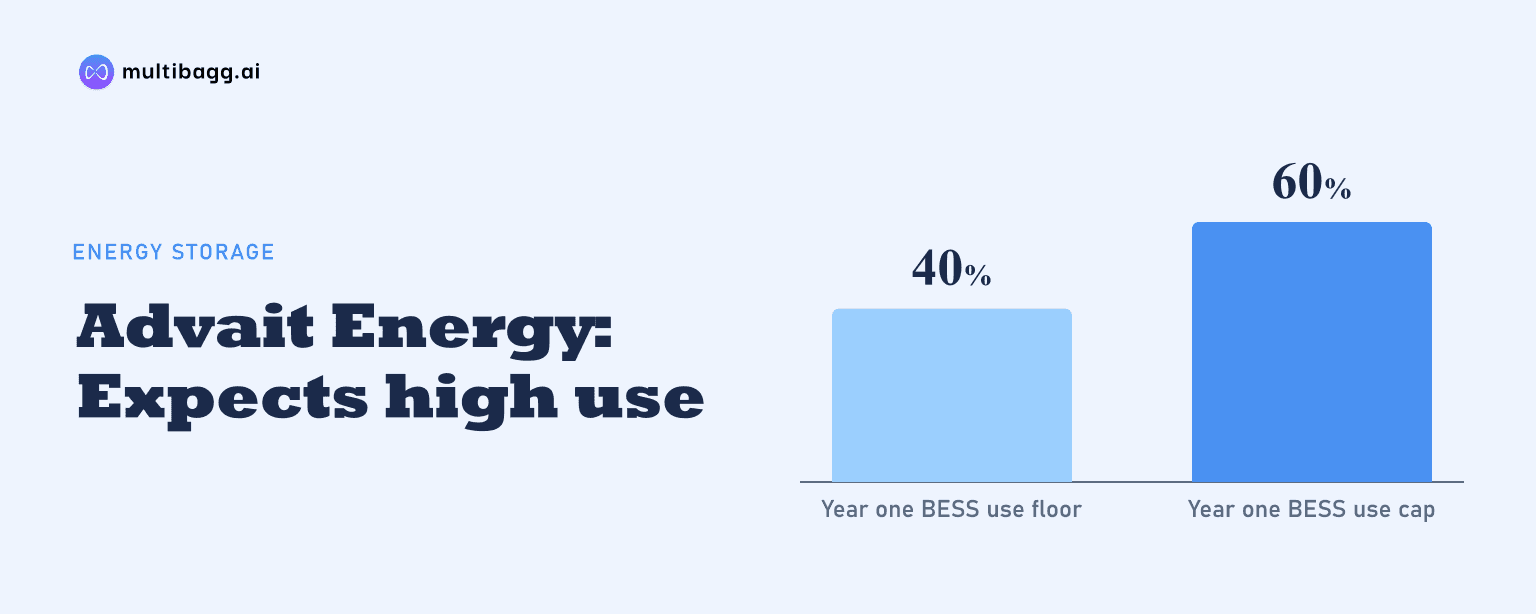
Advait Energy Transitions Limited expects its planned 2.5-gigawatt-hour battery energy storage system plant to run at 40%-60% utilisation in its first year, equal to 1-1.5 GWh of used capacity. Management also said a fully utilised GWh could generate Rs 1,000-1,100 crore of revenue, depending on supply scope and project type.
Know Advait Energy Transitions inside out
Results, valuation, peers and who's buying, in one view.
What utilisation does Advait Energy Transitions expect at its BESS plant?
Advait Energy Transitions expects 40%-60% capacity utilisation in the first year of its planned 2.5-GWh battery energy storage system, or BESS, plant. Vatsal Kundalia provided the range while responding to an investor question about the following year's capacity use, without disclosing a contracted order volume or a formal BESS revenue forecast.
The stated range equates to 1-1.5 GWh of utilised annual capacity. At 40% use, 1.5 GWh of the 2.5-GWh facility would remain unused; at 60% use, the unused portion would be 1 GWh. This comparison describes the plant's initial ramp-up rather than its full operating potential.
In a later exchange, an investor referred to 40%-45% utilisation for the next year and Kundalia agreed. Management did not say whether the narrower 40%-45% range replaced the earlier 40%-60% indication or represented a point within that wider range, leaving the precise operating assumption unresolved.
How much revenue can each GWh of BESS capacity generate?
Advait Energy Transitions said 1 GWh of BESS capacity at 100% revenue utilisation could produce Rs 1,000-1,100 crore of revenue. Management qualified that scale by saying it is agnostic to the supply scope and the type of project, meaning it is not a fixed sales price or a company revenue commitment.
Applying management's per-GWh revenue scale to its 40%-60% utilisation range gives a calculated first-year range of Rs 1,000-1,650 crore. This is arithmetic, not guidance: the lower result assumes 1 GWh at Rs 1,000 crore per GWh, while the upper result assumes 1.5 GWh at Rs 1,100 crore per GWh.
The comparison shows that the first-year operating range is below the revenue scale possible at 100% utilisation of 2.5 GWh. At the lower calculated case, the difference is Rs 1,500 crore versus the Rs 2,500 crore full-utilisation scale at Rs 1,000 crore per GWh, although actual revenue would vary with project scope.
Will Advait Energy Transitions use BESS capacity internally or sell externally?
Advait Energy Transitions said only a few projects each year are expected to involve internal consumption, while it will largely seek open-market orders and tender opportunities. Management did not quantify the capacity share intended for captive projects, outside customers, public tenders or private developers.
The company identified public-market tenders and developer inquiries as channels for BESS demand. Kundalia said Advait Energy Transitions was working on those opportunities and would seek order booking after the plant is operationalised and commissioned, but the call did not disclose a bid pipeline in GWh or named customer contracts.
This external-order focus matters because management's Rs 1,000-1,100 crore per-GWh revenue scale depends on what is included in each contract. A project with a different equipment package, supply responsibility or scope may produce different revenue from another project using the same GWh of battery capacity.
Got a follow-up? Ask IRIS
How does BESS fit into Advait Energy Transitions' capacity plans?
Advait Energy Transitions has discussed a longer-term plan to raise BESS capacity to 5 GWh, compared with the planned 2.5-GWh facility now under discussion. An investor described this expansion as targeted for FY28-FY29, but management responded on market conditions and did not confirm a specific commissioning date for the 5-GWh level.
Management said other players are entering the BESS market, creating competition, while it expects to secure a share of future opportunities. The company described the market as lucrative, but did not provide a BESS market-share target, a capital-expenditure figure dedicated to the 5-GWh expansion or a timeline for additional capacity.
BESS forms part of a broader manufacturing and solutions transition. Narayan Singh said Advait Energy Transitions aims for manufacturing to account for more than 65%-75% of total sales by 2028-2029 or 2029-2030 while maintaining 55%-60% growth, and said product and technology solutions manufacturing could generate more than Rs 2,500 crore in sales at full capacity.
What funding and execution factors could affect the BESS ramp-up?
Advait Energy Transitions said capacity-based revenue calculations must be considered alongside capital allocation, cash flow and the company's ability to generate cash flow. Shalin Sheth said annual targets may be refined and noted that macroeconomic factors beyond the industry's control can affect the pace of execution and revenue conversion.
An investor referred to FY27 capital-expenditure guidance of around Rs 300-350 crore. Singh said Rs 101 crore had been incurred in H1 FY27 and that a further Rs 140 crore was planned for H2 FY27, taking the disclosed H1 and H2 amounts to Rs 241 crore; management did not explain the difference from the range cited by the investor.
Management also said it was in the process of raising funds, possibly in Q3 or Q4, including equity for working-capital requirements. Sheth said the targeted debt-to-equity ratio for the manufacturing and solutions business would be about 0.5-0.7 times, while cautioning that the ratio could change as the business model and asset base develop.
Conclusion
The BESS disclosure provides an initial operating range of 40%-60% for a planned 2.5-GWh plant, equal to 1-1.5 GWh of first-year capacity use. Combined with management's Rs 1,000-1,100 crore full-utilisation revenue scale per GWh, this gives a calculated Rs 1,000-1,650 crore range, but not a formal forecast because project scope and order conversion remain unspecified.
The next points to watch are operationalisation and commissioning of the 2.5-GWh plant, BESS order booking from tenders and developer inquiries, and clarification of the 40%-60% versus 40%-45% utilisation references. Management also disclosed possible Q3 or Q4 equity funding and Rs 140 crore of planned H2 FY27 capital expenditure, both relevant to working capital and execution.