










Advait Q2 profit rises 89% as EBITDA margin reaches 14.5%
Key highlights
- Advait’s Q2 FY27 revenue rose 40.8% year on year to Rs 221 crore.
- Advait’s Q2 FY27 PAT increased 88.5% year on year to Rs 19 crore.
- Advait’s Q2 FY27 EBITDA margin rose to 14.5% from 11% in Q2 FY26.
- Advait’s debt-to-equity ratio was 0.86 times at the H1 FY27 end, versus 0.42 times in March 2026.
powered by IRIS
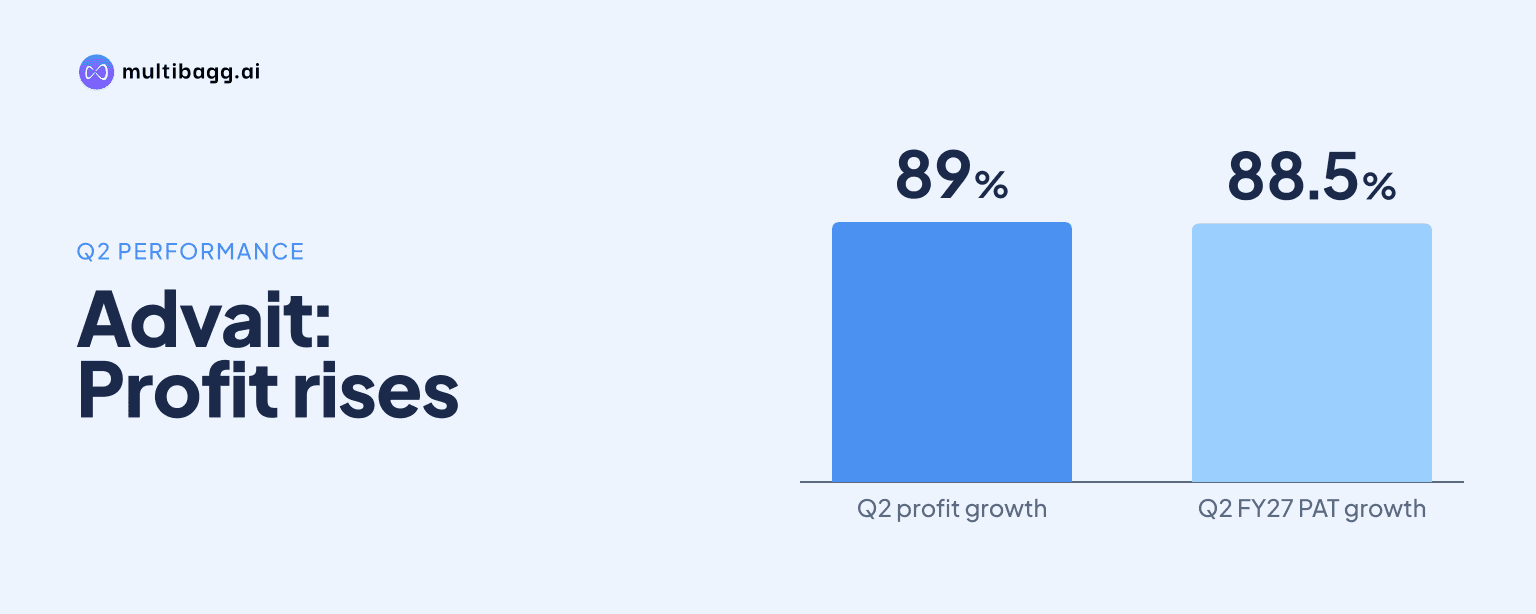
Advait Energy Transitions Limited reported profit after tax of Rs 19 crore in Q2 FY27, up 88.5% year on year, while earnings before interest, tax, depreciation and amortisation margin rose to 14.5% from 11%. Revenue increased 40.8% to Rs 221 crore, meaning profit growth outpaced sales growth in the September 2026 quarter.
Know Advait Energy Transitions inside out
Results, valuation, peers and who's buying, in one view.
What drove Advait’s Q2 FY27 profit increase?
Advait’s Q2 FY27 profit rose faster than revenue because EBITDA grew 84.4%, compared with revenue growth of 40.8%. Revenue from operations reached Rs 221 crore from Rs 157 crore in Q2 FY26. EBITDA was Rs 32 crore in Q2 FY27, and the EBITDA margin increased by 3.5 percentage points to 14.5% from 11% in the corresponding quarter a year earlier.
Profit after tax, or PAT, rose to Rs 19 crore from Rs 10 crore in Q2 FY26, while PAT margin increased to 8.7% from 6.5%. The reported margin changes show that earnings expanded faster than sales during the quarter. Management did not quantify product pricing, input costs, project mix or segment-level profitability on the November 2, 2026 earnings call, so the transcript does not identify a single operating factor behind the expansion.
How did Advait’s first-half FY27 performance compare with last year?
Advait’s H1 FY27 results also showed EBITDA and PAT growing faster than revenue. Revenue from operations for the six months ended September 2026 was Rs 400 crore, up 45.4% from Rs 275 crore in H1 FY26. EBITDA rose 82.6% to Rs 57 crore, and EBITDA margin increased to 14.2% from 11.3% in the prior-year half.
H1 FY27 PAT was Rs 34 crore, up 77.9% from Rs 19 crore in H1 FY26, and PAT margin rose to 8.5% from 6.9%. The Q2 EBITDA margin of 14.5% was 0.3 percentage points above the H1 margin of 14.2%, while the Q2 PAT margin of 8.7% was 0.2 percentage points above the half-year figure. These comparisons indicate that the reported margin improvement continued into the September quarter.
Advait also disclosed Rs 400 crore of executed orders during H1 FY27. Its consolidated order book, including L1 positions, stood at about Rs 1,575 crore as of September 30, 2026, up 47% year on year. L1 means the lowest-bidder position and does not necessarily represent a final order award; the call did not provide an order-book figure excluding L1 positions.
Why did Advait’s borrowings and capital expenditure increase?
Advait’s gross borrowings were Rs 280 crore at the end of H1 FY27, and its debt-to-equity ratio increased to 0.86 times from 0.42 times at March 2026. Consolidated net worth was Rs 326 crore at the September 2026 half-year end. The 0.44-times increase in the ratio came during a period when the company was funding manufacturing and energy-storage expansion projects.
Chief Financial Officer Narayan Singh said incremental capital expenditure in H1 FY27 was Rs 101 crore, compared with Rs 59 crore in FY26. He also referred to anticipated incremental capex of around Rs 140 crore, of which Rs 100 crore was to be funded through debt, although the transcript describes this anticipated spending as H1 FY27 after the period had ended. The company did not disclose interest costs, repayment maturities or a cash-flow reconciliation on the call.
The disclosed capex programme includes Phase 1 of an integrated manufacturing facility at Gangad, Gujarat, expected to be operational by Q4 FY27. Advait has also placed final plant-and-machinery orders for a 2.5-gigawatt-hour battery energy storage system, or BESS, manufacturing facility, expandable to 5 gigawatt-hours, with operations also expected by Q4 FY27.
Got a follow-up? Ask IRIS
What order pipeline and manufacturing plans does Advait have?
Advait’s current order book is weighted toward power transmission solutions, while management expects new and renewable energy to gain share over the next 1.5 to two years. Management estimated that power transmission solutions represented about 60% to 65% of the order book and new and renewable energy represented 35%. It said the two businesses could become equal in order-book share, or new and renewable energy could become larger, which is management’s plan rather than a reported result.
In power transmission, Advait received distribution-related orders worth about Rs 52 crore from Dakshin Gujarat Vij Company Limited and multiple orders from Paschim Gujarat Vij Company Limited. Management also cited orders covering emergency restoration systems, optical ground wire, stringing tools and upcoming facilities. It estimated that public-sector customers accounted for roughly 60% to 65% of the order book and private customers for about 40%, while saying collections from public clients had been as efficient as private-sector collections over the preceding three to four years.
In new and renewable energy, Advait secured a 150-megawatt, 300-megawatt-hour standalone BESS order in Junagadh, Gujarat. It also signed a battery-cell take-off agreement with HiTHIUM for its order pipeline and said its 5-megawatt live electrolyser testing programme had engaged more than 13 Indian green-hydrogen players. The call did not disclose the BESS order’s value, delivery timing or expected revenue contribution.
How is Advait planning to change its business mix?
Advait plans to increase manufacturing’s share of its business from about 38% currently to 70% to 75% in FY2028-29. Management said engineering, procurement and construction, or EPC, solutions presently account for about 60% to 62% of the business. The targeted shift is tied to manufacturing facilities now being developed rather than to an already completed change in revenue mix.
Management said it expects new order inflow over the next year to be split 50% between power transmission solutions and new and renewable energy. Within power transmission, it expects an equal division between EPC and manufacturing. It also cited its planned 150-megawatt Phase 1 electrolyser plant, which management described as about 3% to 4% of current requirement, but did not give an operational date or revenue estimate for that facility.
Conclusion
Advait’s Q2 and H1 FY27 figures show profit and EBITDA growth exceeding revenue growth, supported by higher reported margins. The company combined Q2 PAT of Rs 19 crore and a 14.5% EBITDA margin with an order book of about Rs 1,575 crore including L1 positions, while its debt-to-equity ratio rose to 0.86 times as capital expenditure increased.
The next disclosed milestones are the expected Q4 FY27 operationalisation of Gangad Phase 1 and the 2.5-gigawatt-hour BESS plant. Investors can also watch execution against management’s plan to raise manufacturing to 70% to 75% of the business by FY2028-29, its expected 50:50 order-inflow split between power transmission and new and renewable energy, and further clarity on debt-funded capex.