










AEFC H1 cash flow rises as working capital absorbs ₹95.2 crore
Key highlights
- AEFC generated ₹75.2 crore of net operating cash flow in H1FY27, compared with ₹60.7 crore in H1FY26.
- Working-capital changes consumed ₹95.2 crore in H1FY27, versus ₹14.5 crore in H1FY26.
- AEFC recorded a ₹107.1 crore investing cash outflow in H1FY27, above its ₹75.2 crore operating cash inflow.
- Cash and cash equivalents were ₹7.0 crore at 31 March in AEFC’s H1FY27 cash-flow table.
powered by IRIS
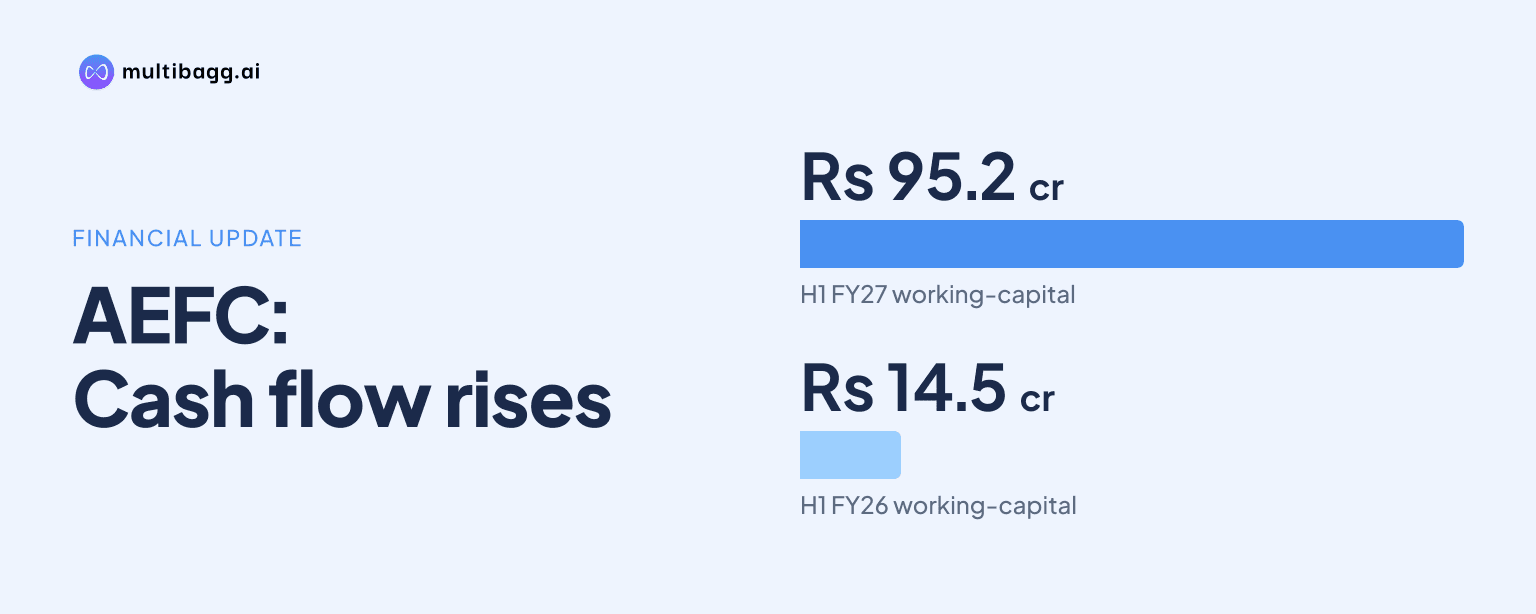
AEFC generated ₹75.2 crore of net operating cash flow in H1FY27, up from ₹60.7 crore in H1FY26, but working-capital changes consumed ₹95.2 crore versus ₹14.5 crore a year earlier. The larger outflow limited cash generated from operations to ₹77.0 crore despite operating profit before working-capital changes rising to ₹172.3 crore.
Know EFC (I) inside out
Results, valuation, peers and who's buying, in one view.
How did AEFC’s H1FY27 operating cash flow change?
AEFC’s net cash from operating activities rose by ₹14.5 crore to ₹75.2 crore in H1FY27 from ₹60.7 crore in H1FY26. Cash generated from operations was ₹77.0 crore, only ₹0.4 crore above ₹76.6 crore a year earlier, while direct taxes paid fell to ₹1.8 crore from ₹15.9 crore.
Operating profit before working-capital changes increased by ₹81.2 crore to ₹172.3 crore in H1FY27 from ₹91.1 crore in H1FY26. Profit before tax in the cash-flow statement was ₹212.2 crore, compared with ₹141.6 crore, and adjustments for non-operating items were negative ₹39.9 crore versus negative ₹50.5 crore.
Why did working capital absorb ₹95.2 crore of AEFC cash?
Working-capital changes used ₹95.2 crore in H1FY27, compared with ₹14.5 crore in H1FY26, increasing cash consumption by ₹80.7 crore. AEFC’s cash-flow statement does not provide a component-by-component reconciliation, so it does not identify the respective effects of receivables, inventory, other assets, payables or liabilities.
Several current balance-sheet lines changed between H1FY26 and H1FY27. Inventories rose to ₹54.1 crore from ₹37.51 crore, while other current assets rose to ₹311.3 crore from ₹135.58 crore. Trade receivables declined to ₹239.8 crore from ₹244.65 crore, so the receivables balance alone does not account for the reported working-capital outflow.
Current liabilities also increased in selected categories. Trade payables other than micro and small enterprise dues rose to ₹165.0 crore from ₹110.5 crore, other financial liabilities rose to ₹189.0 crore from ₹87.4 crore, and micro and small enterprise dues rose to ₹36.4 crore from ₹32.5 crore. AEFC does not connect these individual balance-sheet movements to the ₹95.2 crore cash-flow line.
Did AEFC’s operating profit translate into operating cash?
AEFC translated ₹172.3 crore of operating profit before working-capital changes into ₹75.2 crore of net operating cash flow in H1FY27 after the ₹95.2 crore working-capital outflow and ₹1.8 crore of direct taxes paid. In H1FY26, ₹91.1 crore of operating profit before working-capital changes became ₹60.7 crore of net operating cash flow after a ₹14.5 crore working-capital outflow and ₹15.9 crore of direct taxes.
The comparison shows that the pre-working-capital operating-profit measure rose substantially, whereas cash generated from operations was nearly unchanged at ₹77.0 crore versus ₹76.6 crore. The higher working-capital cash requirement absorbed most of the ₹81.2 crore increase in operating profit before working-capital changes.
AEFC’s consolidated profit and loss statement separately reports H1FY27 revenue from operations of ₹61.49 crore, up from ₹47.42 crore, and earnings before interest, tax, depreciation and amortisation, or EBITDA, of ₹25.67 crore versus ₹21.31 crore. Those figures are presented in ₹ million in the source and convert to crore, while the cash-flow table reports profit before tax in ₹ crore; the supplied pages do not reconcile the differing profit-before-tax amounts.
Got a follow-up? Ask IRIS
How much cash did AEFC invest and finance in H1FY27?
AEFC reported a ₹107.1 crore cash outflow from investing activities in H1FY27, compared with a ₹46.9 crore outflow in H1FY26. The H1FY27 investing outflow exceeded the ₹75.2 crore net operating cash inflow by ₹31.9 crore, and the presentation does not itemise the investments, assets or transactions behind that outflow.
Cash flow from financing activities was an inflow of ₹28.4 crore in H1FY27, against an outflow of ₹3.2 crore in H1FY26. The operating inflow, investing outflow and financing inflow resulted in a ₹3.5 crore net decrease in cash and cash equivalents, compared with a ₹10.6 crore increase in H1FY26.
What happened to AEFC’s cash balance?
AEFC reported ₹7.0 crore of cash and cash equivalents at 31 March in its H1FY27 cash-flow table, after a ₹3.5 crore net decrease from an opening balance of ₹10.5 crore. The H1FY26 table reported ₹27.7 crore at 31 March after a ₹10.6 crore increase from ₹17.1 crore.
The consolidated balance sheet also lists cash and cash equivalents of ₹7.0 crore for H1FY27 and ₹10.50 crore for H1FY26. It separately lists cash at bank of ₹131.4 crore in H1FY27, compared with ₹77.80 crore in H1FY26, so these are separate disclosed balance-sheet classifications rather than figures that can be combined without a reconciliation.
Conclusion
AEFC’s H1FY27 cash-flow statement shows that net operating cash flow rose to ₹75.2 crore, but the ₹95.2 crore working-capital outflow largely offset growth in operating profit before working-capital changes to ₹172.3 crore. The ₹107.1 crore investing outflow also exceeded operating cash generation of ₹75.2 crore, resulting in a ₹3.5 crore decline in cash and cash equivalents.
The next reported period will show whether the ₹95.2 crore working-capital outflow changes and whether investing cash spending remains above operating cash inflow. AEFC disclosed no working-capital target, cash-flow forecast or itemised plan for the ₹107.1 crore H1FY27 investing outflow in the supplied presentation, leaving those matters unresolved.