










EFC review qualified over Rs 76.38 crore unbilled revenue
Key highlights
- EFC’s auditors qualified the September 30, 2026 consolidated review over Rs 76.38 crore of unbilled revenue.
- EFC reported Rs 18.95 crore of receivables overdue by more than six months, including Rs 8.31 crore overdue by more than one year.
- Customer confirmations for work supporting the Rs 76.38 crore contract asset were still awaited at the review date.
- The report was dated November 3, 2026 and covered 22 subsidiaries reviewed by other auditors.
powered by IRIS
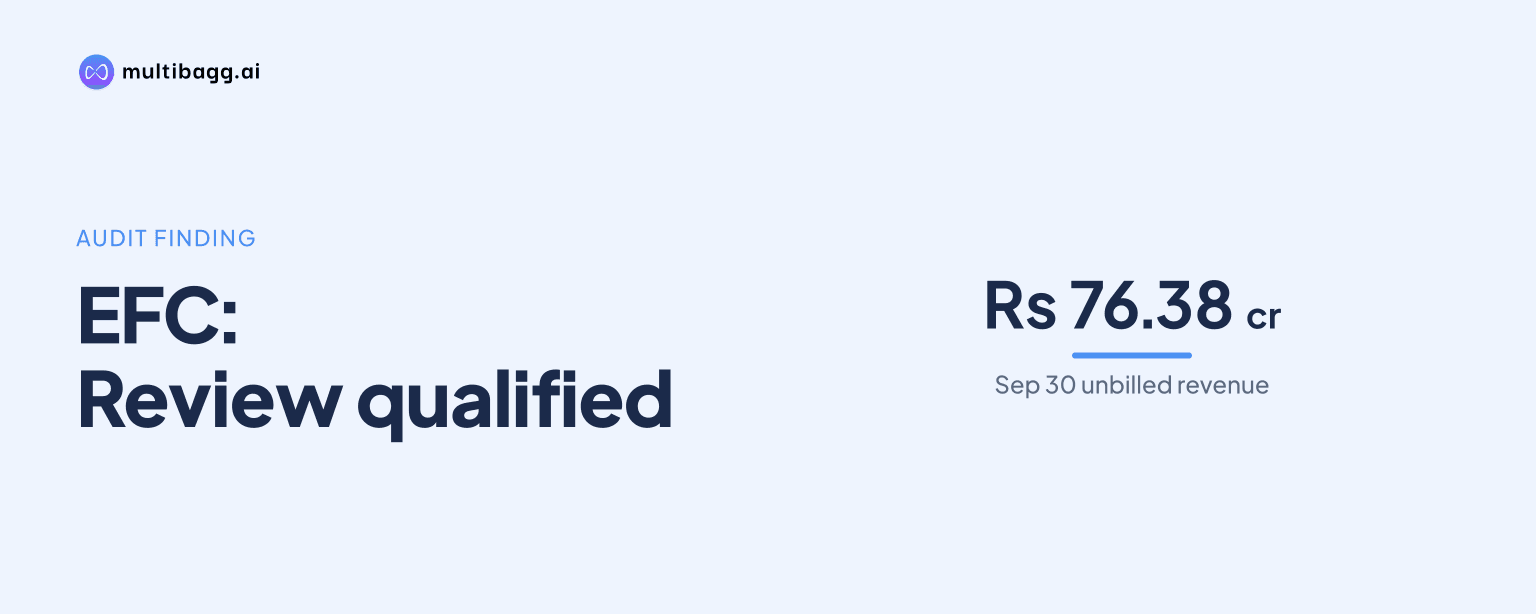
EFC (I) Limited received a qualified conclusion on its consolidated results for the quarter and half year ended September 30, 2026, after auditors could not obtain sufficient review evidence on Rs 76.38 crore of unbilled revenue and the adequacy of credit-loss allowance on Rs 18.95 crore of aged receivables.
Know EFC (I) inside out
Results, valuation, peers and who's buying, in one view.
Why did EFC receive a qualified review conclusion?
EFC received a qualified conclusion because two balance-sheet assessments remained unresolved at the September 30, 2026 review date: customer confirmation of Rs 76.38 crore recorded as unbilled revenue, and the recoverability and expected credit-loss assessment of Rs 18.95 crore of trade receivables overdue by more than six months. The auditors said the possible effects of these matters were the exception to their conclusion on the consolidated financial results.
The report, dated November 3, 2026, was a limited review under the Standard on Review Engagements 2410 rather than a full audit. The auditors stated that a review relies primarily on inquiries and analytical procedures, has substantially less scope than an audit, and does not provide assurance that every significant matter would be identified. Their qualification therefore concerns the sufficiency of review evidence on the two specified balances, not a quantified adjustment.
The Rs 76.38 crore unbilled-revenue balance is more than four times the Rs 18.95 crore of receivables aged beyond six months. That comparison distinguishes the two matters: the first concerns whether revenue should remain recognised before billing under contractual milestones, while the second concerns whether an allowance is sufficient against amounts already recorded as trade receivables.
How did EFC recognise the Rs 76.38 crore unbilled revenue?
EFC recognised the Rs 76.38 crore within other current assets under Indian Accounting Standard 115, or Ind AS 115, using an input method based on cost-to-cost or stage of completion for work performed but not yet billed. The reported revenue relates to contractual milestones that had not yet been invoiced as of September 30, 2026.
Management determined the stage of completion using certificates from independent technical experts, who assessed physical progress against the approved scope and cost estimates. On the basis of work executed, technical certification and contractual terms, management said the contract assets were fully recoverable and no adjustment to recognised revenue was required. However, the auditors qualified their conclusion because customer confirmations of the work done were still awaited at the review date.
The distinction is important because technical certification supported management’s measurement of progress, while customer confirmation was the evidence the auditors said had not yet been obtained. The filing says EFC was in the process of obtaining those confirmations and expected them in due course, but it does not provide a completion date or disclose any customer response as of November 3, 2026.
Got a follow-up? Ask IRIS
What is unresolved about EFC’s aged receivables?
EFC had Rs 18.95 crore of receivables outstanding for more than six months at September 30, 2026, including Rs 8.31 crore outstanding for more than one year. Management said it was actively following up with customers to recover these balances, but its assessment of recoverability and expected credit loss, or ECL, had not been finalised by the report date.
The auditors also said balance confirmations and details of subsequent realisation were not finalised. As a result, they could not obtain sufficient appropriate review evidence to determine whether the ECL allowance recognised on the overdue balances was adequate. The unresolved question is therefore not simply whether Rs 18.95 crore will be collected, but whether the receivable carrying amount and the related loss for the September quarter and half year require adjustment.
Of the Rs 18.95 crore overdue for more than six months, Rs 10.64 crore was outstanding for between six months and one year, calculated by subtracting the Rs 8.31 crore overdue beyond one year. The filing does not split the ECL allowance by age bucket, customer, or subsidiary, so it does not allow the potential amount of any further charge to be calculated.
How does the qualification affect EFC’s consolidated results?
EFC’s auditors said that, except for the possible effects of the two qualified matters, nothing had come to their attention to indicate that the September 30, 2026 consolidated statement failed to meet the disclosure requirements of Regulation 33 of the Securities and Exchange Board of India Listing Regulations or contained a material misstatement. This wording does not establish that either the Rs 76.38 crore revenue asset or the Rs 18.95 crore aged-receivable balance will be adjusted.
The consolidated review also incorporated 22 subsidiaries whose interim financial results were reviewed by other auditors. The principal auditors relied on those other review reports for the subsidiaries’ amounts and disclosures, and said their conclusion was not modified because of that reliance. Separately, comparative information included Whitehills Interior Limited following its merger with EFC effective November 28, 2025, with prior-period information relied upon from preceding auditors.
The filing identifies a narrow accounting-evidence issue rather than a revision to reported numbers. Any eventual effect could fall on revenue if customer confirmation does not support the stage-of-completion contract asset, or on profit and receivable carrying values if the final ECL assessment requires a larger allowance under Indian Accounting Standard 109, or Ind AS 109.
Conclusion
EFC’s qualified consolidated review centres on two unresolved assessments at September 30, 2026: Rs 76.38 crore of revenue recognised before billing under milestone contracts, and Rs 18.95 crore of receivables overdue beyond six months. Management supported the unbilled balance with technical certificates and said it expected full recovery, while auditors said confirmation and final recovery evidence were insufficient for an unqualified review conclusion.
The next disclosures to watch are customer confirmations for the contract assets, subsequent collections and balance confirmations for the aged receivables, and EFC’s completed ECL assessment. The November 3, 2026 report does not set a timetable for either process, so a later financial result or audit filing would be needed to show whether any revenue, receivable or loss adjustment is recorded.