










Aegis Logistics LPG margin stays near Rs 7,000 a tonne in Q2
Key highlights
- Aegis said its Q2 FY27 LPG distribution margin was around Rs 7,000 a tonne, versus roughly Rs 4,000 in 2024-25.
- Aegis distributed 2.41 lakh metric tons of LPG in Q2 FY27, up 25% year on year.
- Aegis's LPG segment EBITDA rose 34% year on year to Rs 309.25 crore in Q2 FY27.
- Aegis reported H1 FY27 distribution volume of 5.18 lakh metric tons, up 54% year on year.
powered by IRIS
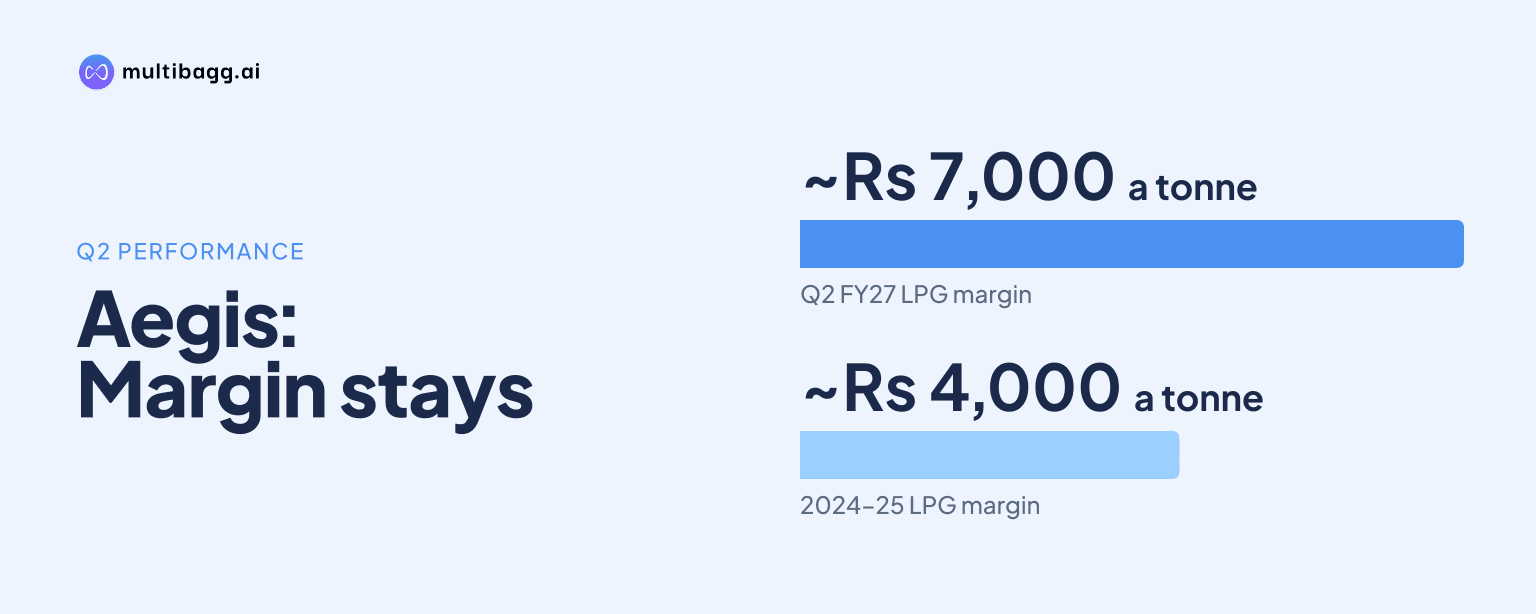
Aegis Logistics said its LPG distribution margin remained around Rs 7,000 a tonne in Q2 FY27 after supply conditions normalised, compared with roughly Rs 4,000 historically in 2024-25. Management attributed the difference to supply-chain efficiencies from larger terminals, larger vessels, partnerships and customer relationships rather than LPG price-setting power.
Know Aegis Vopak Terminals inside out
Results, valuation, peers and who's buying, in one view.
Why did Aegis's LPG distribution margin remain near Rs 7,000 a tonne?
Aegis said its Q2 FY27 distribution margin of around Rs 7,000 a tonne was supported by lower supply-chain costs after earlier supply disruptions had eased. Murad Moledina said Q1 FY27 had been affected by geopolitical conditions and a price-led margin, so management did not consider a sequential comparison with Q2 appropriate.
Management compared the Q2 FY27 outcome with a historical margin of around Rs 4,000 a tonne in 2024-25, a difference of about Rs 3,000 a tonne. Aegis said it follows market LPG prices rather than setting them, and linked the higher margin to procurement and logistics efficiencies developed over the previous 1.5 years.
What infrastructure supports Aegis's LPG cost efficiency?
Aegis said larger terminals enable the unloading of larger LPG vessels, reducing freight costs and limiting demurrage, or charges arising from vessel delays. It commissioned a 48,000-metric-ton cryogenic LPG addition at Pipavav in the previous year, taking that terminal's capacity to 70,000 metric tons, and also commissioned an 82,000-metric-ton terminal at Mangalore.
Management said its facilities can unload ships carrying as much as 50,000 metric tons in 24 hours. It said the Mangalore terminal opened a new distribution geography, while the six-terminal network across Kandla, Pipavav, Mumbai, JNPA, Mangalore and Haldia would be able to handle around 29 million tons once JNPA is operational.
Aegis said it held more than 30% of India's LPG static capacity at the time of the call. Raj Chandaria said the network also includes rail and pipeline evacuation infrastructure, while management cited that broader logistics system, alongside large storage capacity, as part of the mechanism behind the Q2 FY27 margin.
Did LPG volumes and earnings rise with the margin?
Yes. Aegis's distribution business handled 2.41 lakh metric tons in Q2 FY27, up 25% from Q2 FY26, and 5.18 lakh metric tons in H1 FY27, up 54% year on year. Management attributed the volume increase to customer additions and demand, with the newer large terminals providing capacity for distribution growth.
LPG segment earnings increased alongside those volumes. Q2 FY27 earnings before interest, tax, depreciation and amortisation, or EBITDA, rose 34% year on year to Rs 309.25 crore, while H1 FY27 LPG EBITDA increased 137% to Rs 900 crore. The company did not provide a numerical breakdown between volume, margin and other drivers of the first-half EBITDA increase.
Management said Aegis was on course to reach 1 million tons of distribution volume in FY27 if the H1 FY27 pace continued. That statement was a volume expectation rather than formal guidance for the Rs 7,000-per-tonne margin.
Got a follow-up? Ask IRIS
How did Aegis's overall financial performance change in Q2 FY27?
Aegis reported Q2 FY27 revenue of Rs 2,213 crore, compared with Rs 2,294 crore in the corresponding quarter, while normalised segment EBITDA increased 32% to Rs 456 crore from Rs 347 crore. Profit after tax rose 32% to Rs 321 crore from Rs 244 crore, and earnings per share increased 45% to Rs 7.42.
For H1 FY27, revenue rose 14% year on year to Rs 4,570 crore, normalised segment EBITDA grew 97% to Rs 1,184 crore, and profit after tax increased 108% to Rs 866 crore. Earnings per share reached Rs 21.23, compared with Rs 8.86 in H1 FY26, but these company-level figures include businesses beyond LPG distribution.
The liquid division also reported Q2 FY27 revenue growth of 21% to Rs 187 crore and EBITDA growth of 27% to Rs 147 crore. In H1 FY27, liquid revenue increased 22% to Rs 366 crore and EBITDA rose 28% to Rs 284 crore, while management said liquid storage capacity was 2 million cubic metres.
What could affect Aegis's LPG margin from here?
Aegis said the current margin rests on its supply-chain structure, including large storage, larger-vessel unloading, procurement relationships and customer relationships, rather than on a pricing advantage. Management did not provide a formal future margin range, storage-utilisation figure or incremental distribution-cost estimate during the November 3, 2026 call.
The JNPA terminal remains relevant to the operating plan because management linked the future six-terminal network and 29-million-ton handling capacity to its logistics model. The company also said the Mangalore terminal created a new distribution geography, so future throughput and customer additions in that market will be part of the operating evidence for the efficiency explanation.
Conclusion
Aegis's message was that its approximately Rs 7,000-per-tonne LPG distribution margin in Q2 FY27 reflected a changed logistics cost base rather than unusually favourable supply conditions. The comparison with about Rs 4,000 in 2024-25, together with 25% Q2 distribution-volume growth and 34% LPG EBITDA growth, supports management's account of terminal scale and vessel handling as important contributors.
The next disclosed operating milestone is management's expectation of reaching 1 million tons of distribution volume in FY27, after 5.18 lakh metric tons in H1 FY27. Progress on JNPA and the resulting six-terminal network will also matter because management tied larger capacity and access to larger vessels to the efficiencies supporting the current margin.