










Aegis Logistics plans US$809 million Tristar global expansion
Key highlights
- Aegis signed an October 13, 2026 agreement to acquire 89.8% of Tristar for US$809 million.
- Aegis reported H1 FY27 EBITDA of Rs 1,184 crore and profit after tax of Rs 866 crore.
- Aegis Gas Division H1 FY27 EBITDA was Rs 900 crore, up 137% year on year.
- The Kandla-Gorakhpur LPG pipeline was reported as about 96% physically complete.
powered by IRIS
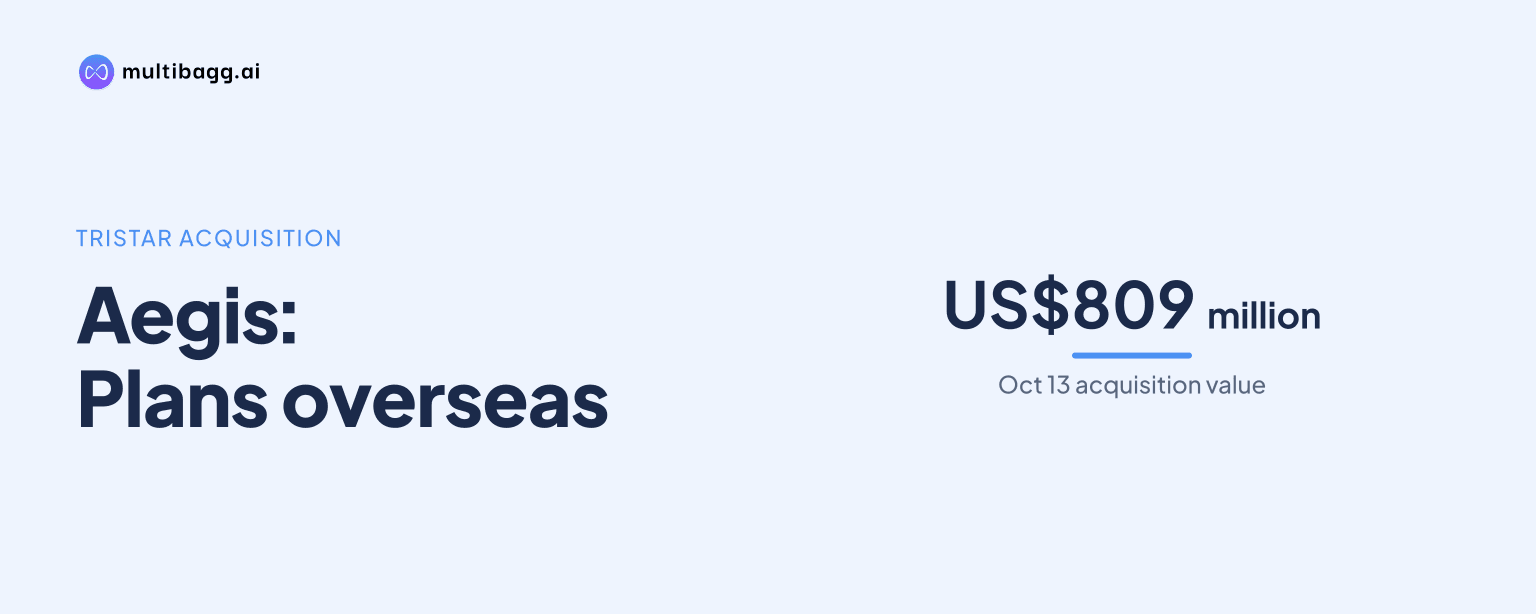
Aegis Logistics Limited plans to acquire an 89.8% stake in Dubai-headquartered Tristar Holdings Limited for US$809 million, under a definitive agreement signed on October 13, 2026 and targeted to close in Q4 FY27. Management said the proposed transaction would move Aegis from a predominantly India-focused operator towards a global integrated energy-logistics platform.
Know Aegis Vopak Terminals inside out
Results, valuation, peers and who's buying, in one view.
Why is Aegis acquiring Tristar?
Aegis is acquiring Tristar to combine its domestic infrastructure and integrated logistics operations with Tristar’s international network, diversified services and established global customer relationships. The October 13, 2026 agreement covers an 89.8% holding in Tristar, an integrated energy-logistics company headquartered in Dubai with global operations.
Management described the proposed purchase as a shift from a predominantly India-focused business towards a global integrated energy-logistics platform. Its stated rationale is greater scale, geographic diversification and earnings potential, as well as operational and commercial synergies between Aegis’s domestic capabilities and Tristar’s international network.
The transaction has not closed. Management expects completion in Q4 FY27, subject to regulatory approvals and customary closing conditions, and said it expects to provide more detail on the benefits while progressing towards completion. The November 3, 2026 conference call also stated that forward-looking comments reflected management’s beliefs and expectations on that date and did not guarantee future performance.
What financial base is Aegis bringing to the deal?
Aegis reported H1 FY27 revenue of Rs 4,570 crore, earnings before interest, tax, depreciation and amortisation, or EBITDA, of Rs 1,184 crore, and profit after tax of Rs 866 crore. Management said H1 FY27 profit after tax doubled from H1 FY26, while earnings per share reached Rs 21.23, up 140% year on year.
For Q2 FY27, Aegis recorded revenue of Rs 2,213 crore, EBITDA of Rs 456 crore and profit after tax of Rs 321 crore. EBITDA and profit after tax each rose 32% year on year, while earnings per share of Rs 7.42 was 45% higher. The H1 totals exceed Q2 because they include two quarters, while the Q2 figures show that the reported year-on-year increase continued during the second quarter.
Within Aegis, the Gas Division produced H1 FY27 EBITDA of Rs 900 crore, up 137% year on year, compared with Rs 284 crore in the Liquid Division. The Liquid Division reported Rs 366 crore of revenue and a 78% EBITDA margin, its highest first-half performance, while management attributed the Gas Division’s larger EBITDA contribution to its integrated business model and market opportunities.
Which operating trends and projects support Aegis’s strategy?
Aegis said Gas Division logistics volumes increased 19% from the previous quarter, while distribution volumes rose 25% year on year in Q2 FY27 and 54% year on year in H1 FY27. Management attributed the increase to capacity additions in the previous year, wider geographic reach and the addition of ammonia, rather than mainly to favourable market conditions.
The distribution operation added several private-sector customers over the year, according to management, while sourcing volumes declined because certain contracts expired. Management also said sourcing volumes exclude Aegis’s own distribution volumes. As a result, the 54% H1 FY27 distribution increase is not a comparable measure of sourcing activity.
At Mumbai, Aegis is developing 64,000 cubic metres of additional liquid storage with investment of Rs 125 crore and expects gradual commissioning during the year. At Jawaharlal Nehru Port Authority, or JNPA, Aegis commissioned an LPG, or liquefied petroleum gas, bottling plant with annual capacity of 35,000 metric tons on October 15, 2026.
The larger JNPA greenfield programme comprises 318,000 cubic metres of additional liquid storage and about 77,286 metric tons of LPG storage. Management expects the first liquid-storage phase of about 100,000 cubic metres to be commissioned in Q3 FY27. These projects add capacity alongside the proposed Tristar transaction, but management did not quantify their expected earnings contribution.
Got a follow-up? Ask IRIS
How do Aegis Vopak Terminals’ projects fit the expansion?
Aegis Vopak Terminals Limited, or AVTL, reported Q2 FY27 revenue of Rs 271 crore, up about 17% year on year, and EBITDA of Rs 212 crore, up 22%. Profit after tax was Rs 96 crore, lower year on year, which management attributed mainly to higher finance costs and tax despite the increase in revenue and EBITDA.
For H1 FY27, AVTL’s revenue rose 15% year on year to Rs 505 crore and EBITDA increased 19% to Rs 392 crore, supported by commissioned capacity ramp-ups and the Liquid business. Profit after tax was Rs 166 crore, while earnings per share fell to Rs 1.38 from Rs 1.49, reflecting the higher finance and tax costs cited by management. Thus, EBITDA grew faster than revenue in both H1 and Q2, but half-year earnings per share declined.
At Kandla, AVTL has 952,000 cubic metres of liquid storage and 48,000 metric tons of static LPG storage. Its CRL-4 liquid terminal is intended to add 94,148 cubic metres, with commissioning targeted for the next financial year. Management cited a CRISIL Ratings report that described the 1,958-kilometre Kandla-Gorakhpur LPG pipeline as about 96% physically complete, with the Kandla-Lucknow section charged with LPG.
Pipavav’s ammonia terminal has 36,000 metric tons of specialised storage and a 15-year take-or-pay agreement with Hindustan Zinc. Management said ITOCHU Corporation has acquired a 10% stake in Aegis Terminal Pipavav Limited and intends to increase it to 25% over the next three years. It also cited planned VLGC, or very large gas carrier, compliant jetty development by APM Terminals and future pipeline connectivity as additions to Pipavav’s LPG handling and evacuation options.
Conclusion
The proposed US$809 million Tristar purchase places an international expansion alongside Aegis’s H1 FY27 EBITDA of Rs 1,184 crore and profit after tax of Rs 866 crore. Management’s stated case is that Tristar’s overseas network, services and customer relationships could complement Aegis’s domestic infrastructure, while Gas Division distribution growth and terminal capacity additions provide an operating backdrop.
The next disclosed transaction milestone is the expected Q4 FY27 closing, subject to approvals and customary conditions. Other disclosed events to watch are the planned Q3 FY27 commissioning of about 100,000 cubic metres of JNPA liquid storage, the next-financial-year target for Kandla’s 94,148-cubic-metre CRL-4 terminal, and progress on the Kandla-Gorakhpur LPG pipeline, reported as about 96% physically complete.