










Aegis Logistics & Aegis Vopak Terminals Limited starts revenue
Key highlights
- Aegis said Pipavav take-or-pay revenue will begin later in FY27.
- Pipavav has a 36,000-metric-tonne ammonia tank and cost Rs 525 crore to build.
- Management put ammonia storage charges close to Rs 2,750 per tonne and potential distribution margin near Rs 7,000 per tonne.
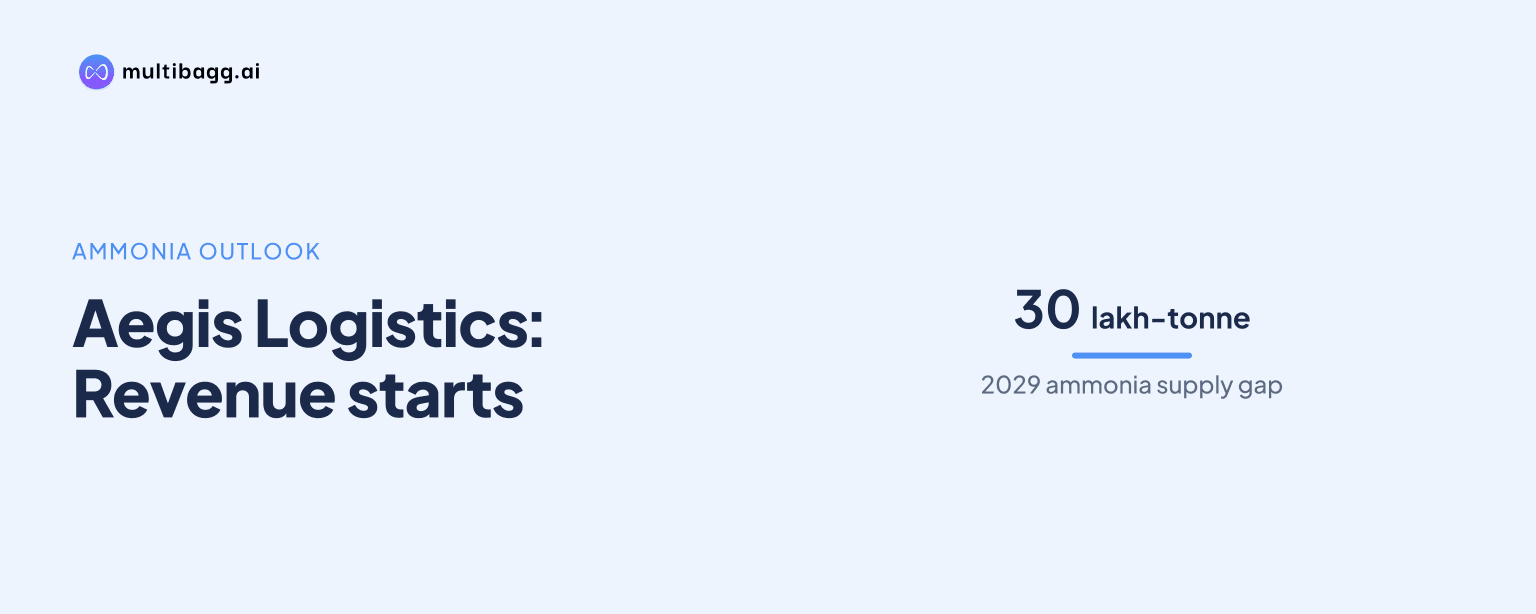
- Aegis cited a CRISIL estimate of a 30 lakh-tonne ammonia supply-demand gap by 2029.
powered by IRIS
Aegis Logistics & Aegis Vopak Terminals Limited says its 36,000-metric-tonne Pipavav ammonia terminal will begin take-or-pay revenue later in FY27, supported by a 15-year Hindustan Zinc contract. Aegis intends to combine storage charges of about Rs 2,750 per tonne with ammonia distribution economics that management compared with Rs 7,000 per tonne in liquefied petroleum gas.
Know Aegis Vopak Terminals inside out
Results, valuation, peers and who's buying, in one view.
When will Aegis begin take-or-pay revenue from Pipavav?
Aegis expects take-or-pay revenue from the commissioned Pipavav ammonia terminal to begin later in FY27. Management gave that timetable on November 3, 2026, when asked whether revenue would start immediately or only in FY28, replying that it would begin “this year, later this year.”
The facility is backed by a 15-year Hindustan Zinc contract, providing the commercial basis for its initial take-or-pay revenue. Management did not disclose the precise FY27 start date, contracted annual throughput, tariff under the agreement or annual revenue, leaving the early contribution dependent on details not provided during the call.
How will Aegis generate income from Pipavav ammonia?
Aegis intends to generate income from ammonia sourcing, storage and distribution rather than from storage alone. Management said the Pipavav model would involve procuring ammonia for Indian customers, storing it in the terminal and distributing it onward, extending the company’s logistics role across the supply chain.
Management put storage charges at close to Rs 2,750 per metric tonne and said ammonia distribution margin could be similar to its liquefied petroleum gas, or LPG, distribution margin of about Rs 7,000 per tonne. These two components imply approximately Rs 10,000 per tonne of combined storage charges and distribution margin when Aegis performs both functions, before operating costs and depending on the customer and service mix.
The Rs 7,000-per-tonne comparison is a management view on potential ammonia distribution economics, not reported ammonia profitability. In the second quarter of FY27, Aegis said LPG distribution earnings before interest, tax, depreciation and amortisation, or EBITDA, per tonne were a shade above Rs 7,000, compared with around Rs 4,000 historically in FY25.
What capacity does the Pipavav terminal have?
Aegis has built Pipavav around a 36,000-metric-tonne single tank that can receive large ammonia cargoes. Management said the tank would enable large ships to bring ammonia into India and described this capability as a first for the country, with the larger cargo size intended to reduce freight costs per tonne.
Management also described the terminal as capable of handling 10 lakh tonnes annually and used 25% capacity utilisation as an illustration of its starting level. At that level, annual throughput would be 2.5 lakh tonnes, but Aegis did not issue a FY27 handling forecast or say that 25% utilisation would be reached during the first year.
The terminal cost about Rs 525 crore, according to management, which also cited the asset’s ability to process 10 lakh tonnes as central to its payback case. Aegis did not disclose the operating cost base, depreciation, financing cost, contracted volume or expected return, so no terminal-level profit estimate can be derived from the call.
Got a follow-up? Ask IRIS
What ammonia demand opportunity does Aegis see?
Aegis cited a CRISIL assessment in its initial public offering prospectus that estimated an ammonia supply-demand gap of around 30 lakh tonnes by 2029. Management used that industry estimate to explain why import infrastructure capable of receiving, storing and distributing ammonia could be required in India.
The 30 lakh-tonne estimate is an industry reference rather than an Aegis volume target. Management did not provide a forecast for Indian ammonia consumption, imports, pricing, Pipavav’s market share or the amount of the projected 2029 gap that its 10 lakh-tonne annual handling capacity could serve.
Pipavav’s proposed economics depend partly on reducing logistics costs through larger cargoes, a mechanism Aegis also described in LPG. In LPG, management said vessels carrying up to 50,000 metric tonnes can be unloaded in 24 hours at its large facilities, reducing freight and limiting demurrage, or charges for vessel delays.
How does Pipavav fit Aegis’s wider logistics network?
Aegis is applying its LPG supply-chain model to ammonia, with procurement efficiency, large-vessel access, terminal capacity and customer delivery forming the stated mechanisms. Management attributed the LPG distribution margin above Rs 7,000 per tonne in the second quarter of FY27 to these logistics capabilities rather than to the ability to set selling prices.
Its LPG network currently has 20 million tonnes of handling capacity, which management expects to rise to around 29 million tonnes when the Jawaharlal Nehru Port Authority, or JNPA, terminal is ready next year. Aegis handled 24 lakh tonnes of LPG logistics volume in the first half of FY27, comprising 11 lakh tonnes in the first quarter and 13 lakh tonnes in the second quarter.
The comparison shows that LPG is an established, higher-volume operation while Pipavav ammonia is at the revenue-start stage. Aegis said it holds more than 30% of India’s static LPG capacity, but it did not provide a comparable ammonia capacity share, a planned number of ammonia terminals or separate ammonia capital expenditure in the call.
Aegis Vopak has planned aggregate capital expenditure of about $5 billion through FY31 and targets debt gearing of no more than 0.6 times, according to management. The company said the programme covers traditional energy infrastructure and emerging energy-transition value chains, but it did not identify Pipavav’s share of that wider plan beyond the stated Rs 525 crore construction cost.
Conclusion
Pipavav moves Aegis into the revenue ramp-up phase for a 36,000-metric-tonne ammonia terminal, with take-or-pay income expected later in FY27. Its business case differs from a storage-only asset because management plans to add procurement and distribution services, pairing storage charges near Rs 2,750 per tonne with a potential distribution margin benchmarked to LPG at about Rs 7,000 per tonne.
The next items to watch are the exact start date for take-or-pay revenue, early throughput against the 25% utilisation illustration, and the split between contracted storage and distribution activity. Management has cited a CRISIL estimate of a 30 lakh-tonne ammonia supply-demand gap by 2029, while its broader infrastructure programme runs through FY31 with a stated gearing ceiling of 0.6 times.