










Aegis Says Tristar Can Extend Supply Chain Beyond India
Key highlights
- Aegis said Tristar has 28 ships, many of which call at Aegis-operated ports.
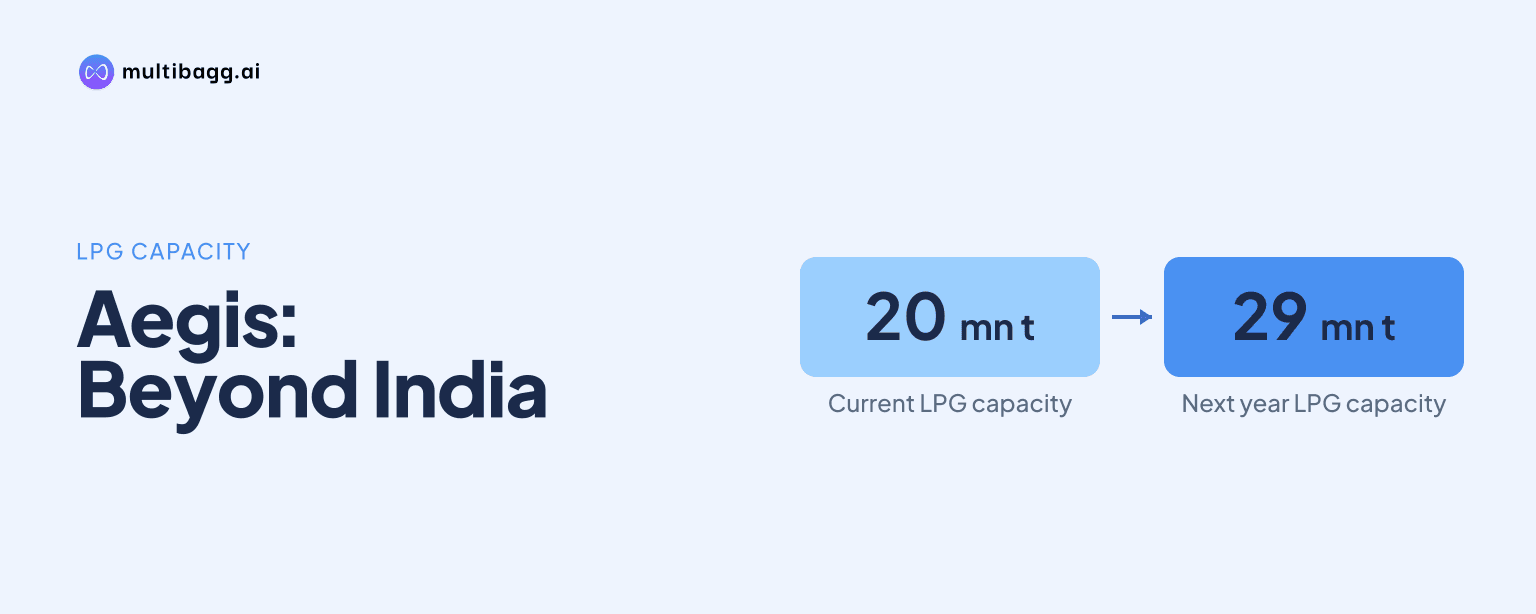
- Aegis expects LPG handling capacity to rise from 20 million tonnes to about 29 million tonnes after JNPA opens next year.
- Aegis reported Rs 147 crore of Liquid EBITDA and Rs 309 crore of Gas EBITDA in the reported period.
- Management expects the Tristar transaction to close in the next few months and plans fuller synergy disclosure afterward.
powered by IRIS
Aegis Logistics said on November 3, 2026 that Tristar’s 28 ships, global liquid-storage terminals and long-term supplier relationships could extend Aegis’s supply chain beyond India after the acquisition closes in the next few months. Management did not quantify revenue, cost or volume synergies because the transaction remains incomplete.
Know Aegis Vopak Terminals inside out
Results, valuation, peers and who's buying, in one view.
How can Tristar extend Aegis’s supply chain beyond India?
Tristar could give Aegis physical supply-chain assets outside India, including liquid terminals, ships, trucks and fuel pumps, according to management. Murad Moledina said Tristar had assembled these assets over 30 years as “small, small building blocks” across global markets, while Aegis had previously focused on India and domestic distribution.
Management said the assets can support the movement of products from supply sources through storage and transport to end customers. Moledina said Tristar’s facilities, ships, trucks and fuel pumps are all part of the chain needed to reach the consumer, and that Aegis could use those overseas assets for distribution over time.
The disclosed vessel fleet comprises 28 ships, many of which call at ports operated by Aegis. Raj Chandaria said the vessels operate in liquid and gas markets, creating an overlap with Aegis’s terminal operations rather than adding an unrelated transport activity.
Which Tristar relationships could Aegis use in India?
Aegis said Tristar’s long-standing relationships with major energy and commodity companies could be used in India after completion. Chandaria named Shell, Glencore, BP, Total and Saudi Aramco among Tristar’s customer partnerships and said those relationships would be available for Aegis to leverage.
Management also identified Tristar’s connections with supply sources in the Middle East. Chandaria cited Abu Dhabi National Oil Company and Saudi Aramco when discussing Tristar’s deep relationships with oil-producing companies and countries in the region, though he did not disclose any agreed sourcing volumes or new supply contracts.
The strategic mechanism described by management is a link between source markets and India as a destination market. An analyst noted that Aegis had principally operated at the destination end of liquid trade, while management said Tristar’s source-market connections could benefit Aegis without providing further commercial details.
Tristar also has expertise in inert gases and aircraft refuelling, according to management’s response to an analyst’s question. Chandaria said inert-gas expertise could be leveraged in India, but Aegis did not identify products, customers, investment requirements or an implementation timetable for either activity.
What Indian network could Aegis connect to Tristar’s assets?
Aegis could connect Tristar’s sourcing and transport assets with an Indian LPG network that is expected to handle about 29 million tonnes after JNPA is ready next year. The network will comprise six terminals at Kandla, Pipavav, Mumbai, JNPA, Mangalore and Haldia, management said.
The company’s current LPG handling capacity is 20 million tonnes, so the planned 29 million-tonne level represents an increase of 9 million tonnes once JNPA is operational. Aegis also said it holds more than 30% of India’s LPG static-storage capacity, although it did not provide a separate market-share target after JNPA opens.
Aegis reported LPG logistics volumes of 1.1 million metric tonnes in the first quarter and 1.3 million metric tonnes in the second quarter, taking first-half volume to 2.4 million metric tonnes. Management said second-quarter volume rose 19%, while the first quarter was affected by war-related disruption; the prior full year’s logistics volume was 5.1 million metric tonnes.
Management linked its existing distribution economics to supply-chain scale rather than price-setting power. It said distribution earnings before interest, tax, depreciation and amortisation, or EBITDA, were slightly above Rs 7,000 per tonne in the second quarter, compared with a historical range around Rs 4,000 per tonne in 2024 and 2025, citing larger ship unloading capacity, lower freight and lower demurrage.
Got a follow-up? Ask IRIS
Could Aegis’s terminal operations support the wider supply chain?
Aegis said its terminal infrastructure could support a broader chain, but it did not say Tristar would accelerate a specific terminal project. Management said its facilities can unload LPG ships carrying up to 50,000 metric tonnes within 24 hours, which it said reduces freight costs and practically eliminates demurrage on such cargoes.
The company attributed higher liquid-segment EBITDA to operations in higher-realisation locations. It said approximately 60,000 cubic metres commissioned in Mumbai and 101,000 cubic metres at JNPA had supported earnings, with a further approximately 318,000 cubic metres planned at JNPA and 64,000 cubic metres at Mumbai.
Aegis reported Liquid EBITDA of Rs 147 crore and Gas EBITDA of Rs 309 crore in the reported period. Aegis Vopak Terminals Limited reported consolidated EBITDA of Rs 392 crore, rather than separate liquid and gas figures, showing that the group already has terminal and gas operations alongside the proposed Tristar acquisition.
Management did not attribute any of those reported earnings to Tristar, which has not yet been acquired. Chandaria responded to a question on whether Tristar could help Aegis Vopak Terminals Limited progress from 3 million kilolitres to 6 million kilolitres by saying source-market relationships could benefit Aegis, without revising the capacity goal or its timing.
When will Aegis disclose Tristar’s financial synergies?
Aegis will discuss the transaction’s “real synergies and benefits” after it is completed in the next few months, management said. Moledina said repeatedly that the company was constrained in discussing an incomplete transaction, so it gave no expected procurement savings, revenue contribution, integration cost or return target on the November 3 call.
Management said an extraordinary general meeting had approved a Rs 6,000 crore fundraise and that Aegis had Rs 6,400 crore of available cash on its September balance sheet. It said the acquisition would not require excessive debt, but did not give a final purchase-price funding bridge or a closing date.
The separate capital plan for Aegis Vopak Terminals Limited should not be treated as a Tristar synergy forecast. Management said it would follow debt gearing of 0.6 times for its expansion programme and described equity from the prior listing, shareholder dilution and internal accruals as funding sources.
Management’s timetable therefore has two stages: transaction closing in the next few months and fuller discussion of synergies after that event. Chandaria also said management expected to connect again around the end of January, while JNPA’s planned opening next year remains a separate operational milestone.
Conclusion
The disclosed case for the acquisition is that Tristar can add international supply-chain reach to Aegis’s Indian terminal and distribution base. Its 28 ships, overseas liquid terminals, trucks, airport-refuelling capability and relationships with named energy suppliers may help Aegis connect sourcing, transport, storage and distribution across more markets, but management has not quantified the financial outcome.
The next issue to watch is completion of the transaction in the next few months, when management says it will provide more detail on actual synergies and benefits. Investors can also watch the planned JNPA opening next year, which is expected to lift Aegis’s LPG handling capacity from 20 million tonnes to about 29 million tonnes.