










Aether Industries' Baker Hughes pact lifts oilfield revenue
Key highlights
- Aether Industries signed its five-year Strategic Supply Agreement with Baker Hughes on June 25, 2024.
- The agreement covers six oilfield chemical products to be manufactured in India for the first time.
- Oil and gas reached about one-third of Aether Industries' revenue after initial product commercialisation.
- The Baker Hughes programme could contribute more than Rs 3,000 million annually at full ramp-up.
powered by IRIS
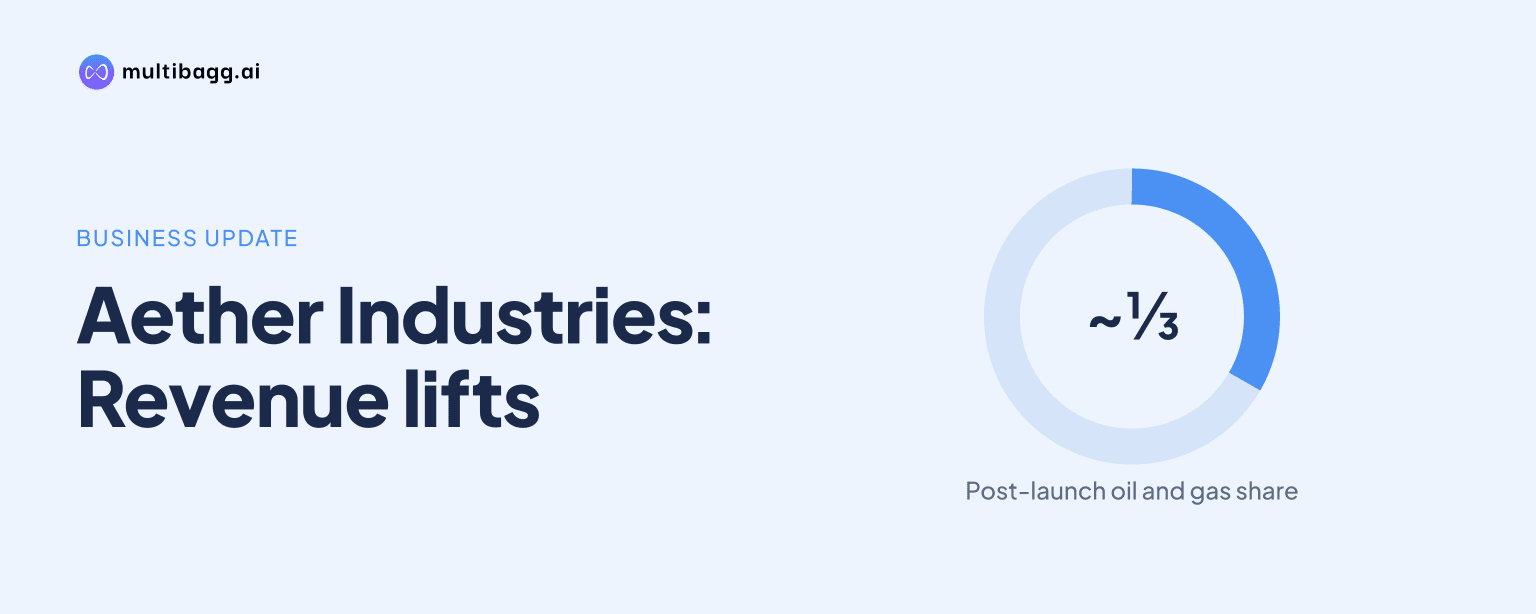
Aether Industries Limited's five-year supply agreement with Baker Hughes has helped oil and gas reach about one-third of revenue, while the contract could contribute more than Rs 3,000 million annually at full ramp-up. The deal is important because it moves the Surat-based specialty chemicals maker into scaled production for global oilfield applications.
Know Aether Industries inside out
Results, valuation, peers and who's buying, in one view.
What does Aether Industries' Baker Hughes agreement cover?
Aether Industries Limited signed a Strategic Supply Agreement with Baker Hughes on June 25, 2024, to contract manufacture six products for the oilfield services company. The agreement has an initial term of five years, with options for three additional one-year extensions and further yearly renewals thereafter.
All six products are to be manufactured in India for the first time and supplied to Baker Hughes' global locations, with a significant portion intended for Indian oil and gas applications. Most of the production is to be undertaken by Aether Specialty Chemicals Limited, Aether Industries' wholly owned subsidiary.
The products include specialty pour-point depressants, which are used to improve the flow and transport of crude oil. The arrangement places Aether in a specialised part of the oilfield chemicals chain, where product qualification, consistent performance and supply reliability are central to customer relationships.
Baker Hughes is one of the world's largest oilfield services companies. Its agreement with Aether gives the Indian manufacturer a defined route to serve global facilities rather than relying only on domestic demand for specialty chemical intermediates.
How did the Baker Hughes supply arrangement enter commercial production?
The supply arrangement entered its next stage when Aether and Baker Hughes executed an amendment on January 7, 2025, with the final copy received on January 15, 2025. The amendment finalised volume and pricing details for the first two products under the wider agreement.
Aether said the amendment initiated commercialisation activities at Site 4, a facility built under Aether Specialty Chemicals Limited for this contract manufacturing programme. The subsidiary had already installed and commissioned the required assets, plant and machinery for the work.
Site 4 was developed to support the Baker Hughes contract, and commercial production was expected to begin by the end of FY25. The first two products established the initial operating phase, while the agreement covers six products in total.
On its Q2 FY27 earnings call, management said further oilfield chemicals for Baker Hughes had been commercialised. According to management, these products address a global market of about USD 2 billion to USD 2.5 billion. That figure describes the market opportunity for the relevant products, not Aether's reported sales.
Why has oil and gas become material for Aether Industries?
Oil and gas became about one-third of Aether's revenue after commercialisation of the initial Baker Hughes products, mainly pour-point depressants. This represents a notable change for a company that began as a maker of pharmaceutical intermediates in Surat.
The potential scale is also meaningful relative to Aether's prior reported revenue base. The Baker Hughes programme is expected to contribute more than Rs 3,000 million annually at full ramp-up, while Aether had reported revenue above Rs 6,000 million in the preceding year.
The contract does not mean that the full contribution has already been recorded. Production and revenue depend on product-wise commercialisation, agreed volumes, pricing and operational ramp-up. The January 2025 amendment only fixed the first two products, while the wider agreement includes six.
Aether's broader customer development activity also provides context for the oilfield push. The company has announced manufacturing and research-related arrangements with other international chemical groups, including SEQENS and Milliken Chemical, though the Baker Hughes agreement is the disclosed programme tied to dedicated Site 4 capacity.
Got a follow-up? Ask IRIS
What has been the market and operating impact of the agreement?
The announcement of the Strategic Supply Agreement was positively received by the market in June 2024. Aether Industries' shares rose 4.21% to Rs 932.75 following the announcement, reflecting investor attention on the five-year contract and its global supply potential.
For investors, the key disclosed financial markers are oil and gas contributing about one-third of revenue and the prospect of more than Rs 3,000 million in annual contribution at full ramp-up. These figures indicate that execution of the Baker Hughes programme has become important to Aether's revenue mix and utilisation of Site 4.
The arrangement also supports domestic manufacturing of products that had not previously been made in India, according to the company. Supply is intended for Baker Hughes' global network as well as Indian oil and gas applications, linking Aether's operations to both export-oriented and local energy-sector demand.
Aether's valuation was described as about 80 times earnings in the source material. That valuation places particular attention on whether additional products are commercialised as planned and whether Site 4's production moves toward the stated full-ramp potential. The disclosed agreement provides a long-term framework, but it does not guarantee a specific annual revenue outcome before ramp-up is completed.
How do new partnerships shape Aether Industries' next phase?
Aether is seeking to broaden its end markets beyond pharmaceutical intermediates through contract manufacturing and research partnerships. The source material says Dow selected Aether as an exclusive research partner, while the company's first semiconductor shipments have also left the factory.
These developments sit alongside the Baker Hughes programme rather than replacing it. The oilfield agreement is the clearest disclosed example of a dedicated manufacturing facility, a multi-year supply framework, identified products and an indicated annual contribution potential.
For the chemicals industry, such agreements can create longer customer relationships because production involves customer-specific formulations, quality requirements and installed manufacturing assets. But the financial benefit remains tied to commercial volumes, product approvals and operating execution.
Conclusion
Aether Industries has shifted a meaningful part of its revenue mix towards oilfield chemicals through its Baker Hughes agreement. The five-year framework covers six products, initiated Site 4 commercialisation and helped oil and gas reach about one-third of revenue, with more than Rs 3,000 million of annual contribution indicated at full ramp-up.
The next points to watch are the commercialisation of the remaining Baker Hughes products, Site 4's ramp-up and the pace at which the company converts its other disclosed research, contract manufacturing and semiconductor initiatives into reported revenue. The agreement's extension options also remain available after the initial five-year term.