










Ahluwalia cuts FY27 capex to Rs 220 crore amid uncertainty
Key highlights
- Ahluwalia reaffirmed FY27 capital expenditure of about Rs 220 crore, down from an initial plan of more than Rs 300 crore.
- Ahluwalia's unexecuted order book was about Rs 20,000 crore, with execution expected over 3 to 3.5 years.
- Fixed-price contracts represented 9.19% of contracts, while EPC contracts accounted for around 46%.
- Management guided for FY27 operating margin of 8.5% to 9% and estimated a 0.5-percentage-point provident-fund cost impact.
powered by IRIS
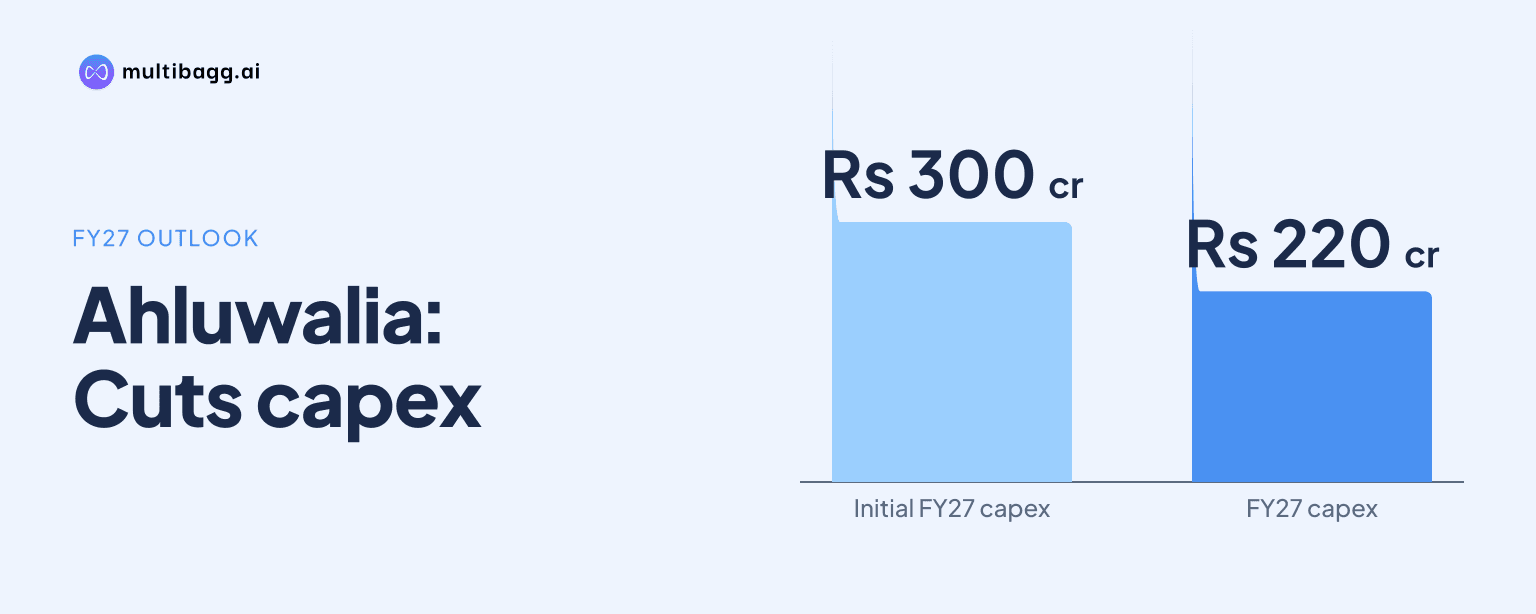
Ahluwalia Contracts (India) Limited cut planned FY27 capital expenditure to about Rs 220 crore from more than Rs 300 crore, because management said existing equipment can support its Rs 20,000 crore unexecuted order book while construction cyclicality and supply-chain disruption create risks around carrying additional assets.
Know Ahluwalia Contracts (India) inside out
Results, valuation, peers and who's buying, in one view.
Why did Ahluwalia reduce its FY27 capital-expenditure plan?
Ahluwalia reduced the plan because management believes its current equipment and shuttering inventory can support the existing workload without the originally envisaged outlay. At the beginning of FY27, management said capital expenditure would exceed Rs 300 crore; it lowered that estimate to about Rs 220 crore in the preceding quarter and reaffirmed the figure on the November 16, 2026 call.
The Rs 220 crore spending plan remains focused on execution equipment rather than a new business line. Management identified cranes, batching plants, loaders and specialised shuttering materials as the main categories. Aluminium shuttering is used for high-rise buildings, while system shuttering supports large table forms for commercial buildings.
What risks led Ahluwalia to conserve investment capacity?
Ahluwalia cited construction cyclicality as its central reason for caution. Management referred to the downturn spanning late 2008, 2009 and 2010, and said a slowdown three, four or five years ahead could leave the company with substantial plant-and-machinery costs. This was management's rationale for reducing capex despite describing the order book as being at an all-time high.
Supply-chain disruption was the second stated risk. Management said events in the West and Middle East had affected supply chains, changing material-planning assumptions. Reinforcement steel, structural steel and cement that previously reached sites in two to three weeks are now planned for in five to six weeks, while electromechanical materials including chillers, panels and transformers can require as long as eight weeks.
The decision marks a change from the previous financial year, when management said Ahluwalia made substantial capital expenditure and initially planned a similar level for FY27. Management said it is now waiting and watching because it considers current equipment and shuttering adequate for the Rs 20,000 crore order book, rather than because it disclosed any reduction in work available for execution.
Can Ahluwalia execute its order book with lower capex?
Ahluwalia said current equipment and shuttering materials are sufficient to execute its unexecuted order book of about Rs 20,000 crore. Management expects that work to be completed over about three to three-and-a-half years, which is the period against which it assessed the need for additional cranes, plants and formwork.
The execution schedule differs by project. Management said the Central Vista project had a timeline of about two years and was expected to be completed in another 18 to 20 months, around six months ahead of that timeline. Central Vista is a Rs 3,000 crore project that management said covers about 33.5 lakh square feet and uses off-site fabricated structural components.
Varanasi provides a separate timing example. Its stipulated completion date is June 2027, but management said the client wanted an inauguration before elections and that Ahluwalia was likely to finish by the end of January or before February. Management also said it did not expect a major disruption from Uttar Pradesh elections because little of its workforce comes from the state.
Got a follow-up? Ask IRIS
How do contract terms and disruptions affect Ahluwalia's spending case?
Ahluwalia's contract mix provides some protection against cost changes, although management did not say it eliminates risk. Fixed-price contracts represented 9.19% of contracts and engineering, procurement and construction, or EPC, contracts accounted for around 46%. Management said it now seeks labour and material escalation clauses when bidding and that about 50% of clients without a labour-escalation clause had agreed to minimum-wage-index escalation going forward.
Management also cited the billing pattern of large EPC projects, including Central Vista and CSMT, as a reason material costs were higher by about four to five percentage points. Materials can arrive before billing captures the full value of completed structural work. Management expects material cost as a share of revenue to decline over the next six to nine months as structural items are fully billed.
National Capital Region, or NCR, work restrictions illustrated the execution uncertainty behind the lower capex plan. On November 16, projects in Gurgaon and Noida were closed until November 20 except for Max Hospital, while Central Vista and the hospital project were exempt. Management nevertheless expected about Rs 150 crore of turnover from Central Vista and about Rs 50 crore from the Gurgaon hospital project during the affected period.
What does Ahluwalia expect for margins and regional growth?
Ahluwalia's management guided for an operating margin of 8.5% to 9% in FY27 rather than a double-digit margin. It cited recurring third-quarter disruption, costs associated with preparing for growth, uncertainty over compensation for electromechanical-price increases and a provident-fund increase estimated to reduce margin by about 0.5 percentage points.
Management said employee cost reached Rs 133 crore in the second quarter because of announced increments and would not decline in absolute terms in the second half. It expects that cost to fall as a percentage of turnover as revenue rises. The company also expected other income in the second half to be approximately similar to the first-half level, without disclosing a figure on the call.
Ahluwalia said lower equipment capex does not mean it is withdrawing from regional expansion. It operated in 19 states, with Mumbai representing 24% of the order book and the East 15%. Management said Bangalore alone had an order book of about Rs 2,000 crore and that it was bidding for Hyderabad projects, while maintaining a selective approach in Bihar and Bengal.
Conclusion
Ahluwalia's FY27 capex reduction is a capital-allocation decision based on management's assessment that existing cranes, plants and specialised shuttering can execute about Rs 20,000 crore of work over three to three-and-a-half years. The reduction from more than Rs 300 crore to about Rs 220 crore reflects concern that a cyclical slowdown or prolonged supply disruption could make excess equipment costly to carry.
The next measures to watch are whether material lead times remain at five to eight weeks, whether clients compensate the estimated 0.5-percentage-point provident-fund impact, and whether Central Vista stays on its 18-to-20-month completion path. Management's FY27 operating-margin range of 8.5% to 9% and its selective order-inflow target of about Rs 4,000 crore are the disclosed benchmarks for the strategy.