










Ahluwalia Contracts (India) Limited: Half accept labour escalation
Key highlights
- About 50% of Ahluwalia clients without labour-escalation clauses accepted minimum-wage-index payments going forward.
- Ahluwalia said Q2 staff costs rose by about Rs 12.5 crore and September provident-fund outlays increased by about Rs 3 crore.
- Ahluwalia now requires labour and material escalation clauses in new bids and previously revised expected order inflow to about Rs 4,000 crore.
- Ahluwalia guided for FY28 EBITDA margin of 8.5%-9%, compared with 7.6% in Q2.
powered by IRIS
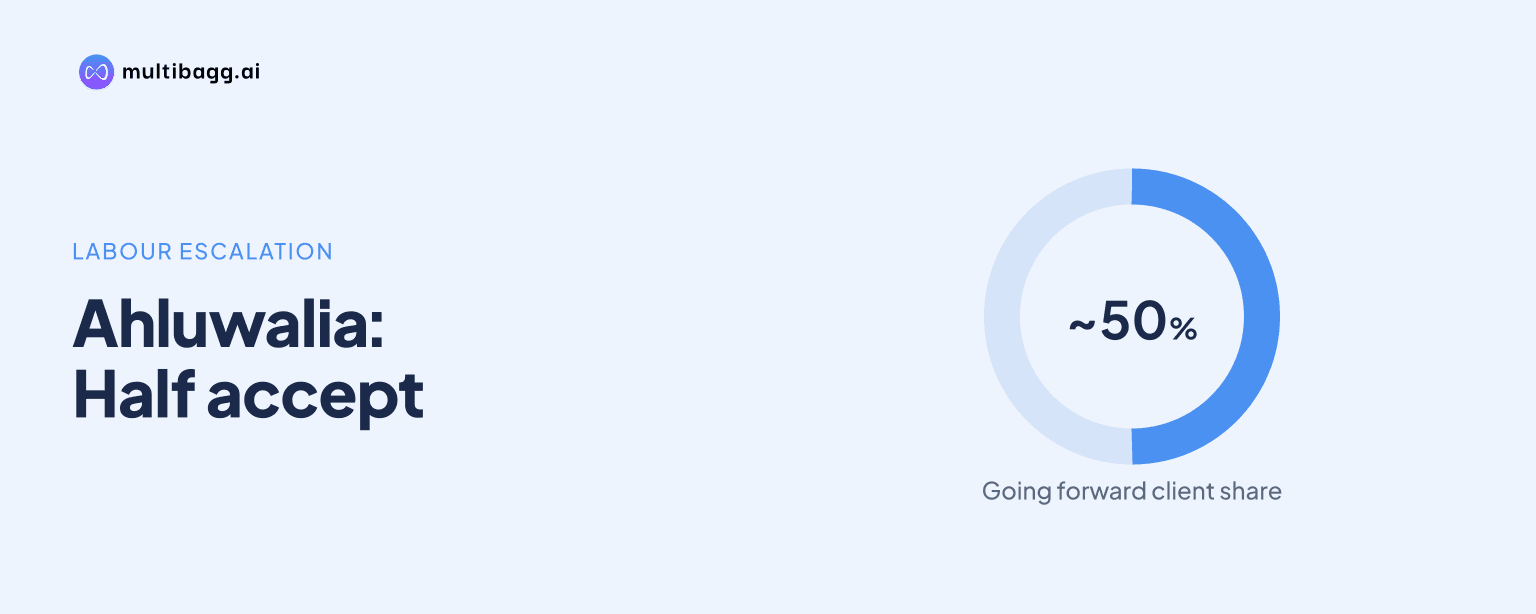
On November 16, 2026, Ahluwalia Contracts (India) Limited said about 50% of clients without labour-escalation clauses had agreed to pay minimum-wage-index escalation going forward, and it now requires labour and material escalation clauses in new bids, changing its contract approach after higher payroll and statutory costs in Q2.
Know Ahluwalia Contracts (India) inside out
Results, valuation, peers and who's buying, in one view.
How many Ahluwalia clients have accepted labour escalation?
About 50% of Ahluwalia clients whose contracts did not include labour-escalation clauses have agreed to pay escalation linked to the minimum wage index going forward. Management said negotiations continued with other clients, but did not disclose the value of contracts covered, the order-book share involved or whether previous wage increases would be fully recovered.
The negotiations follow a reported rise in labour-related expenses in Q2. Ahluwalia said staff costs increased by about Rs 12.5 crore in absolute terms, while provident-fund outlays in September were about Rs 3 crore higher than either the corresponding or preceding quarter because of changes in provident-fund rules.
Management said the Employees' Provident Fund wage ceiling increased from 15,000 rupees to 25,000 rupees, bringing virtually 85% of Ahluwalia's labour force and staff within the provident-fund ambit. An analyst referred to minimum-wage increases of about 35%-40% in Haryana and Uttar Pradesh, but management's direct update was limited to the 50% client-acceptance estimate and continuing discussions.
How is Ahluwalia changing terms for new bids?
Ahluwalia said it is making sure it does not bid for work without escalation clauses covering labour and materials. Management linked this condition to a healthy order book that permits it to select opportunities rather than accept contracts without mechanisms for cost changes.
Management had revised its order-inflow expectation to about Rs 4,000 crore in the prior conference call, saying the lower expectation reflected a decision to “pick and choose” work. The new bidding policy applies to future orders; the call did not say that Ahluwalia can automatically revise pricing in existing contracts without escalation clauses.
Government contracts generally have escalation linked to the Wholesale Price Index, or WPI, while private contracts specify base rates for volatile materials including cement, ready-mix concrete and steel. Management said WPI-linked recovery can lag actual costs at the start of a project, but the cost and escalation curves generally align by the end of the project cycle.
Ahluwalia said fixed-price contracts accounted for 9.19% of its book and engineering, procurement and construction, or EPC, contracts accounted for about 46%. It did not provide the share represented by item-rate or other variable-price contracts, so the call does not support a full classification of its unexecuted book.
Got a follow-up? Ask IRIS
What does the recovery plan mean for Ahluwalia's margins?
Ahluwalia management is targeting an Earnings Before Interest, Tax, Depreciation and Amortisation, or EBITDA, margin of 8.5%-9% in FY28, after reporting 7.6% in Q2. It also said it aimed to increase EBITDA margin by at least one percentage point in FY28, but did not commit to a double-digit outcome.
For the second half, management expects Q4 to be the best quarter for revenue but with margins similar to Q2. It expects Q3 turnover of about Rs 1,300 crore, down by up to 10% quarter on quarter because of restrictions under the Graded Response Action Plan, or GRAP, but above about Rs 1,100 crore reported in the corresponding quarter of the previous financial year.
Employee costs are not expected to decline in absolute terms in the second half because they include announced increments, management said. Ahluwalia expects those costs to reduce as a percentage of turnover as revenue grows, making this dependent on execution as well as recovery from legacy contracts and protections in new bids.
Management described its FY28 range as conservative because of recurring disruptions and costs incurred to prepare for higher revenue. It said inefficiencies from planning for growth should reduce in the next financial year, while also stating that there was no project-specific issue behind the 8.5%-9% guidance.
Why did Ahluwalia's material-cost ratio rise in Q2?
Ahluwalia said material costs were higher by about four to five percentage points in Q2 because of the projects being executed, particularly Central Vista and Chhatrapati Shivaji Maharaj Terminus, or CSMT. Management described both as EPC contracts, where material deliveries and billing timing can temporarily raise the material-cost share of revenue.
In item-rate contracts, billing for an item includes material cost, fixed cost and profit, management said. In the EPC contracts cited, billing may initially cover materials received before the full value of structural work is billed, creating a different revenue-cost profile during individual project phases.
Management expects the material percentage of revenue to decline over the next six to nine months for some larger projects as structures near completion and structural items are fully billed. This is a project-billing expectation for Central Vista and CSMT, separate from the labour-cost negotiations with clients lacking escalation clauses.
Central Vista turnover was about Rs 43 crore in October and was expected to rise to about Rs 60 crore in November and Rs 60 crore to Rs 70 crore in December. Ahluwalia also projected more than Rs 200 crore of Central Vista turnover in Q4, while CSMT billing was projected at about Rs 150 crore in Q3 and close to Rs 200 crore in Q4.
Conclusion
Ahluwalia's response to higher labour costs has two parts: negotiating minimum-wage-index payments for legacy contracts and insisting on labour and material escalation protections in new bids. The 50% client acceptance estimate provides evidence of progress, but the undisclosed contract value and ongoing negotiations mean the ultimate recovery across the affected book remains unquantified.
The next indicators are the remaining client negotiations, Q3 turnover targeted at about Rs 1,300 crore amid GRAP restrictions, and the expected six-to-nine-month easing in material-cost intensity at larger EPC projects. Management's FY28 EBITDA-margin guidance of 8.5%-9% will also test whether project billing, higher turnover and tighter bid terms offset the higher payroll base.