










Alicon Q2 total income reaches ₹651.98 crore, EBITDA margin at 10%
Key highlights
- Alicon reported Q2 FY27 total income of ₹651.98 crore, up 50% year on year.
- Q2 FY27 EBITDA was ₹65.31 crore, while EBITDA margin declined to 10.0% from 13.2%.
- Raw-material expense rose 77% year on year to ₹393.69 crore in Q2 FY27.
- H1 FY27 total income increased 44% to ₹1,231.05 crore and PAT rose 25% to ₹29.05 crore.
powered by IRIS
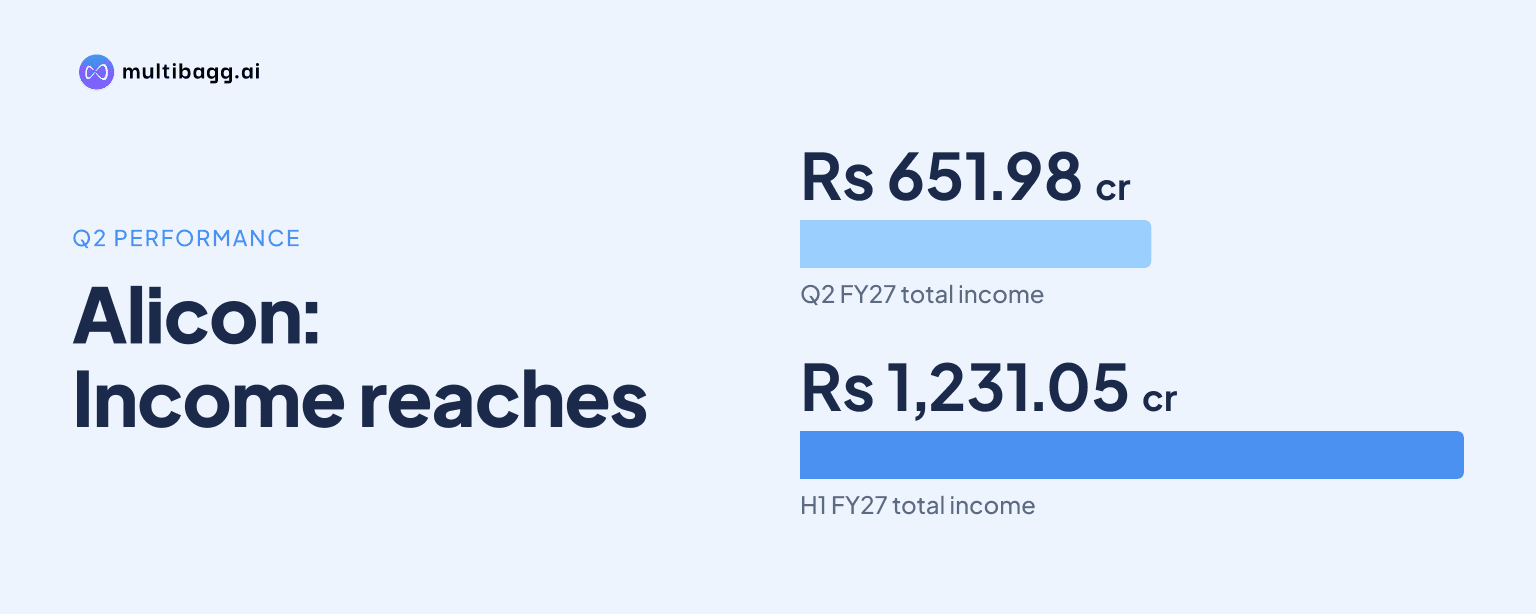
Alicon Castalloy reported record Q2 FY27 total income of ₹651.98 crore, up 50% year on year, while earnings before interest, tax, depreciation and amortisation (EBITDA) margin fell 318 basis points to 10.0% as raw-material costs increased faster than income. Domestic programme launches and higher production on existing programmes supported the quarter.
Know Alicon Castalloy inside out
Results, valuation, peers and who's buying, in one view.
Why did Alicon’s Q2 FY27 total income reach a record?
Alicon’s Q2 FY27 total income reached a record ₹651.98 crore because new domestic customer programmes entered serial production and existing programmes scaled up. Net revenue from operations increased 51% to ₹649.84 crore from ₹429.92 crore in Q2 FY26, while total income rose from ₹433.61 crore. Management also said higher material costs added to reported topline, meaning growth reflected both programme volumes and a higher material-cost pass-through denominator.
The quarter also improved sequentially, with total income rising 13% from ₹579.10 crore in Q1 FY27 to ₹651.98 crore in Q2 FY27. Domestic business accounted for 87% of Q2 revenue and global business for 13%, while automotive products contributed 96% and non-automotive products 4%. The record quarter therefore remained principally dependent on domestic automotive programme execution.
What caused Alicon’s EBITDA margin to decline to 10%?
Alicon’s EBITDA margin declined to 10.0% because raw-material expense increased 77% year on year to ₹393.69 crore, exceeding the 50% rise in total income. EBITDA still increased 14% to ₹65.31 crore from ₹57.22 crore, but margin fell from 13.2% in Q2 FY26. The company said gross margin faced a nearly 900-basis-point year-on-year impact from higher material costs, principally aluminium, which it expects to pass through with a lag.
The sequential position was different: EBITDA rose 18% from ₹55.30 crore in Q1 FY27 to ₹65.31 crore in Q2 FY27, and margin improved from 9.5% to 10.0%. Alicon attributed the quarter-on-quarter gross-margin resilience to a higher-value business mix. Its stated cost actions include low-cost automation, lean and agile manufacturing, lower overheads and diversification of the energy mix.
Total expenditure rose 56% year on year to ₹586.68 crore in Q2 FY27, compared with ₹376.39 crore in Q2 FY26. Employee-benefit expense increased 13% to ₹60.69 crore and other expenses rose 31% to ₹132.30 crore, both slower than raw-material expense. This cost mix allowed EBITDA to rise in rupee terms while the EBITDA share of total income declined by 318 basis points.
How did Alicon’s H1 FY27 results compare with last year?
Alicon’s H1 FY27 total income increased 44% to ₹1,231.05 crore, while EBITDA increased 11% to ₹120.60 crore and EBITDA margin fell to 9.8% from 12.7%. The first-half pattern matched Q2: domestic programme ramps increased income, while higher aluminium prices and sales-mix effects reduced the margin percentage. Gross profit was ₹483 crore, with a gross margin of 39.3%, down 774 basis points year on year.
Profit before tax (PBT) increased 33% to ₹42.13 crore in H1 FY27 from ₹31.61 crore in H1 FY26. Profit after tax (PAT) rose 25% to ₹29.05 crore from ₹23.20 crore, although PAT margin decreased 35 basis points to 2.4%. Finance costs declined 4% to ₹21.53 crore, while depreciation and amortisation rose 11% to ₹56.94 crore.
Got a follow-up? Ask IRIS
Which markets and programmes are supporting Alicon’s growth?
Alicon’s growth was led by domestic automotive programmes, with domestic revenue accounting for 87.5% of H1 FY27 revenue and automotive contributing 96%. In Q2, Indian two-wheeler volumes grew 17%, passenger-vehicle volumes 25% and commercial-vehicle volumes 34% year on year. Alicon identified serial production at new customer programmes and higher scale at existing programmes as its company-specific growth drivers.
Alicon booked eight new parts from three customers in Q2 FY27, comprising three passenger-vehicle parts, three global passenger-vehicle parts and two non-automotive parts. Five parts were for domestic business and three were for global business. Management said larger, more complex and machined components were raising domestic value addition, while commercial-vehicle traction was strengthening the business portfolio.
Global operations represented 12.5% of H1 FY27 revenue, while management described the US commercial-vehicle market as weak in the period. Management said the Slovakia facility delivered sequential growth and the European business showed early signs of recovery. Manufacturing facilities operated at around 86% utilisation amid tariff uncertainty, supply-chain disruption, input-cost inflation and elevated passenger-vehicle inventory.
What should investors watch in Alicon’s next results?
The central issue is whether Alicon can convert higher programme volumes into a margin above the 10.0% reported in Q2 FY27. Management’s stated H2 FY27 priority is disciplined execution, operational efficiency and translating scale into stronger margins. The disclosed variables are material-cost pass-through timing, product mix, capacity utilisation, automation, material flow and overhead control.
Working-capital balances increased between March 31, 2026 and September 30, 2026. Trade receivables rose to ₹629.72 crore from ₹534.68 crore, inventories increased to ₹191.95 crore from ₹160.94 crore and short-term borrowings rose to ₹256.81 crore from ₹222.78 crore. Long-term borrowings declined to ₹90.13 crore from ₹102.26 crore over the same period.
Conclusion
Alicon delivered record Q2 FY27 total income of ₹651.98 crore through domestic serial-production launches and scaling customer programmes, with automotive accounting for 96% of revenue. However, raw-material expense increased 77% to ₹393.69 crore, faster than income, limiting EBITDA growth to 14% and reducing margin to 10.0% from 13.2% a year earlier. H1 FY27 showed the same divergence, with total income up 44% and EBITDA up 11%.
Management has phased investment in a new Pune facility in line with secured customer programmes, with production targeted to begin by April 2027. Before then, the H2 FY27 focus is whether utilisation, mix improvement and cost actions can offset the lag in material-cost pass-through, while US commercial-vehicle demand and the early European recovery remain unresolved factors.