










Alicon retains Slovakia plant despite legacy-program losses
Key highlights
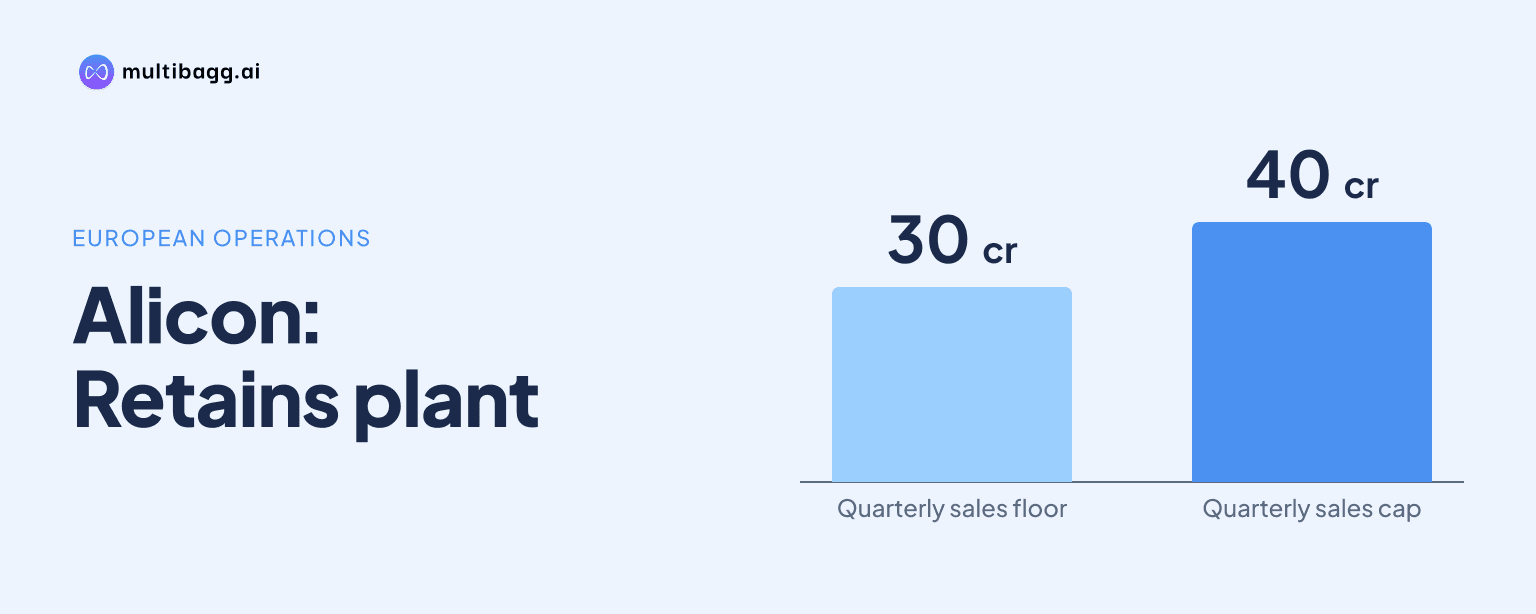
- Alicon said its Slovakia plant needs approximately Rs 30 crore to Rs 40 crore of quarterly sales to break even.
- Management said more than Rs 15 crore of quarterly legacy business has already been lost at the European operation.
- An analyst calculated an approximately Rs 3.1 crore Q2 European loss drag from the gap between Rs 20.7 crore standalone PAT and Rs 17.6 crore consolidated PAT.
- Management said capacity at the developing new plant is fully booked, with an expected asset turnover of 3.5 to 4 times or potentially higher.
powered by IRIS
In Q2, Alicon Castalloy Limited said it would retain its Slovakia plant despite losing more than Rs 15 crore of legacy business each quarter, arguing that about Rs 30 crore to Rs 40 crore in quarterly sales can bring the site to break-even. Management cited inquiries for specialised European work.
Know Alicon Castalloy inside out
Results, valuation, peers and who's buying, in one view.
Why is Alicon keeping its Slovakia plant?
Alicon is keeping the Slovakia plant because management sees a European requirement for low-volume, high-technology components that certain niche customers are unlikely to source from India or China. Management cited racing cars and other specialised segments, where customers require carefully manufactured parts in smaller quantities. It said the plant already makes many such parts and therefore serves a customer need that differs from mass production.
Alicon also said market conditions in Europe could create opportunities for the site. Management pointed to foundries in Germany, France and Italy either closing or shifting parts of their businesses towards Eastern Europe, including Slovakia and the Czech Republic. Alicon said it is receiving inquiries for the plant and expects it to contribute positively over time, although it did not disclose the number, value or expected conversion timing of those inquiries.
Alicon's decision is not to move all Slovakia production to India. Management said it offers customers a choice between European and Indian supply, and that it has added business in Europe where making the parts there is more viable than producing them in India. That mechanism positions the European factory as a manufacturing option for specific programmes rather than solely as a development or prototype location.
What sales does Alicon say Slovakia needs to break even?
Alicon said the Slovakia plant needs approximately Rs 30 crore to Rs 40 crore of quarterly sales to break even, although management stressed that the threshold varies by programme mix and margin. The range is therefore an average rather than a fixed revenue target. Higher-margin and lower-margin businesses can produce different break-even outcomes at the same sales level.
The plant has lost more than Rs 15 crore of legacy business per quarter, according to management. Against the stated Rs 30 crore to Rs 40 crore break-even range, the lost revenue represents a substantial part of the sales base that the site needs. Management did not specify the customers, products or programme end dates behind those exits, nor did it provide current Slovakia quarterly revenue.
The loss was also visible in the Q2 profit comparison raised by an analyst. The analyst said standalone profit after tax, or PAT, was about Rs 20.7 crore in Q2, compared with consolidated PAT of about Rs 17.6 crore, implying an approximately Rs 3.1 crore quarterly loss drag from the European operations. Management's response focused on the sales needed for break-even rather than disputing that calculation.
How does Alicon plan to rebuild Slovakia revenue?
Alicon plans to rebuild the Slovakia site through inquiries for European work rather than by reversing its decision to exit legacy programmes. Management said it was confident that the inquiries coming to the plant, together with its future-growth efforts, could return the site to positive contribution. However, it gave no booked-revenue number, order announcement or timetable for replacing the more than Rs 15 crore of quarterly legacy sales lost.
The approach is consistent with Alicon's stated focus on higher-value-added and more complicated products. In its defence and aerospace discussion, management said it receives requests for quotations, or RFQs, but examines them critically and does not want to expand non-auto revenue at the expense of margins. That screening process means inquiry volume alone will not determine the Slovakia recovery; conversion economics and product complexity will also matter.
Alicon described a similar qualification process in its data-centre component work. It said samples supplied to a customer for critical aluminium castings had been appreciated, that a few RFQs had been received, and that it expected some orders to convert in coming quarters. Those comments concerned a separate customer opportunity, but they show the company's broader route to replenishing business through technically demanding castings rather than commoditised volume.
Got a follow-up? Ask IRIS
How does the Slovakia decision fit Alicon's wider capacity plans?
Alicon is pursuing the Slovakia recovery while developing another plant for which management said planned capacity is already fully booked by customers. In the call, an analyst referred to approximately Rs 125 crore of investment and potential revenue of around Rs 500 crore over four to five years. Management said the asset-turnover ratio for that new plant could be between 3.5 times and four times, and possibly somewhat higher, though the plant remains under development.
That contrast separates a booked-capacity expansion from the rebuilding task in Slovakia. The new plant has customer capacity commitments, based on management's statement, while the Slovakia site is being supported by niche manufacturing capability and incoming inquiries after legacy-program losses. Alicon did not provide a capex figure for Slovakia in this discussion, despite being asked whether European manufacturing investment remained justified amid wage and energy pressure.
Management also did not provide an update on potential inorganic opportunities. It said it would return to investors once such opportunities mature. In the closing remarks, it said capital allocation would remain focused on investments supporting sustainable growth, alongside execution of secured programmes, customer relationships and operational efficiency under its Reset, Refocus, Rebuild initiatives.
What other operating trends affect Alicon's turnaround capacity?
Alicon's wider profitability expectations provide context for how it intends to absorb the European loss drag. Management said it expected full-year earnings before interest, tax, depreciation and amortisation, or EBITDA, margin of around 12%, followed by about 1 percentage point of year-on-year improvement over the next two to three years. An analyst cited a first-half margin of 9.8%, while management said an alloy adjustment would put the EBITDA level at around 12%.
Working capital also moved during the quarter, although management said this was a cash-flow timing issue rather than an aluminium pass-through margin issue. An analyst said receivables increased by Rs 88 crore and inventory by Rs 32 crore. Management said higher sales volumes and aluminium prices lifted receivables and payables, and that customers' internal approval processes delayed payment; it expected collections over the next two to three months.
For Slovakia, the relevant implication is that management is attempting to preserve manufacturing capability while maintaining group-level margin discipline. Its stated refusal to pursue commoditised non-auto work at any margin, together with the Rs 30 crore to Rs 40 crore quarterly break-even estimate, makes programme selection central to the plant's recovery rather than simply maximising European revenue.
Conclusion
Alicon is retaining its Slovakia manufacturing base despite a stated loss of more than Rs 15 crore of legacy sales per quarter because management sees a continuing European market for specialised, low-volume castings. The decision rests on a specific operating case: niche customers may require regional production, the plant needs roughly Rs 30 crore to Rs 40 crore in quarterly sales to break even, and management says inquiries are emerging as Western European foundries close or relocate work.
The next issue to watch is whether those inquiries convert into enough profitable programmes to close the sales gap, since management disclosed neither current Slovakia revenue nor replacement orders. Investors can also watch for the company's promised updates in coming quarters on potential data-centre orders, as well as progress in executing secured programmes and the developing new plant whose capacity management said is fully booked.