










Alicon sees Rs 270 crore peak annual sales from Q2 wins
Key highlights
- Alicon’s eight Q2 FY27 parts from three customers are expected to generate about Rs 270 crore of annual sales at peak.
- Management estimated roughly Rs 1,000 crore of sales from the Q2 FY27 wins over six years.
- Alicon expects about 70% of volumes from the Q2 FY27 wins in 2028-2029.
- Alicon’s executable order book stood at about Rs 6,700 crore as of September 30.
powered by IRIS
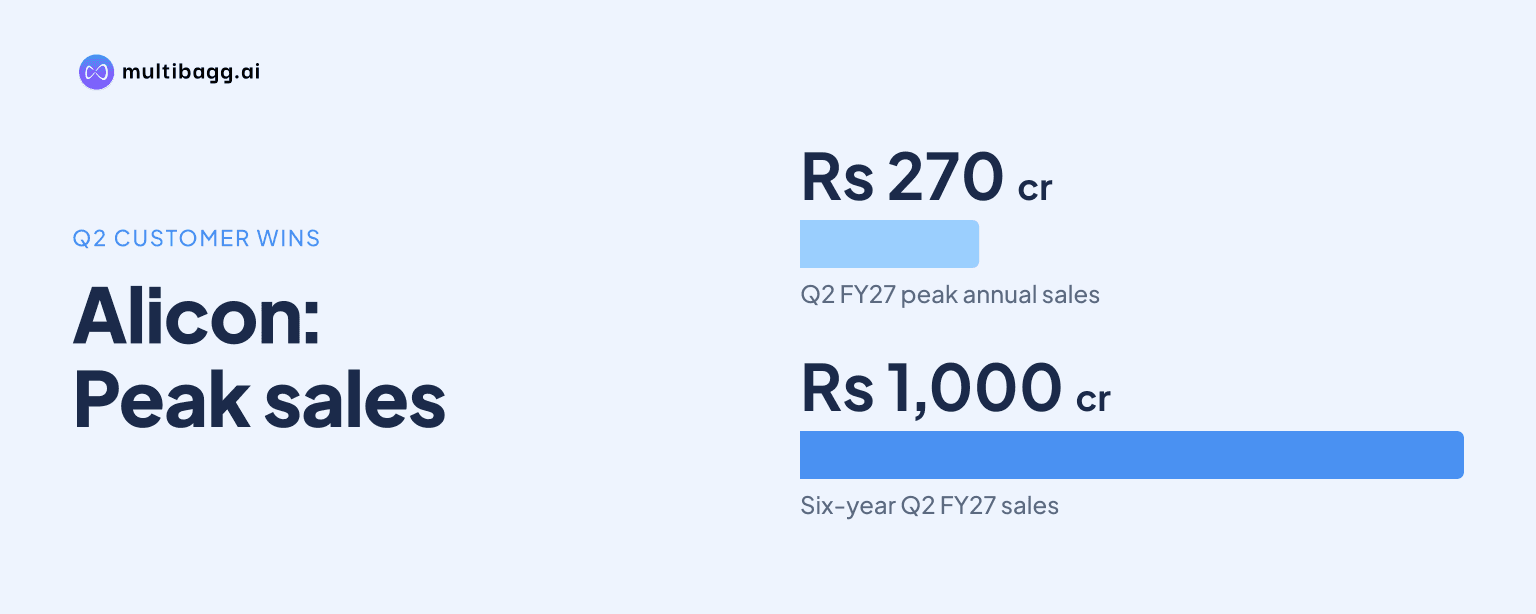
In Q2 FY27, Alicon said eight parts won from three customers could generate about Rs 270 crore of annual sales at peak and roughly Rs 1,000 crore over six years. Management said passenger vehicles account for 95% of the new business and that about 70% of its volumes should arrive in 2028-2029.
Know Alicon Castalloy inside out
Results, valuation, peers and who's buying, in one view.
How large are Alicon’s Q2 FY27 order wins?
Alicon’s Q2 FY27 order wins cover eight parts for three customers, with annual sales realization expected to reach about Rs 270 crore at peak volumes. Management estimated cumulative sales of roughly Rs 1,000 crore over six years, meaning the peak annual figure is a programme run-rate rather than revenue expected immediately in FY27.
Passenger-vehicle applications account for about 95% of the newly won business, while non-auto applications make up the remaining 5%. That mix differs from Alicon’s broader H1 FY27 revenue composition, where two-wheelers contributed about 40%, passenger vehicles 36% to 38%, commercial vehicles about 18%, and non-auto made up the balance.
The Rs 270 crore peak-sales estimate and Rs 1,000 crore lifetime-sales estimate measure different stages of the programmes. Management’s six-year estimate includes development, launch and volume ramp-up, while the peak figure applies once the parts have reached their stated annual sales potential.
When will Alicon’s Q2 order wins contribute revenue?
Alicon expects the major volume contribution from the Q2 FY27 wins in 2028-2029, when management said the programmes should reach about 70% of their volumes. Rajiv Gupta cited development lead times, indicating that most of the Rs 270 crore peak potential is weighted toward later years rather than the current financial year.
Some other programmes are closer to production. Management said electric-vehicle projects for a leading global original equipment manufacturer, or OEM, are entering start of production, or SOP, while global commercial-vehicle programmes serving Europe and the United States are also expected to enter SOP in the next quarter.
For the next 12 months, Sumit Bhatnagar said about 25 to 30 part numbers are expected to newly enter SOP. He did not provide a first-year revenue estimate because new parts usually ramp gradually, but said about 30 new products should reach the market during that period.
Got a follow-up? Ask IRIS
How do the new wins compare with Alicon’s current sales?
Alicon reported Q2 FY27 total income of Rs 652 crore, up 50.4% year on year and 12.6% quarter on quarter, which management described as its highest quarterly revenue. H1 FY27 total income was Rs 1,231 crore, up 44% year on year, showing that the new order wins were announced alongside growth in existing programmes.
The Rs 270 crore annual peak-sales potential equals about 41% of Q2 FY27 total income on a simple comparison, but the two figures cover different periods. Q2 income is reported revenue for one quarter, whereas the order-win estimate is management’s annualized peak-sales projection, primarily associated with 2028-2029 volumes.
Earnings before interest, tax, depreciation and amortisation, or EBITDA, rose 14% year on year to Rs 65.3 crore in Q2 FY27, while profit after tax increased 27% to Rs 17.6 crore. EBITDA margin rose from 9.5% in the preceding quarter to 10.0%, and management said it was 12.1% after adjusting for higher aluminium prices.
What other programmes and investments support Alicon’s sales ramp?
Alicon’s executable order book stood at about Rs 6,700 crore as of September 30, covering FY26-27 through FY31-32. Management did not disclose how much of that order book came from the eight Q2 FY27 parts, but the new wins form part of a wider set of secured customer programmes.
Exports represented 13% of Q2 FY27 revenue, and Rajiv Gupta said management expects the share to reach about 18% to 20% by the end of FY27. He also indicated a further 2% to 3% addition in subsequent years, linked to the planned SOP of global electric passenger-vehicle and commercial-vehicle programmes.
Alicon spent about Rs 70 crore on capital expenditure in H1 FY27, including Rs 40 crore of leasing, against a full-year plan of about Rs 150 crore. The spending includes phased investment in a Pune facility aligned with secured programmes, and management said the plant could generate about Rs 120 crore to Rs 150 crore of revenue in its first year before a larger ramp in FY28-29.
Management said it plans to fund capital expenditure primarily through internal accruals. At September 30, Alicon had net debt of about Rs 322 crore, working-capital days of 34, and net debt to annualized H1 EBITDA of 1.33 times.
Conclusion
Alicon’s Q2 FY27 wins add a disclosed future opportunity of about Rs 270 crore in annual sales at peak and roughly Rs 1,000 crore over six years. The programmes are predominantly passenger-vehicle related and are expected to reach about 70% of their volumes in 2028-2029, while Q2 FY27 total income was already Rs 652 crore.
The next measures to watch are the SOP of global electric-vehicle and commercial-vehicle projects in the next quarter, the planned launch of 25 to 30 part numbers over the next year, and the Pune plant’s first-year revenue target of Rs 120 crore to Rs 150 crore. Management’s stated FY27 goals of 12% to 15% material-adjusted growth, 18% to 20% export share and about Rs 150 crore of capital expenditure will indicate how the pipeline converts into sales.