










Alicon targets structural gains as alloy-adjusted Q2 margin hits 12.1%
Key highlights
- Alicon reported a 12.1% aluminium-adjusted EBITDA margin in Q2 FY27, compared with a 10% reported margin.
- Q2 FY27 total income was Rs 652 crore, up 50.4% year-on-year, while EBITDA was Rs 65.3 crore.
- Alicon reported net debt of about Rs 322 crore and net debt to annualised H1 EBITDA of 1.33 times.
- Management reiterated 12% to 15% FY27 material-adjusted growth guidance and expects Pune mass manufacturing by April 2027.
powered by IRIS
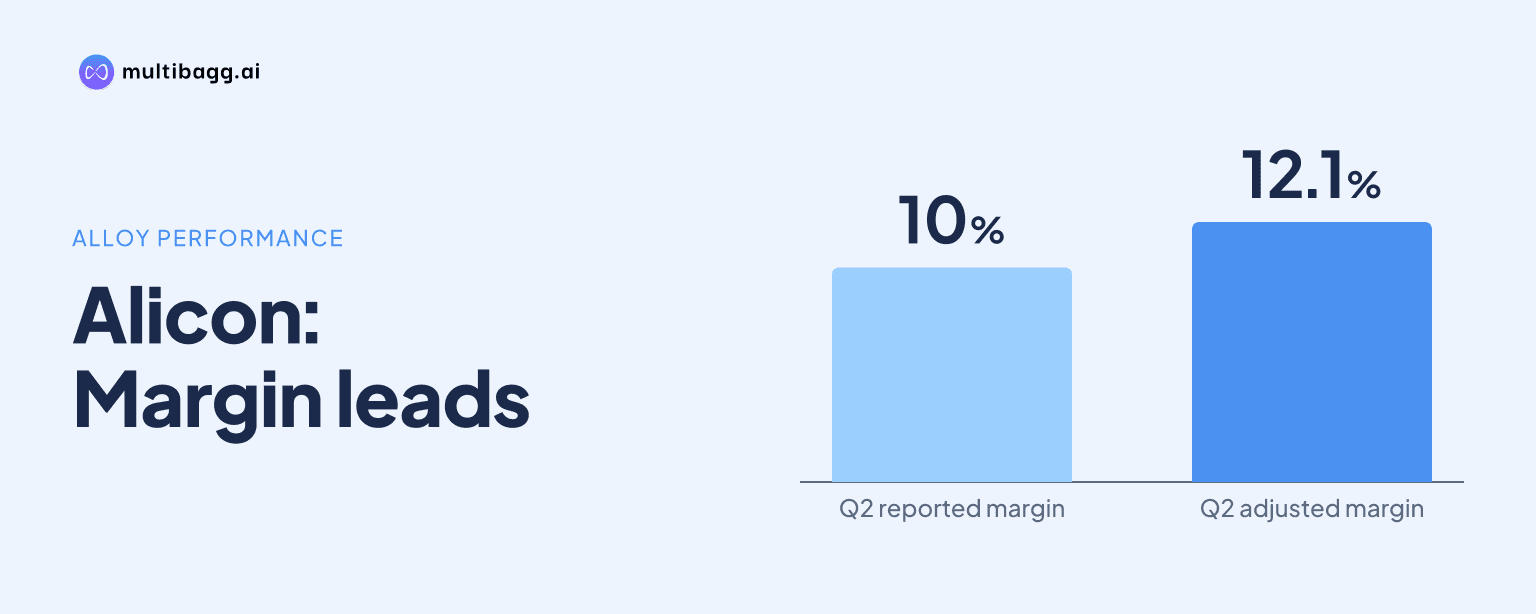
Alicon reported a 12.1% aluminium-adjusted earnings before interest, tax, depreciation and amortisation margin in the second quarter of fiscal year 2027 (Q2 FY27), compared with a 10% reported margin, as management pursued cost absorption, efficiency, input-cost recovery and higher-value product mix. Q2 consolidated EBITDA was Rs 65.3 crore on total income of Rs 652 crore.
Know Alicon Castalloy inside out
Results, valuation, peers and who's buying, in one view.
How did Alicon's Q2 FY27 margin change?
Alicon's reported EBITDA margin improved to 10% in Q2 FY27 from 9.5% in the preceding quarter, while the aluminium-price-adjusted measure was 12.1%. EBITDA rose 14% year-on-year and 18% sequentially to Rs 65.3 crore. Alicon described Q2 total income of Rs 652 crore as its highest reported quarterly revenue, up 50.4% year-on-year and 12.6% quarter-on-quarter.
The 2.1-percentage-point difference between the reported and adjusted margins reflects the effect of alloy pricing on revenue and costs. Chief Financial Officer Vimal Gupta said aluminium-price increases are passed to customers with a time lag. Management said it recovers 100% of raw-material price inflation, although the timing can affect the relationship between revenue and costs in a particular quarter.
For the first half of FY27 (H1 FY27), EBITDA increased 11% year-on-year to Rs 120.6 crore and profit after tax increased 25% to Rs 29.1 crore, while EBITDA margin was 9.8%. In Q2, profit before tax increased 26% year-on-year to Rs 23.9 crore and profit after tax rose 27% to Rs 17.6 crore.
What is distorting Alicon's reported EBITDA margin?
Alicon said aluminium pass-throughs affect reported revenue and margin comparisons because higher metal prices are recovered from customers after a time lag rather than immediately. Aluminium is Alicon's main raw material, and the CFO said November and December had already seen price decreases. He said management expected a 20% to 25% decrease from September to December, citing additional supply from Vietnam and Indonesia.
Alicon is also addressing inflation in labour, energy, freight and other operating expenses through price recoveries and structural cost actions. The 12.1% adjusted EBITDA margin excludes the stated effect of higher aluminium prices, whereas the 10% reported margin includes their effect on total income. Management's objective is to convert higher volumes and greater value addition into profitability less affected by commodity-driven revenue movements.
Management said volume growth was 19% in Q2, with commercial-vehicle business a major contributor after developments completed by the end of the previous financial year began growing. Alicon also cited increased share of business with some customers and demand from two Chennai-based customers whose products are exported to Europe and the United States, although those sales are recorded domestically.
How does Alicon plan to improve EBITDA margin structurally?
Alicon plans to improve EBITDA margin structurally through better cost absorption, operating efficiencies, input-cost recovery and higher use of existing capacity. Management said it is examining conversion cost, energy consumption, tooling, rejections, rework and manpower efficiency across manufacturing processes. These measures are intended to improve the underlying cost structure rather than only offset quarterly alloy-price movements.
The operating programme also includes improving material flow, automating critical operations and strengthening process controls. Management identified manpower productivity and process capability as priorities under its Reset, Refocus and Rebuild strategy. The stated aim is to make operations more consistent and productive as new customer programmes enter production, rather than merely increase output volumes.
Alicon is reviewing product and customer mix so capacity is increasingly directed to applications with higher value addition and returns. Machining accounted for about 68% of revenue, according to management. The H1 revenue mix was about 40% two-wheelers, 36% to 38% passenger vehicles, 18% commercial vehicles and the balance non-automotive; electric vehicles represented about 4% to 5% and hybrids about 6% to 7%.
Got a follow-up? Ask IRIS
Can Alicon fund expansion while containing leverage?
Alicon reported net debt of about Rs 322 crore at the end of H1 FY27, with net debt to annualised H1 EBITDA of 1.33 times and working-capital days of 34. Management said maintaining working-capital efficiency and cash conversion remains a priority as business volumes and capacity investment rise. These are Alicon's disclosed balance-sheet measures during its margin-improvement programme.
H1 capital expenditure was about Rs 70 crore, including Rs 40 crore of leasing, against a full-year plan of about Rs 150 crore. Management said the spending includes part of the Pune facility budget and is being phased in line with secured customer programmes. It expects capital expenditure to be funded primarily through internal accruals while evaluating further capacity additions against customer demand and original equipment manufacturer expansion plans.
The Pune plant remains on track for mass manufacturing by April 2027, management said. In its first year, management expects the facility to add about Rs 120 crore to Rs 150 crore of revenue, with larger contributions expected in FY28-29 after the ramp-up period. That timetable leaves productivity, utilisation and mix improvements at current facilities important before the new site reaches meaningful scale.
What targets and programmes could lift Alicon's margin?
Management reiterated FY27 guidance for 12% to 15% material-adjusted growth and said it expects to achieve a 12% adjusted margin during the year. The CFO said management expects at least 1 percentage point of margin improvement each year after that. In response to an analyst's question on a 14% to 15% margin by FY30, management said this was a company goal it was striving for rather than a reported result.
Alicon's executable order book was about Rs 6,700 crore as of 30 September, covering FY26-27 through FY31-32. Q2 order booking added eight parts from three customers, with about 95% in passenger vehicles and 5% in non-automotive. At peak, these wins are expected to have annual sales realisation of about Rs 270 crore and roughly Rs 1,000 crore over six years, with about 70% of volumes expected in 2028-29.
Nearer-term programme launches could support capacity absorption. Management said about 25 to 30 new part numbers are scheduled to enter start of production over the next year, including electric passenger-vehicle and global commercial-vehicle projects. Alicon expects export revenue to reach about 18% to 20% by the end of FY27 from 13% in Q2, supported by these launches, although management said global automotive demand remains uneven.
Conclusion
Alicon's Q2 FY27 results show a 10% reported EBITDA margin and a 12.1% aluminium-adjusted margin, with the difference reflecting the timing effects of alloy pass-throughs. Management's structural margin plan combines lower conversion and operating costs, more automation and capacity use, input-cost recovery, and a shift toward higher-value components as volumes rise.
The next measures to watch are the 25 to 30 planned part launches over the coming year, progress toward Pune mass manufacturing in April 2027, and performance against the stated 12% to 15% FY27 material-adjusted growth guidance. Management also plans about Rs 150 crore of FY27 capital expenditure, primarily funded through internal accruals, while monitoring working capital, which stood at 34 days in H1 FY27.