










AMIC Forging Ltd commits Rs 148 crore to capacity through FY28
Key highlights
- AMIC Forging disclosed about Rs 148 crore of Phase 1 extension and Phase 2 machinery commitments.
- The Rs 58 crore Phase 1 extension is expected to add 15,000 MTPA of forging and 10,000 MTPA of machining capacity.
- Phase 1 extension commercial production is expected at the start of Q4 FY27.
- AMIC Forging expects its approximately Rs 90 crore Phase 2 machinery project to go live by Q4 FY28.
powered by IRIS
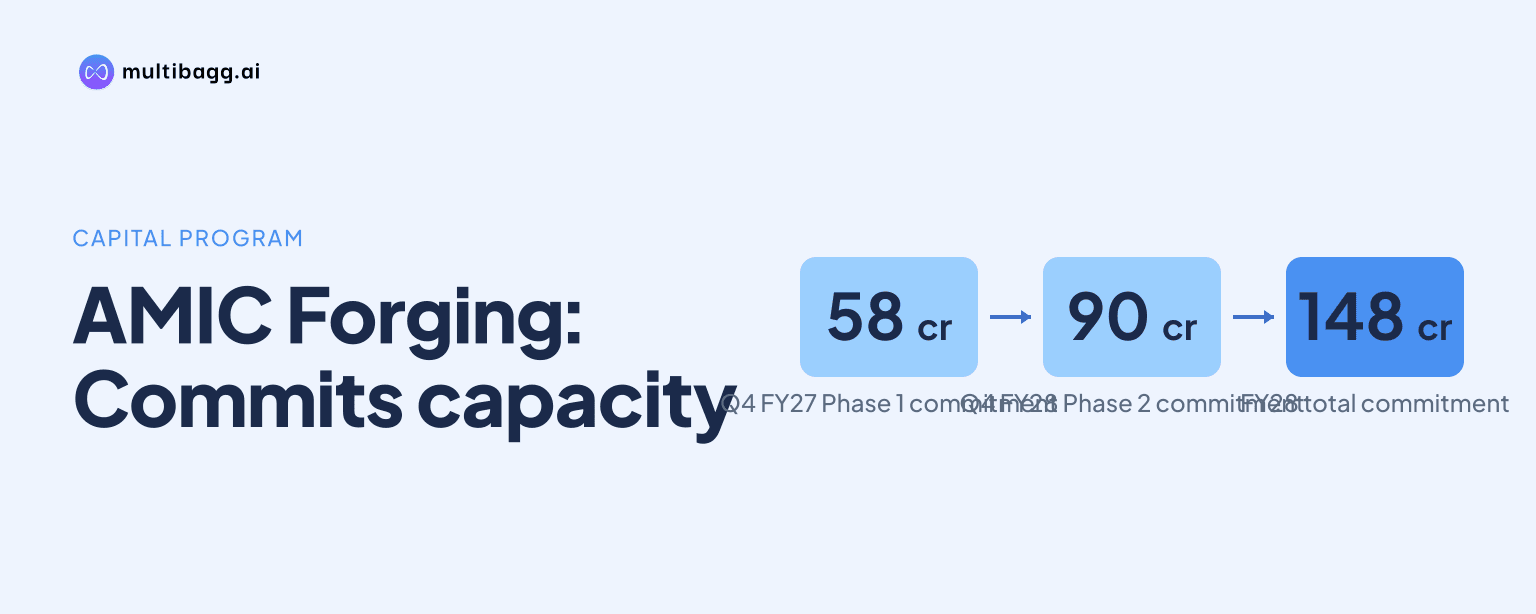
AMIC Forging Ltd has disclosed about Rs 148 crore of Phase 1 extension capex and Phase 2 machinery orders, with the Rs 58 crore extension targeted for commercial production at the start of Q4 FY27 and the Rs 90 crore Phase 2 project expected to go live by Q4 FY28.
Know Amic Forging inside out
Results, valuation, peers and who's buying, in one view.
What is AMIC Forging’s Rs 148 crore expansion plan?
AMIC Forging’s disclosed commitment comprises approximately Rs 58 crore for a Phase 1 extension and approximately Rs 90 crore for Phase 2 machinery. The company decided on the Phase 1 extension during H1 FY27 after its assessment identified a demand-supply gap and it received incremental customer enquiries for additional forging and machining capacity.
The Rs 58 crore Phase 1 extension includes one 500-tonne press, one 800-tonne press and specialised computer numerical control, or CNC, machines. AMIC Forging said the advance paid for this equipment was included in loans and advances during H1 FY27, accounting for the increase in that balance from H1 FY26.
The Rs 90 crore Phase 2 machine order is from SMS, Italy, and AMIC Forging has also ordered related infrastructure. Payments for Phase 2 started in H2 FY27, while all capital work-in-progress reported at H1 FY27 related to Phase 1. The presentation does not disclose the infrastructure cost, so Rs 148 crore represents the stated Phase 1 extension and Phase 2 machinery commitments rather than a full Phase 2 project-cost figure.
How much capacity will the Phase 1 extension add?
The Phase 1 extension is expected to add 15,000 metric tonnes per annum, or MTPA, of forging capacity and 10,000 MTPA of machining capacity. Ingot capacity remains 48,000 MTPA, while the extension is intended to support further value-added products in forging and machining.
Forging capacity is set to rise from 40,000 MTPA under Phase 1 to 55,000 MTPA after the extension, while machining capacity rises from 33,000 MTPA to 43,000 MTPA. This means the extension increases forging capacity by 15,000 MTPA and machining capacity by 10,000 MTPA without adding to the 48,000 MTPA ingot capacity.
The post-extension configuration is also materially above the pre-expansion base of 18,000 MTPA in forging and 8,400 MTPA in machining. The presentation lists pre-expansion ingot capacity as nil, compared with 48,000 MTPA after Phase 1 and its extension.
When will AMIC Forging commission the added capacity?
AMIC Forging expects the Phase 1 extension to commence commercial production by the start of Q4 FY27 and expects Phase 2 to go live by Q4 FY28. These dates are management expectations, rather than completed commissioning milestones, and the company has not provided a more specific date for Phase 2.
The underlying Phase 1 project has already entered commercial production. AMIC Forging said Phase 1 went live on 18 September 2026, and commercial production commenced on 12 November 2026 after trial runs and requisite statutory approvals.
Management did not give a firm ramp-up estimate, but said its internal assessment, orders in hand and new enquiries supported an expectation of more than 80% Phase 1 capacity utilisation by Q4 FY27. That expectation concerns Phase 1, not Phase 2, whose capacity addition and production ramp have not been disclosed.
Got a follow-up? Ask IRIS
What operating evidence supports the capacity expansion?
AMIC Forging reported H1 FY27 revenue of Rs 97.7938 crore, up 46.9% year on year, and earnings before interest, tax, depreciation and amortisation, or EBITDA, of Rs 26.3353 crore, up 44.5%. Management said machining capacity expanded partially in H1 FY27 and that the effect had begun to flow into reported performance.
Profit after tax was Rs 19.2606 crore in H1 FY27, up 55.3% year on year, while EBITDA margin was 26.93% versus 27.34% in H1 FY26. Management attributed an approximately 142% rise in employee cost to front-loading investment in talent, which it said was intended to support profitability in later periods.
The machining rollout also affected working capital in H1 FY27. AMIC Forging said its normal debtor cycle is generally 90 days, but sales from expanded machining were generated in the final three months of the half-year, causing debtors to include those sales as well as base sales. Management described the current debtors-to-sales ratio as a one-off and expects it to normalise as sales grow and receivables are realised.
What remains undisclosed about Phase 2?
AMIC Forging has not disclosed Phase 2 capacity, its expected utilisation, its revenue contribution or the cost of related infrastructure. Those omissions mean the supplied presentation does not allow a calculation of Phase 2 capital cost per tonne or a comparison of its capacity addition with the 15,000 MTPA forging and 10,000 MTPA machining additions planned under the Phase 1 extension.
The company also has not disclosed its order book or an industry-wise order breakdown, citing contractual obligations and strategic business reasons. Management reiterated its earlier guidance for triple-digit revenue and profitability growth over the next few years, but stated that forward-looking outcomes may differ because of market, regulatory and operational risks.
On supply conditions, AMIC Forging said the Middle East conflict had caused no major operational impact as of its H1 FY27 communication. It is maintaining buffer stock to mitigate unforeseen supply-chain risk, although the presentation gives no figure for the inventory amount or its cost.
Conclusion
AMIC Forging’s disclosed Rs 148 crore programme has two stages: a Rs 58 crore Phase 1 extension that takes forging capacity to 55,000 MTPA and machining capacity to 43,000 MTPA, followed by a Rs 90 crore Phase 2 machinery order. The first stage has defined capacity additions, while Phase 2 has a disclosed supplier and commissioning target but no stated capacity.
The next milestones are the Phase 1 extension’s expected commercial production at the start of Q4 FY27, management’s expectation of more than 80% Phase 1 utilisation by Q4 FY27, and Phase 2’s planned go-live by Q4 FY28. Disclosure of Phase 2 capacity, infrastructure spending and order-book support would clarify the scale and timing of the next expansion stage.