










TFS targets APAC lounge growth and expressway QSR expansion
Key highlights
- TFS plans to pursue APAC and Middle East lounge opportunities while scaling expressway QSRs in India.
- India’s expressway travel-QSR market is projected at Rs 26,500 crore to Rs 28,500 crore by 2035.
- TFS had 535 travel-QSR outlets and 35 lounges as of September 30, 2026.
- TFS reported a 92.1% airport-concession contract-retention rate and an 8.41-year average concession duration.
powered by IRIS
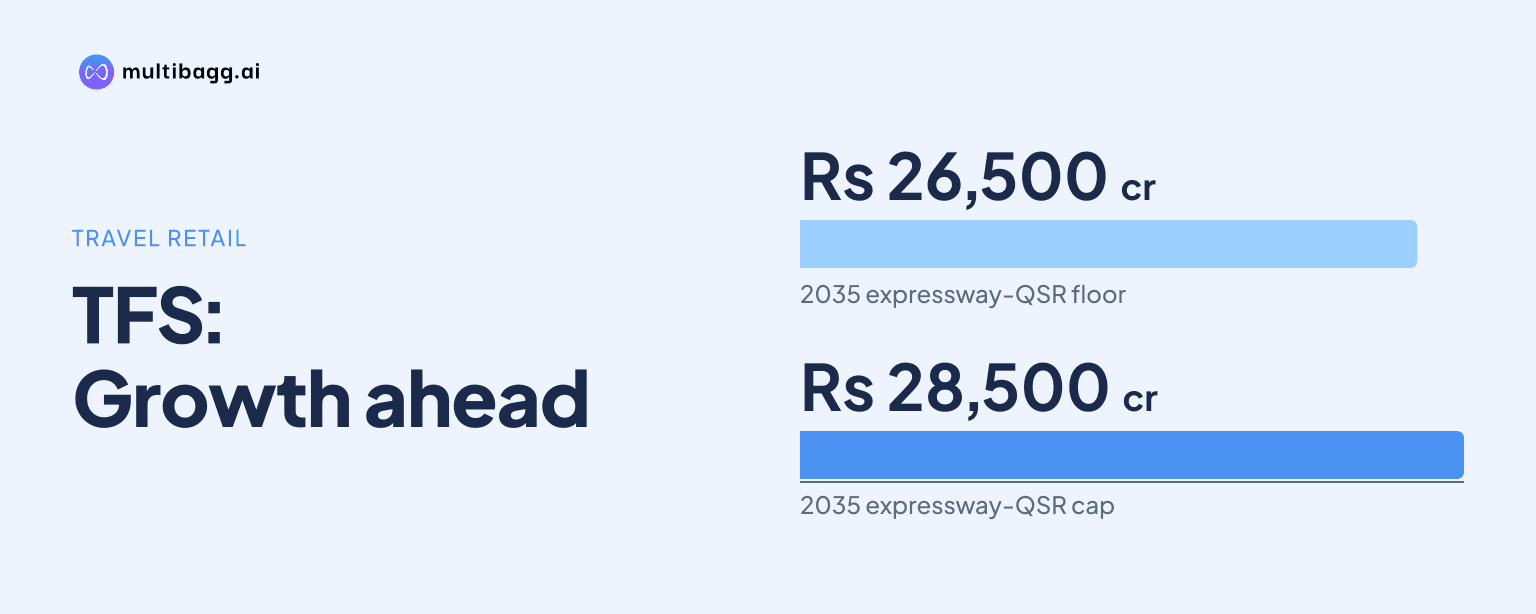
Travel Food Services Limited (TFS) plans to pursue APAC and Middle East lounge opportunities and scale expressway quick-service restaurants, or QSRs, as India’s expressway travel-QSR market is projected to reach Rs 26,500 crore to Rs 28,500 crore by 2035. The strategy supplements TFS’s airport food-service and lounge platform, with 535 QSR outlets and 35 lounges at September 30, 2026.
Know Travel Food Services inside out
Results, valuation, peers and who's buying, in one view.
What markets is TFS targeting beyond Indian airports?
TFS is targeting Asia-Pacific, or APAC, and Middle East markets for international lounge growth, while planning to scale travel QSRs on Indian expressways. Management presents these as future-growth priorities alongside expanding its core airport business, improving like-for-like, or LFL, sales, and growing space in existing and new markets. The presentation does not specify a launch date, capital allocation or country-level expansion timetable for the APAC and Middle East plan.
The international lounge initiative extends an existing overseas footprint rather than representing a first international entry. At September 30, 2026, TFS operated across three countries, including through a 49.9% holding in SSP Malaysia Sdn Bhd and a 49.0% holding in SSP TFS HK Lounge Ltd. Its KYRA Lounge at Hong Kong International Airport was named Asia’s Leading Airport Lounge at the 2026 World Travel Awards for the second consecutive year.
Management identifies bank and card partnerships, operating complexity, and security and compliance requirements as structural entry barriers in global lounges. Those mechanisms matter because 70% to 80% of Indian airport lounge passenger traffic is driven through credit cards, according to the presentation. TFS also describes technology-enabled services and a scalable travel-hospitality platform as part of the infrastructure it is building for future growth.
How large are the lounge and expressway QSR opportunities for TFS?
TFS is pursuing markets that its presentation expects to expand materially through FY35 or 2035, with Indian expressway travel QSR projected to be the fastest-growing of the three identified domestic categories. The table compares the industry-size forecasts cited by TFS, with all Indian rupee values shown in Rs crore.
The airport travel-QSR market is forecast to rise from Rs 4,100 crore in FY26E to Rs 8,000 crore to Rs 9,000 crore in FY30P, with stated growth of 18% to 20% in the earlier period and 17% to 19% thereafter. The airport lounge market is projected to increase from Rs 2,700 crore in FY26E to Rs 6,000 crore to Rs 6,500 crore by FY30P, with stated growth of 22% to 25% initially and 21% to 23% in the later period. The lounge forecast therefore has the higher stated growth range within airport consumption.
Expressway travel QSR expanded from Rs 400 crore in FY19 to Rs 1,500 crore in FY24, and the presentation cites a 30% compound annual growth rate, or CAGR, for the category. Its Rs 9,500 crore to Rs 10,500 crore FY30P estimate would exceed the FY30P airport-QSR forecast of Rs 8,000 crore to Rs 9,000 crore, although these are separate formats. TFS attributes the expressway outlook to expanding highway infrastructure, rising intercity mobility and more organised roadside consumption.
The global airport-lounge market is separately estimated at US$6.7 billion in 2023, compared with US$5.7 billion in 2019, and is projected at US$11 billion to US$12 billion by 2030. The presentation forecasts US$15 billion to US$17 billion by 2035 and cites 7% CAGR. This stated global growth rate is below the 30% CAGR cited for Indian expressway travel QSR.
Got a follow-up? Ask IRIS
What supports TFS’s airport-led growth plan in India?
TFS’s core expansion plan is supported by projected growth in Indian aviation passenger traffic, which is expected to increase from 420 million in FY26 to 605 million to 635 million in FY31P. The presentation expects traffic to reach 785 million to 815 million by FY35P, implying stated growth of 8.1% in the earlier forecast period and 6.6% in the later period. TFS says Indian passenger traffic is expected to grow at 7% to 8% CAGR, versus 3% to 4% globally.
India’s air-passenger traffic per capita was 0.29, compared with 1.08 in China and 5.59 in the United States, according to the presentation. TFS also cites Indian per-capita income growth of 3.5% CAGR versus 1.4% globally as a demand-side factor. Within airport food service, management identifies premium experiences, branded dining and longer dwell time as mechanisms that can lift food-and-beverage spending.
Supply additions could create locations for airport consumption formats. India had 163 airports in FY25, and the presentation estimates 350 to 400 by FY47E, while the aircraft order-book pipeline exceeded 2,400 aircraft against an existing fleet of more than 750. It also cites planned airport infrastructure capital expenditure of more than Rs 100,000 crore over the next five years and a near-term target to privatise 11 airports.
How is TFS positioned to execute the expansion strategy?
TFS enters the planned growth phase with a reported 30% share of the airport travel-QSR market and a 45% share of the lounge market. Its QSR business accounted for 55% of revenue as of the March 2026 consolidated financials, while lounges accounted for 41%; management and other services made up the remaining 4%. The platform had 156 brands across 535 travel-QSR outlets and 35 lounges as of September 30, 2026.
Its airport network covered 14 of India’s 15 largest airports by FY26 passenger traffic and served airports representing 74% of total Indian air-passenger traffic. TFS reports an average concession duration of 8.41 years and a 92.1% contract-retention rate, calculated as expired airport concessions renewed or won back as a percentage of total expired concessions. These partnerships and concession arrangements are the existing route through which TFS plans to grow new space in established markets.
The presentation also labels TFS debt-free with cash reserves for new opportunities, but gives no cash balance or expenditure commitment for the APAC, Middle East or expressway initiatives. It also does not disclose a rollout timetable, number of sites or individual-site economics. The strategy therefore establishes intended directions and market rationale, while leaving the pace and funding of expansion unresolved.
Conclusion
TFS is using its 535-outlet QSR and 35-lounge base to pursue growth beyond Indian airport food service, combining international lounge expansion with an Indian expressway-QSR plan. The market forecasts presented point to a Rs 26,500 crore to Rs 28,500 crore expressway category by 2035, while Indian airport lounges are forecast at Rs 15,500 crore to Rs 16,500 crore by FY35P.
What to watch next is whether TFS discloses specific APAC or Middle East lounge partnerships and the first expressway QSR locations, since the presentation provides no launch schedule or capital commitment. Core-business progress also remains relevant: TFS reported 92.1% contract retention and an 8.41-year average concession duration, while Indian air traffic is forecast to reach 605 million to 635 million by FY31P.