










TFS serves 14 of India’s 15 largest airports, retention 92.1%
Key highlights
- TFS says it is present at 14 of India’s 15 largest airports, representing 74% of FY26 national air passenger traffic.
- TFS reports an 8.41-year average airport concession duration and a 92.1% contract retention rate.
- TFS had 535 travel QSR outlets, 35 lounges and 156 brands as of September 30, 2026.
- Joint-venture and associate system-wide sales rose to Rs 1,566.60 crore in FY26 from Rs 876.40 crore in FY25.
powered by IRIS
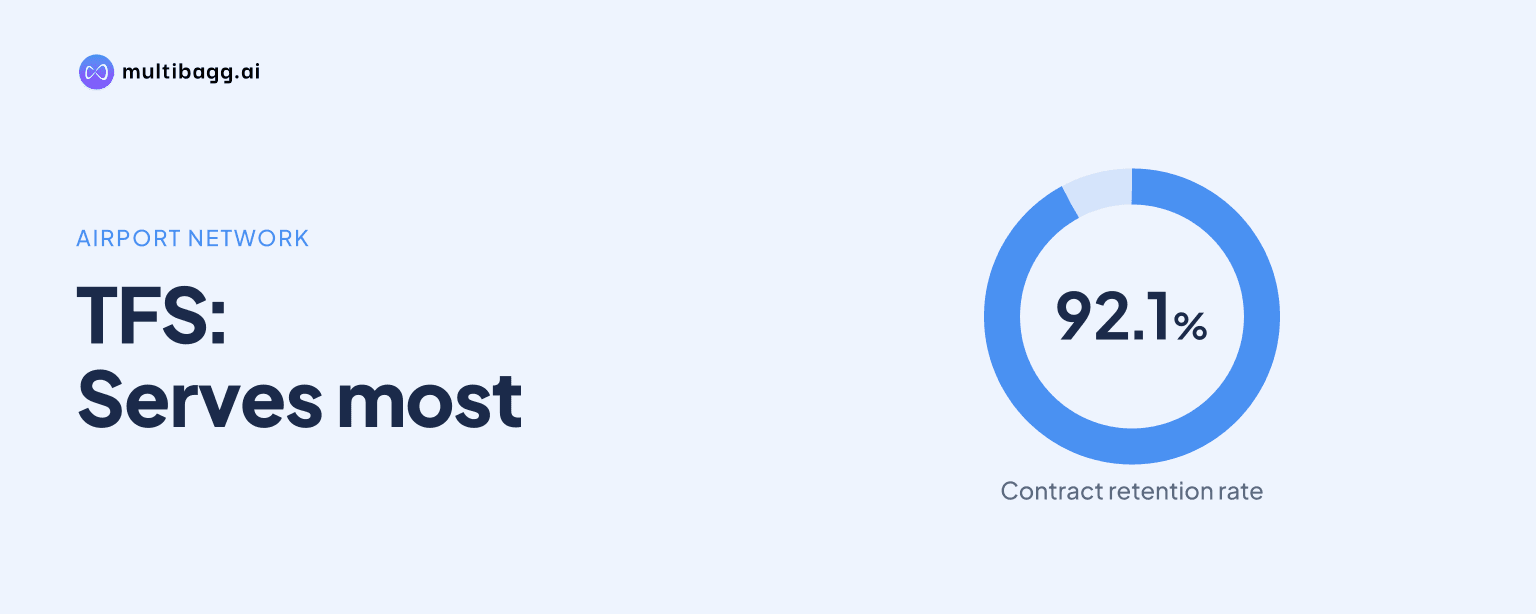
Travel Food Services Limited, or TFS, says it is present at 14 of India’s 15 largest airports by FY26 passenger traffic, representing 74% of national air passenger traffic, while its airport concessions average 8.41 years and its contract retention rate is 92.1%. The footprint combines directly held concessions with strategic partnerships and joint ventures.
Know Travel Food Services inside out
Results, valuation, peers and who's buying, in one view.
How broad is TFS’s airport concession footprint?
TFS says it serves 14 of India’s 15 largest airports, measured by FY26 passenger traffic, and that those airports account for 74% of India’s total air passenger traffic. Its stated existing presence extends across Indian locations including Delhi, Noida, Mumbai, Bengaluru, Chennai, Hyderabad, Kolkata, Ahmedabad, Goa and Thiruvananthapuram, as well as airports in Hong Kong and Malaysia.
TFS’s directly held India long-term concessions cover Delhi, Bengaluru, Chennai, Kolkata, Bhubaneswar, Goa Dabolim, Cochin and Noida. Its airport platform had 535 travel quick-service restaurant, or QSR, outlets and 35 lounges as of September 30, 2026, showing that the airport footprint supports both food-and-beverage operations and lounge services.
TFS reported a 30% share of the airport travel QSR market and a 45% share of the airport lounge market, according to the CRISIL Report 2026 cited in its presentation. The two divisions represented 55% and 41%, respectively, of revenue based on March 2026 consolidated financials, with management and other services constituting the remaining 4%.
How long are TFS airport concessions and how is retention calculated?
TFS reports an average concession duration of 8.41 years and a contract retention rate of 92.1%. The retention rate is the number of airport concession agreements that expired and were either renewed or won back, divided by the total number of airport concession agreements that expired; it is not stated as a percentage of all live contracts.
The presentation links the 8.41-year average duration to long-term contracts and partnerships with airport operators. It also identifies airport-operator relationships as a competitive strength of TFS’s travel QSR business, alongside its multi-format food-and-beverage offering and curated brand portfolio.
The presentation does not provide a year-by-year expiry schedule, individual concession end dates or the number of agreements included in the 92.1% calculation. The disclosed measure therefore does not show the timing or scale of renewals due after September 30, 2026, although TFS has disclosed both its average duration and its historical renewal-or-win-back measure.
What role do joint ventures play in TFS’s airport network?
Joint ventures and associates broaden TFS’s airport access beyond directly held concessions. Semolina Kitchens Limited covers Mumbai, Ahmedabad, Jaipur, Lucknow, Guwahati, Thiruvananthapuram and Navi Mumbai, while GMR Hospitality Limited, or GHL, covers Goa Mopa, Hyderabad and Bhogapuram; TFS identifies both as strategic partnerships.
TFS discloses a 24.99% interest in Semolina Kitchens Limited and a 30.00% interest in GHL. It also lists international partnerships with a 49.9% holding in SSP Malaysia Sdn Bhd and a 49.0% holding in SSP TFS HK Lounge Ltd., providing exposure to Kuala Lumpur, Kota Kinabalu, Kuching and Hong Kong through partnership structures.
The financial contribution of joint ventures and associates increased in FY26. System-wide sales attributed to joint ventures and associates rose to Rs 1,566.60 crore in FY26 from Rs 876.40 crore in FY25, while consolidated revenue declined to Rs 1,647.80 crore from Rs 1,687.70 crore. Total system-wide sales nevertheless rose 25.4% to Rs 3,214.40 crore in FY26 from Rs 2,564.20 crore in FY25.
Got a follow-up? Ask IRIS
How does TFS use brands and formats across its concessions?
TFS operates a portfolio of 156 brands across airport, Malaysian airport and Indian highway outlets as of September 30, 2026. The roster comprises 58 owned in-house brands, 36 franchised international brands and 62 franchised regional brands, creating a mix of proprietary concepts and externally owned food-and-beverage names.
The owned group includes hello Mercato!, caféccino, DILLI STREAT, idli.com and CURRY KITCHEN, while the international franchise list includes KFC, Nando’s, SUBWAY and Pizza Hut. Regional franchise partners include BIKANERVALA, THIRD WAVE COFFEE, WOW! momo and BOMBAY BRASSERIE, reflecting TFS’s stated work with partners to adapt offerings to the travel environment.
The number of brand partners rose from 55 in March 2023 to 76 in March 2024, 90 in March 2025 and 98 in March 2026, before remaining at 98 in September 2026. TFS says brand attractiveness can lead to master or multi-concession agreements, but the presentation does not quantify the number of agreements won through any particular brand relationship.
The 156-brand portfolio and 98 disclosed brand partners are separate system-wide measures. TFS also reported 535 travel QSR outlets as of September 30, 2026, distinguishing its brand roster, partner count and outlet network as different measures of scale.
What supports TFS’s travel QSR and lounge model?
TFS’s disclosed model combines travel QSR, lounges and partnerships across three countries. Travel QSR accounted for 55% of revenue in the March 2026 consolidated financials, versus 41% for lounges, while management and other services represented 4%.
The presentation identifies a 30% airport travel QSR market share and a 45% airport lounge market share, based on the CRISIL Report 2026. The difference between the two disclosed market-share measures coincides with a larger reported revenue contribution from travel QSR, at 55%, than from lounges, at 41%.
CRISIL projections cited by TFS place India’s airport travel QSR industry at Rs 4,100 crore in FY26E and Rs 8,000 crore to Rs 9,000 crore in FY30P. The Indian lounge industry is projected at Rs 2,700 crore in FY26E and Rs 6,000 crore to Rs 6,500 crore in FY30P, with the presentation also stating that credit cards drive 70% to 80% of Indian airport lounge passenger traffic.
Management’s stated priorities are to optimise products and service to grow like-for-like sales, expand in existing and new markets, develop technology-enabled services and build a scalable travel hospitality platform. It also plans to pursue lounge opportunities in Asia-Pacific and the Middle East while scaling expressway travel QSRs; these are plans rather than disclosed contracted additions.
Conclusion
TFS’s disclosed competitive position rests on coverage of 14 of India’s 15 largest airports, exposure to 74% of national passenger traffic at those airports, and an 8.41-year average concession duration. Its 92.1% retention metric records renewals or wins of expired concessions, while the FY26 increase in joint-venture and associate system-wide sales shows the growing role of partnership-led operations.
The next items to watch are management’s plans for Asia-Pacific and Middle East lounges, expressway QSR expansion and technology-enabled services. The presentation also leaves unresolved the timing of individual concession expiries and the number of contracts underlying the 92.1% retention rate, making future disclosures on renewals, wins and partnership expansion relevant.