










Travel Food Services Limited Q2 profit rises 50.5% with write-backs
Key highlights
- TFS reported Q2FY27 consolidated PAT of Rs 147.3 crore, up 50.5% year on year.
- Q2FY27 system-wide sales rose 18.8% to Rs 865.4 crore despite a 4.8% decline in passenger traffic.
- Q2FY27 PAT included approximately Rs 46.8 crore of net-of-tax provision write-backs.
- TFS expanded to 22 airports and 535 system-wide Travel QSR outlets by September 30, 2026.
powered by IRIS
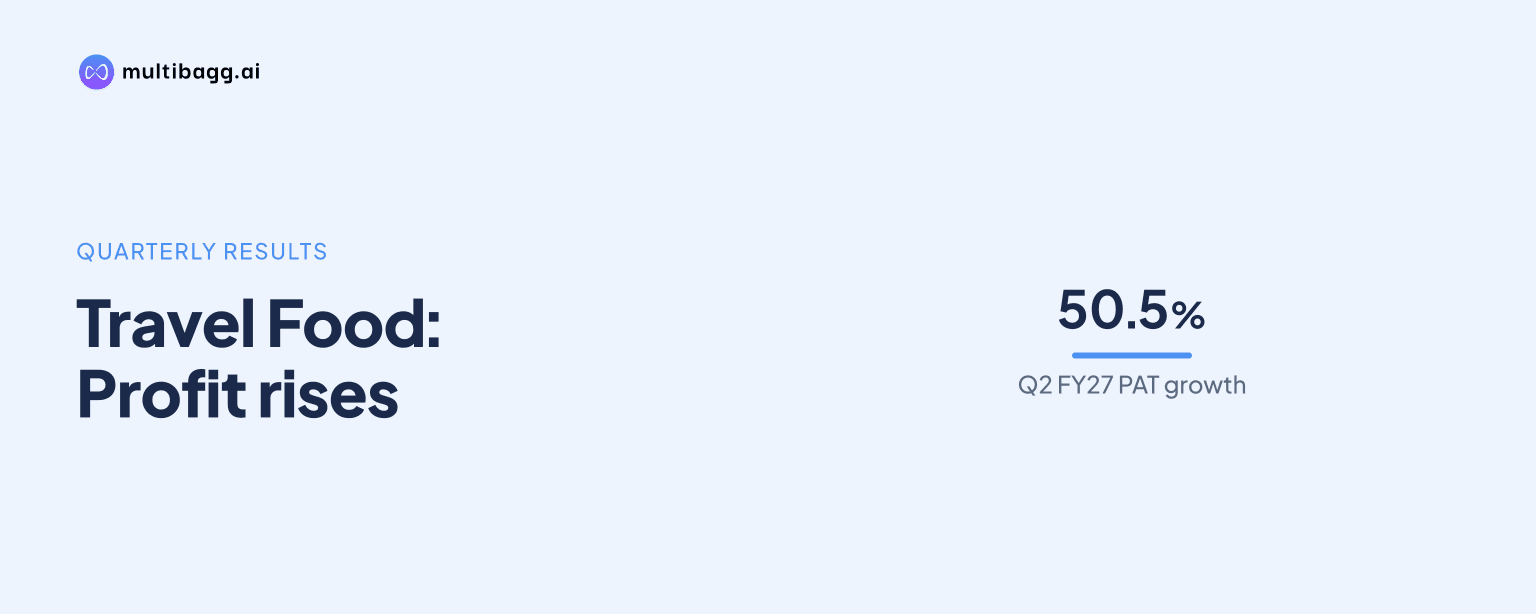
Travel Food Services Limited reported a 50.5% year-on-year increase in consolidated profit after tax to Rs 147.3 crore for Q2FY27 ended September 30, 2026, as consolidated sales rose 19.5% to Rs 425.3 crore and system-wide sales grew 18.8% despite a 4.8% decline in passenger traffic. Profit also included Rs 46.8 crore of net-of-tax provision write-backs.
Know Travel Food Services inside out
Results, valuation, peers and who's buying, in one view.
How did TFS perform in Q2FY27?
TFS increased Q2FY27 consolidated sales by 19.5% year on year to Rs 425.3 crore, while consolidated profit after tax, or PAT, rose 50.5% to Rs 147.3 crore. System-wide sales, which include TFS, its subsidiaries, associates and joint ventures, reached Rs 865.4 crore, compared with Rs 728.4 crore in Q2FY26.
TFS reported consolidated PAT as a percentage of consolidated sales of 34.6% in Q2FY27, compared with 27.5% a year earlier, an increase of 714 basis points. A basis point is one-hundredth of a percentage point. The company separately reports system-wide sales as a measure covering its broader network, while consolidated sales relate to its consolidated financial results.
For H1FY27, TFS reported system-wide sales of Rs 1,709 crore, up 18.4%, and consolidated sales of Rs 877.5 crore, up 20.1%. Consolidated PAT for the first half rose 43.2% to Rs 276.1 crore from Rs 192.9 crore in H1FY26, with PAT as a percentage of consolidated sales increasing to 31.5% from 26.4%.
What drove TFS sales despite lower passenger traffic?
TFS said new contracts and comparable outlet sales offset lower passenger volumes in Q2FY27. Net contract gains were 11.1% year on year in system-wide sales, while like-for-like, or LFL, sales rose 3.5%; LFL measures revenue growth from Travel QSR and lounge outlets that have operated for at least 12 months.
Passenger traffic at TFS-managed airports fell 4.8% year on year in Q2FY27 and 2.2% in H1FY27. TFS attributed the traffic pressure during the quarter to factors influenced by the West Asia crisis, while it said menu enhancement and premiumisation supported LFL sales growth despite that decline.
On the consolidated measure, net contract gains were 11.0% year on year in Q2FY27 and LFL sales rose 6.6%. TFS said the new-unit contribution included locations at Delhi Airport's Terminal 1 and Terminal 2, Cochin Airport's Domestic Terminal 1, and the recently opened Noida Airport, as well as its lounge aggregation business.
The first-half comparison showed a different mix in growth rates: system-wide net contract gains were 13.5% in H1FY27, above Q2's 11.1%, while system-wide LFL growth was 2.2%, below the quarter's 3.5%. At the consolidated level, H1FY27 net contract gains were 15.7% and LFL growth was 5.3%, compared with 11.0% and 6.6%, respectively, in Q2FY27.
How much of TFS profit growth came from write-backs?
TFS disclosed that Q2FY27 PAT included approximately Rs 46.8 crore of provision write-backs, net of tax. The reported Rs 49.4 crore increase in quarterly PAT from Rs 97.9 crore to Rs 147.3 crore therefore included a material contribution from this item, alongside sales growth, higher other income and increased share of profit from joint ventures.
For H1FY27, PAT included approximately Rs 56.6 crore of net-of-tax provision write-backs. That half-year amount also included a partial goods and services tax, or GST, provision write-back of approximately Rs 9.8 crore, net of tax, recognised in Q1FY27. TFS did not quantify in the release the separate contribution from sales growth, other income or joint-venture profit.
The quarter's 34.6% PAT as a percentage of consolidated sales was 7.1 percentage points above the prior-year quarter's 27.5%, while the H1FY27 measure rose 5.1 percentage points to 31.5%. These reported increases occurred alongside the disclosed provision write-backs and sales growth.
Got a follow-up? Ask IRIS
How did TFS expand its airport and outlet network?
TFS expanded its system-wide airport presence to 22 airports as of September 30, 2026, from 18 airports a year earlier. The increase included the start of operations at Alluri Sitarama Raju International Airport, Bhogapuram, and came alongside the mobilisation of more than 70 units over the preceding 12 months.
The system-wide Travel QSR, or quick-service restaurant, portfolio reached 535 outlets, compared with 464 at September 30, 2025. TFS added more than 70 outlets across New Delhi, Navi Mumbai, Cochin, Noida and other airports, while its portfolio of partner and in-house brands rose by 21 to 156 brands.
Not every operating segment expanded in the same direction. The lounge portfolio stood at 35 lounges at September 30, 2026, down from 37 a year earlier, primarily because of closures associated with terminal transitions and airport infrastructure renovations. TFS also said Elite Assist Technology and Services Private Ltd., or EATS, was extending lounge-access distribution beyond banking and card-network channels.
TFS reported a cash balance of Rs 1,030.9 crore as of September 30, 2026 and said it had no debt. Its stated cash-balance measure includes cash and cash equivalents, other bank balances and current investments.
What is TFS management watching for the second half?
TFS management said passenger-traffic recovery remains a key monitorable after geopolitical uncertainty, elevated airfares, airline schedule changes and capacity rationalisation affected travel patterns in H1FY27. The company expects the operating environment to improve gradually in the second half, subject to potential easing of geopolitical pressures and seasonally stronger travel demand.
Management's operating priorities are to improve productivity across the existing network, ramp recently opened locations and progress its development pipeline. The company said many of the more than 70 units mobilised over the past 12 months remain in ramp-up, and that a significant pipeline of outlets is yet to be mobilised at new and existing airports.
TFS also plans to deepen its presence at current airports, scale at new and greenfield airports, and selectively expand beyond its core in international lounges and expressways. These are management plans rather than financial targets, and the release gave no date or sales contribution forecast for the planned locations or EATS initiatives.
Conclusion
TFS delivered double-digit sales growth in Q2FY27 despite a 4.8% decline in passenger traffic, supported by new contracts, new outlets and positive LFL sales. Consolidated PAT grew 50.5%, faster than consolidated sales growth of 19.5%, but the disclosed Rs 46.8 crore provision write-back means the profit increase reflected both operating performance and a non-sales accounting benefit.
The next developments to watch are the pace of passenger-traffic recovery in the second half, the ramp-up of the more than 70 recently mobilised units and progress on outlets in TFS's development pipeline. Management also identified expansion at existing, new and greenfield airports, alongside EATS and selected international lounge and expressway opportunities, as its stated growth agenda.