








ANI Integrated Services Reports Rs 110.25 Crore Receivables
MAX Plan at ₹4,999/yr

Find your next multibaggerBe a Pro Investor
Research stocks and track your picks on the go. Download the app.
Key highlights
- ANI reported Rs 110.25 crore of trade receivables at September 2026, up from Rs 107.94 crore at March 2026.
- Trade receivables represented about 79.1% of ANI’s Rs 139.46 crore total assets at September 2026.
- ANI disclosed a 155-day working-capital cycle for March 2026.
- ANI reported H1 FY27 revenue of Rs 134.91 crore and a loss after tax of Rs 0.64 crore.
powered by IRIS
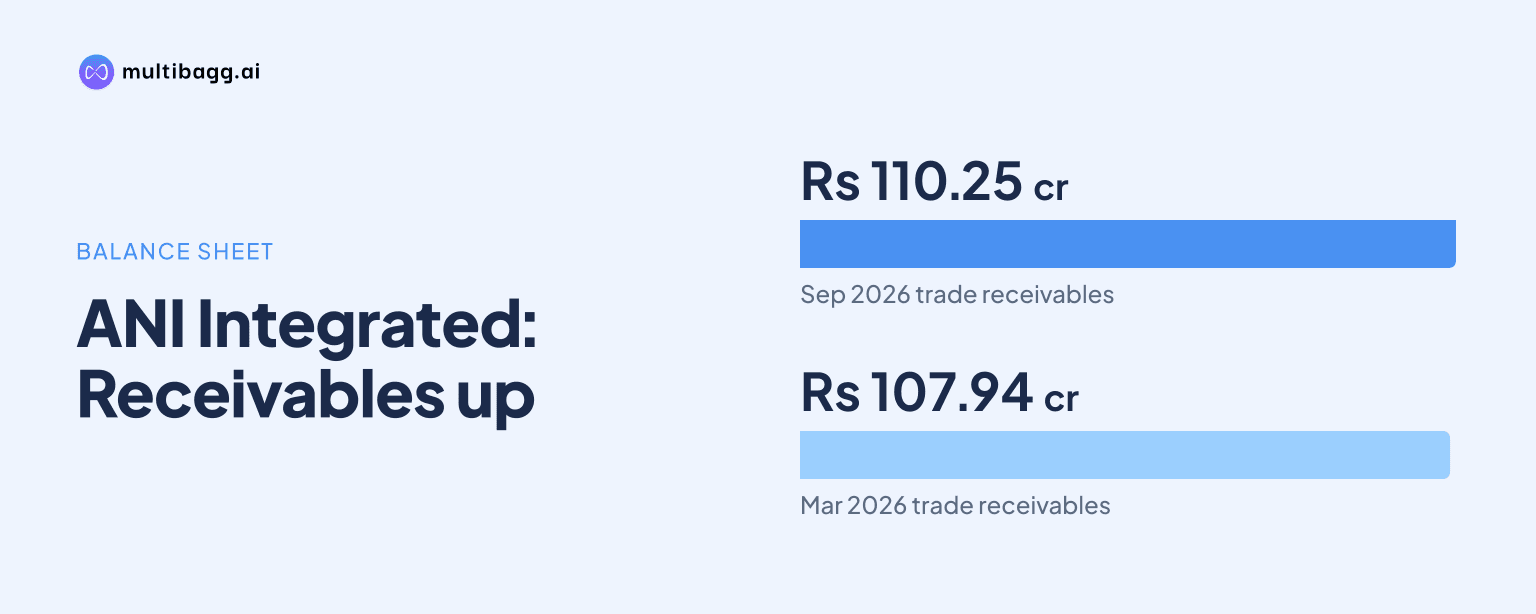
ANI reported trade receivables of Rs 110.25 crore at September 2026, equal to about 79.1% of total assets of Rs 139.46 crore, while disclosing a 155-day working-capital cycle for March 2026. The figures show that customer dues were the central component of ANI’s balance sheet at the latest reported date.
Know ANI Integrated Services inside out
Results, valuation, peers and who's buying, in one view.
How large were ANI’s receivables in September 2026?
ANI’s trade receivables were Rs 110.25 crore at September 2026, up Rs 2.31 crore from Rs 107.94 crore at March 2026 and up Rs 7.48 crore from Rs 102.77 crore at March 2025. Receivables represented about 84.3% of ANI’s Rs 130.85 crore in current assets at September 2026, based on the reported balance-sheet values.
The asset mix was concentrated in those dues. Cash and bank balances were Rs 10.05 crore, other current assets were Rs 10.55 crore, and total non-current assets were Rs 8.61 crore at September 2026. Trade receivables alone were more than 10 times the reported Rs 10.05 crore cash balance, showing the difference between recorded current assets and cash and bank balances.
ANI’s total assets increased Rs 4.81 crore between March 2026 and September 2026, from Rs 134.65 crore to Rs 139.46 crore. The Rs 2.31 crore rise in receivables accounted for nearly half of that increase, while cash and bank balances rose by Rs 3.39 crore and other current assets declined by Rs 1.98 crore over the same six-month comparison.
What does ANI’s disclosed 155-day working-capital cycle mean?
ANI disclosed a working-capital cycle of 155 days for March 2026. The presentation does not provide the calculation components, such as days sales outstanding, inventory days or payable days, so the figure cannot be separated into collection, stockholding and supplier-payment effects from the supplied information.
The 155-day metric is dated March 2026, whereas the Rs 110.25 crore receivables figure is dated September 2026. They should therefore not be treated as measurements of the same reporting date. Receivables nonetheless rose from Rs 107.94 crore in March 2026 to Rs 110.25 crore in September 2026, meaning the later balance sheet continued to carry a substantial amount of customer dues.
ANI’s current assets exceeded current liabilities by Rs 77.77 crore at September 2026, calculated from Rs 130.85 crore of current assets less Rs 53.08 crore of current liabilities. At March 2026, the equivalent difference was Rs 77.38 crore, from Rs 127.14 crore and Rs 49.76 crore respectively. The reported surplus changed by Rs 0.39 crore, despite a Rs 3.71 crore increase in current assets and a Rs 3.32 crore increase in current liabilities.
How did trade payables and borrowings change alongside receivables?
ANI’s trade payables increased to Rs 6.66 crore at September 2026 from Rs 2.76 crore at March 2026, a rise of Rs 3.90 crore. Over that period, trade receivables increased by Rs 2.31 crore. The presentation does not identify the customers, suppliers, due dates or ageing of these balances, so it does not establish the timing of collections or payments.
Current borrowings were Rs 16.36 crore at September 2026, compared with Rs 15.79 crore at March 2026 and Rs 21.32 crore at March 2025. Non-current borrowings rose to Rs 3.48 crore from Rs 0.61 crore in March 2026. Taken together, reported current and non-current borrowings were Rs 19.84 crore at September 2026, versus Rs 16.40 crore six months earlier.
Other financial liabilities were broadly unchanged at Rs 20.43 crore in September 2026 and Rs 20.48 crore in March 2026. Other current liabilities fell to Rs 5.86 crore from Rs 10.73 crore, while lease liabilities and provisions declined to Rs 0.56 crore from Rs 0.81 crore. These offsets explain why total current liabilities rose by Rs 3.32 crore even as trade payables rose by Rs 3.90 crore.
Got a follow-up? Ask IRIS
How does the balance sheet compare with ANI’s recent earnings?
ANI reported revenue from operations of Rs 134.91 crore for H1 FY27, compared with Rs 124.62 crore in H1 FY26, an increase of 8.3%. The September 2026 receivables balance of Rs 110.25 crore was therefore large relative to the Rs 134.91 crore reported for the six-month period, although a balance-sheet closing amount cannot be equated with revenue or used alone to calculate collections.
Profitability moved in the opposite direction during H1 FY27. Earnings before interest, tax, depreciation and amortisation, or EBITDA, were Rs 0.47 crore, down from Rs 6.01 crore in H1 FY26, and the EBITDA margin was 0.3% versus 4.8%. ANI reported a loss after tax of Rs 0.64 crore for H1 FY27, compared with profit after tax of Rs 2.83 crore a year earlier.
In Q2 FY27, revenue rose 12.2% year on year to Rs 73.71 crore, while EBITDA fell 65.0% to Rs 1.05 crore and profit after tax fell 85.0% to Rs 0.24 crore. Employee expenses increased to Rs 59.39 crore from Rs 46.87 crore in Q2 FY26, while other expenses declined to Rs 8.31 crore from Rs 12.72 crore. The presentation supplies these income-statement movements but does not attribute them to the working-capital cycle or receivable balance.
What balance-sheet capacity did ANI report before September 2026?
ANI reported total equity of Rs 82.34 crore at September 2026, down Rs 1.12 crore from Rs 83.46 crore at March 2026 but above Rs 67.77 crore at March 2025. Equity share capital was unchanged at Rs 11.69 crore between September and March 2026, while other equity reduced to Rs 70.65 crore from Rs 71.78 crore.
For March 2026, ANI reported net debt of Rs 16.21 crore and net debt to equity of 0.11 times. The presentation separately reports the 155-day working-capital cycle for that date, but it does not provide a target for reducing the cycle, a collection target, or a forecast receivables balance. The supplied material therefore provides a historical position rather than a stated timetable for working-capital improvement.
Conclusion
ANI’s September 2026 balance sheet was dominated by Rs 110.25 crore of trade receivables, which made up about 79.1% of Rs 139.46 crore in total assets and 84.3% of current assets. The balance rose from Rs 107.94 crore in March 2026, while ANI’s disclosed March 2026 working-capital cycle was 155 days. H1 FY27 revenue increased 8.3% to Rs 134.91 crore, but EBITDA declined to Rs 0.47 crore and ANI reported a Rs 0.64 crore loss after tax.
The next reported trade-receivables balance and any updated working-capital-cycle disclosure are the principal items to watch because the presentation gives no collection target or post-September 2026 plan. ANI also reported Rs 19.84 crore of combined current and non-current borrowings at September 2026, compared with Rs 16.40 crore in March 2026, making future changes in receivables, cash of Rs 10.05 crore and borrowings relevant to the reported balance-sheet position.

