










ANLON says local airport equipment costs 30% less than imports
Key highlights
- ANLON says made-in-India equipment costs about 30% less on average than imported equipment.
- Manufacturing and assembly represent about 30% of ANLON's business mix, versus about 51% for distribution.
- ANLON reported revenue from operations of Rs 105.83 crore in FY26, up from Rs 50.23 crore in FY25.
- Trade receivables were Rs 57.94 crore in H1 FY27, compared with Rs 35.58 crore in FY26.
powered by IRIS
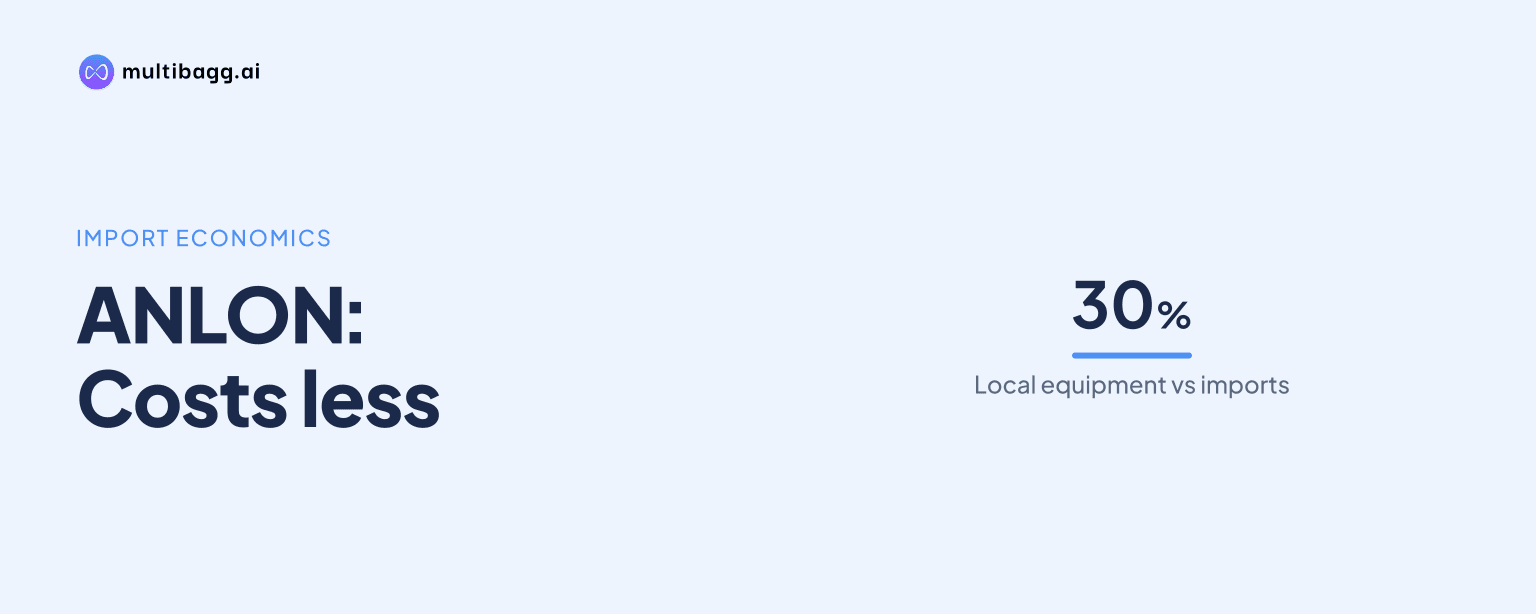
In its Make-in-India presentation, ANLON says its airport and critical-infrastructure equipment costs about 30% less than imports on average, a position it links to local design, engineering, assembly and sourcing. The company says the model can support tender qualification and faster execution.
Know Anlon Technology Solutions inside out
Results, valuation, peers and who's buying, in one view.
How does ANLON's Make-in-India model reduce equipment costs?
ANLON says its indigenous platform reduces costs by moving from an import-dependent model to in-house design, engineering and assembly, while sourcing locally and selectively importing critical safety components. The company puts the average difference between imported and made-in-India equipment at around 30%, rather than presenting this as a quoted price reduction for every product.
The model is intended to give ANLON more control over its cost structure and pricing than an import-led supply chain. Its presentation says India-specific product optimisation can also shorten execution relative to import-led timelines, while selective imports retain access to critical safety components for safety-focused equipment.
Which ANLON activities are being shifted toward indigenous manufacturing?
ANLON's manufacturing and assembly segment accounts for about 30% of its business mix, compared with about 51% for distribution and about 18% for annual maintenance contract (AMC) and services activity. The mix shows that manufacturing and assembly is a meaningful part of the business, although it remains smaller than the distribution operation shown in the presentation.
Within manufacturing and assembly, crash fire tenders represent about 41% of the product mix, emergency responsible vehicles about 24%, emergency crash foam tenders about 15%, and runway sweeping and moss or algae cleaning machines about 14%. Compact battery-operated sweeping machines account for about 5%, showing that the range covers firefighting, emergency response and airside cleaning applications.
ANLON also describes itself as a product introducer for the Indian airport industry. The company says lower local costs could allow it to introduce vehicles that were earlier not imported because of higher costs, while timely execution is specialised in public-safety applications.
What supports ANLON's tender eligibility and execution capability?
ANLON says certifications, technical capability and partnerships with original equipment manufacturers (OEMs) support its participation in high-value airport-equipment tenders. The company reports receiving EN 14043 certification from TÜV SÜD, becoming the first Indian manufacturer of a turntable ladder with rescue lift, and developing indigenous runway-cleaning solutions.
The company says it was the sole qualified bidder in a key tender, although the presentation does not name the tender, state its value or disclose an award outcome. ANLON also says it has exclusive or authorised partnerships with Rosenbauer International AG and Bucher Municipal, providing access to technology, components and high-value projects.
Its execution record includes the supply of rubber-removal systems, rapid-intervention vehicles and foam-mist vehicles for airport infrastructure projects. ANLON further reports completing the refurbishment of what it calls the world's largest firefighting vehicle at Goa Airport, illustrating its specialised service work alongside manufactured and distributed equipment.
Got a follow-up? Ask IRIS
Why does ANLON describe this as a high-utilisation growth phase?
ANLON says it is entering a high-utilisation phase because capital expenditure, vehicle testing, safety certifications and regulatory approvals have been completed, positioning it for large-scale orders. The company also says the capital-expenditure-to-utilisation cycle is extended because safety compliance and regulatory approvals require longer lead times.
The planned benefit is not limited to a vehicle's initial sale. ANLON says that as vehicle deployments scale, revenue from AMC and spare parts is expected to grow after commissioning. The company also says newer vehicles have shorter lead times and can be produced at scalable volumes, which it expects to improve working-capital efficiency and cash-flow management.
This strategy sits alongside an integrated model covering OEM partnerships, in-house manufacturing, supply, commissioning and maintenance. ANLON says increasing Make-in-India products should reduce reliance on imports and improve operational control, but the presentation provides no numerical target for the future manufacturing share.
How do ANLON's financial figures frame the manufacturing plan?
ANLON's reported figures show revenue from operations rose to Rs 105.83 crore in financial year 2026 (FY26) from Rs 50.23 crore in financial year 2025 (FY25), while profit after tax (PAT) increased to Rs 13.56 crore from Rs 12.86 crore. In the first half (H1) of FY27, revenue from operations was Rs 74.34 crore and PAT was Rs 9.21 crore; H1 FY27 is not directly comparable with the two full financial years.
The balance sheet shows trade receivables of Rs 57.94 crore in H1 FY27, up from Rs 35.58 crore in FY26, while cash and bank balances increased to Rs 42.38 crore from Rs 7.41 crore. Net worth reached Rs 128.21 crore in H1 FY27 from Rs 72.24 crore in FY26, alongside ANLON's stated aim of improving working-capital efficiency as production and deployments expand.
Conclusion
ANLON's central manufacturing proposition is that local design, assembly and sourcing can create an average cost advantage of about 30% against imported equipment while improving tender competitiveness and execution speed. The proposition spans a product range led by crash fire tenders and is supported by certification, engineering milestones, OEM partnerships, distribution, commissioning, AMC and spare-parts activity.
The next evidence to watch is whether large-scale vehicle deployments convert into the recurring AMC and spare-parts revenue ANLON expects, and whether newer vehicles deliver the shorter lead times it cites. Working-capital execution will also remain relevant as trade receivables stood at Rs 57.94 crore in H1 FY27, alongside the company's plan to scale volume production after its certification and approval phase.