










Anthem Biosciences reports 75%-78% domestic procurement
Key highlights
- Anthem Biosciences said 75%-78% of H1 FY27 procurement was domestic.
- China represented about 20%-21% of Anthem Biosciences procurement in H1 FY27.
- Anthem Biosciences said it reduced a Chinese-vendor reliance over roughly 18 months.
- Anthem Biosciences kept its Rs 1,200 crore Unit 4 Phase 1 capital-expenditure guidance unchanged.
powered by IRIS
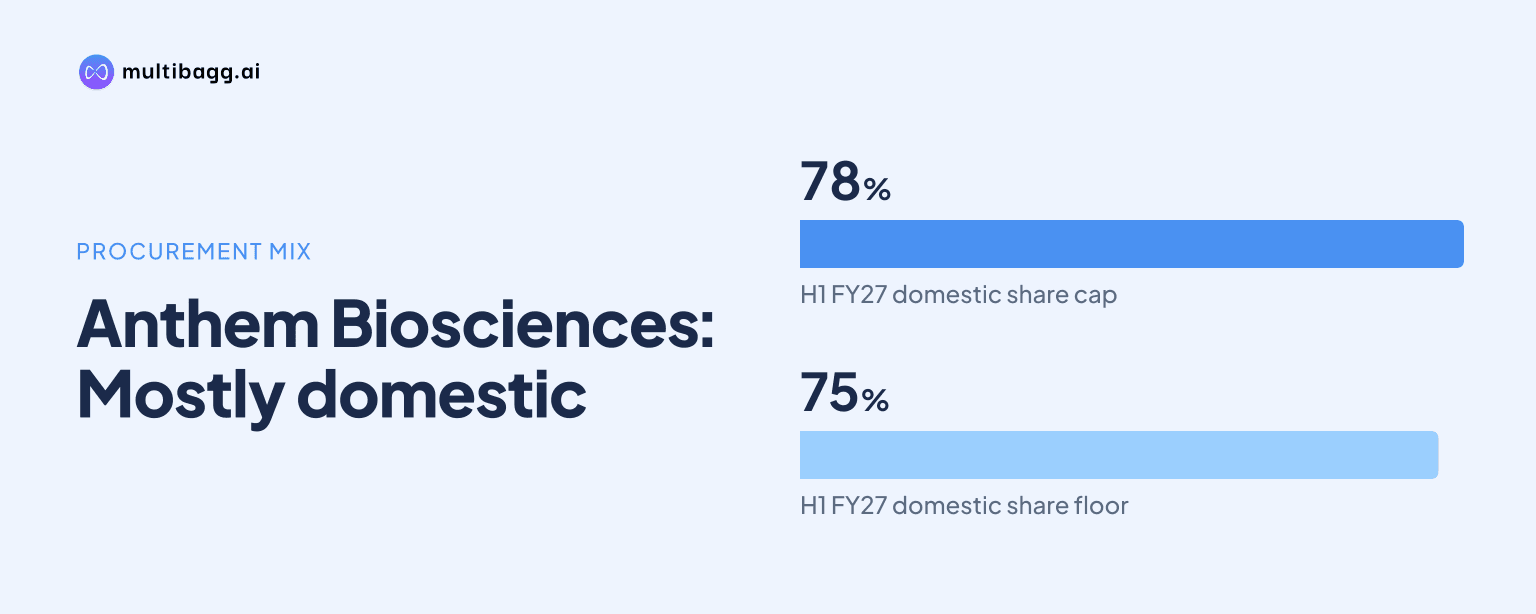
Anthem Biosciences Limited said 75%-78% of its procurement was domestic in H1 FY27, while China represented about 20%-21%, reflecting an 18-month effort to reduce a previously disclosed reliance on a Chinese vendor for one product. Management linked the shift to captive domestic vendors, backward integration and competitive manufacturing costs.
Know Anthem Biosciences inside out
Results, valuation, peers and who's buying, in one view.
How much of Anthem Biosciences' procurement is now domestic?
Anthem Biosciences said domestic procurement accounted for almost 75%-78% of its purchases on an H1 FY27 basis, leaving China at about 20%-21%. Chief Financial Officer Gawir Baig gave the split during the November 4, 2026 earnings call, describing it as current procurement data rather than a target for a later period.
The disclosure gives a sourcing measure rather than a rupee value or a product-by-product breakdown. Anthem Biosciences did not state the share supplied by countries other than India and China, nor did it provide a comparable percentage for an earlier half-year, but management said reliance on China had “definitely come down” over the prior 18 months.
The procurement update comes as Anthem Biosciences reported consolidated revenue from operations of Rs 1,012 crore for H1 FY27. Its contract research, development and manufacturing operations generated Rs 850 crore, while Specialty Ingredients generated Rs 162 crore, meaning the sourcing programme spans a business principally tied to manufacturing and development activity.
How did Anthem Biosciences reduce its reliance on China?
Anthem Biosciences said it moved away from a reliance disclosed in its draft prospectus on a Chinese vendor for one particular outsourced product. According to Baig, the company reduced that exposure over roughly 18 months and is developing captive vendors in India to supply starting materials.
Management did not identify the product, vendor or the earlier proportion of procurement sourced from China. That limits a numerical before-and-after calculation, but the company explicitly described the historical issue as dependence relating to one product, rather than saying every imported input had been replaced by domestic production.
The company also described a broader approach to process inputs in response to a question on specialised enzymes and biocatalysts. Managing Director and Chief Executive Officer Ajay Bhardwaj said that, once programmes move beyond early development into more mature stages, Anthem Biosciences is almost always self-sufficient through backward-integrated enzymes or its own fermentation-based solutions.
That description includes an important qualification: in early development, Anthem Biosciences may test inputs from different sources because it does not commit its own resources at that stage. The company’s stated preference is to internalise or localise supply as a project matures, rather than claiming that every early-stage project begins fully self-sufficient.
Got a follow-up? Ask IRIS
Why does domestic sourcing matter for Anthem Biosciences' costs?
Anthem Biosciences said domestic and backward-integrated sourcing is intended to improve supply availability and help it offer customers competitive cost of goods. Bhardwaj said the company seeks to avoid supply chains outside India because they have been “whimsical,” while customers depend on Anthem Biosciences to provide competitive manufacturing costs.
The link between localisation and profitability is not a one-factor explanation. An analyst noted a 3% gross-margin increase in the quarter, and Baig said reduced Chinese sourcing and fully in-house manufacturing had contributed, but he also attributed the change to shipment and product mix across customers with different margin profiles.
For Q2 FY27, Anthem Biosciences reported consolidated revenue of Rs 594 crore and earnings before interest, tax, depreciation and amortisation of Rs 330 crore, equal to a 50.6% margin. The figure included Rs 59 crore of other income, compared with Rs 48 crore in Q2 FY26, so the reported quarterly margin cannot be attributed solely to sourcing changes.
For H1 FY27, earnings before interest, tax, depreciation and amortisation were Rs 506 crore, a 46.2% margin, and profit after tax was Rs 331 crore, a 30.2% margin. H1 earnings before interest, tax, depreciation and amortisation included Rs 84 crore of other income versus Rs 70 crore in H1 FY26; management said cost efficiencies, yield optimisation and workforce productivity also supported year-on-year margin expansion.
What does the supply shift mean alongside Anthem Biosciences' operating scale?
Anthem Biosciences is localising inputs while expanding capacity, with its Rs 1,200 crore capital-expenditure plan for Unit 4 Phase 1 unchanged. The 30-acre facility is intended to be equivalent, in Phase 1, to Units 1, 2 and 3 combined, according to management on the November 4 call.
Management did not give a completion date or a new procurement target for Unit 4. It said Phase 2 would again be equivalent to Units 1, 2 and 3, but guidance for that phase will be given only after the board approves the capital expenditure. Of the current Unit 4 investment, Bhardwaj estimated that 30%-35% would go to biology, with the remainder to chemistry, subject to customer demand.
The commercial portfolio provides another indication of the manufacturing base being supplied. Anthem Biosciences had 15 commercial molecules and nine late-stage molecules in Q2 FY27, compared with 14 commercial and 10 late-stage molecules in the preceding quarter, after one programme received approval and entered the commercial category.
Management said 65% of its business comes from commercial manufacturing of approved molecules. It described the remaining 20 percentage points within its roughly 85% contract development and manufacturing business as split equally between research and development supplies, while Specialty Ingredients represents about 15% of business. These proportions underline why continuity of starting-material and process-input supply is operationally relevant.
Conclusion
Anthem Biosciences has reported a material domestic tilt in procurement, with 75%-78% sourced locally in H1 FY27 and China at 20%-21%. The company presents this as the outcome of moving beyond a specific Chinese-vendor dependence, adding domestic captive suppliers and using backward integration for mature programmes. Management also says the model supports competitive costs, although it attributes margin movement to sourcing, in-house production and product mix together.
The next point to watch is execution of the unchanged Rs 1,200 crore Unit 4 Phase 1 plan, including the mix between biology and chemistry capacity. Investors can also monitor whether management provides a more specific sourcing target, further detail on domestic vendor development, or an update on Phase 2 after board approval; none was disclosed on the November 4, 2026 call.