










The Anup Engineering Limited Q2 EBITDA Falls 66% to ₹17.44 Crore
Key highlights
- Anup Engineering reported Q2 EBITDA of ₹17.44 crore, down 66.12% year on year from ₹51.48 crore.
- Operating EBITDA margin declined 1,260 basis points to 9.56% from 22.16% in the prior-year quarter.
- Anup Engineering reported an order book of ₹985 crore and FY27-to-date new orders of ₹538 crore.
- Management had guided for FY27 revenue growth of 5% to 10% and an EBITDA margin of 15%.
powered by IRIS
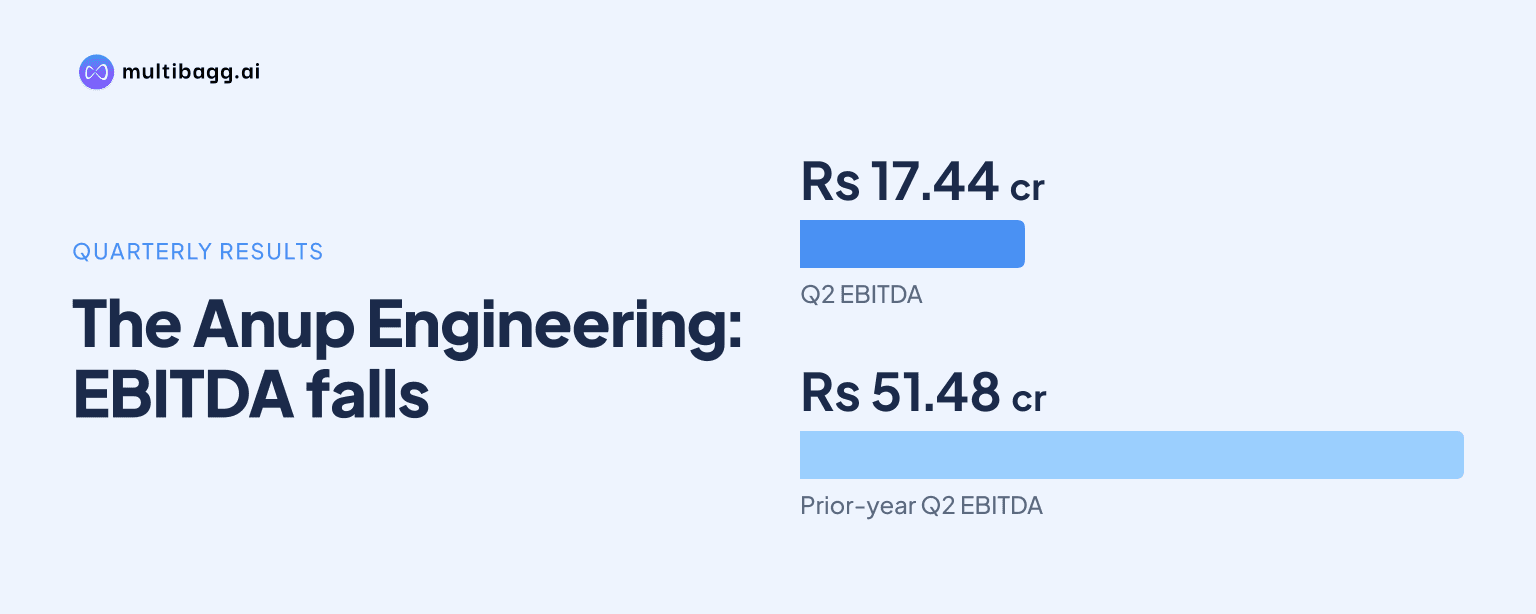
The Anup Engineering Limited reported Q2 EBITDA of ₹17.44 crore, a 66.12% year-on-year decline from ₹51.48 crore, while its operating EBITDA margin narrowed to 9.56% from 22.16%. The figures point to significant pressure on the company's operating profitability during the quarter.
Know The Anup Engineering inside out
Results, valuation, peers and who's buying, in one view.
What were Anup Engineering's Q2 EBITDA and margin figures?
Anup Engineering reported EBITDA of ₹17.44 crore for Q2, compared with ₹51.48 crore in the corresponding quarter a year earlier. This represents a year-on-year fall of ₹34.04 crore, or 66.12%, in operating earnings.
The operating EBITDA margin stood at 9.56%, against 22.16% in the prior-year quarter. The decline of 1,260 basis points indicates that profitability weakened substantially relative to the company's revenue base during the period.
The reported data focuses on operating profit and margin, and does not provide a Q2 revenue figure alongside these metrics. It also does not state a separate detailed break-up of costs, product mix, or other factors behind the margin movement.
How significant was the year-on-year deterioration in profitability?
The deterioration was significant because EBITDA fell by roughly two-thirds while the margin fell below 10%. Anup Engineering's EBITDA of ₹17.44 crore was only about one-third of the ₹51.48 crore reported in the comparable previous-year quarter.
A 1,260-basis-point margin contraction is equivalent to a 12.60-percentage-point reduction. Operating margin moved from 22.16% to 9.56%, showing that the earnings decline was not limited to a modest change in quarterly operating conditions.
The scale of the margin change is relevant for shareholders because EBITDA measures profit from core operations before interest, tax, depreciation and amortisation. A lower EBITDA margin means a smaller portion of revenue was retained as operating earnings.
What recent operating context has Anup Engineering disclosed?
Anup Engineering's most recently cited Q1 FY27 performance had already indicated operational pressure. The company reported revenue of ₹125.25 crore for the quarter ended June 2026, down 28.5% year on year, while net profit declined 97.8% to ₹0.57 crore.
The Q1 FY27 commentary attributed the weaker result primarily to lower execution and fixed-cost under-absorption. Lower execution can affect revenue recognition in an engineering business, while fixed costs can weigh more heavily on margins when production or project activity is lower.
The company had also reported an order book of ₹985 crore and new orders of ₹538 crore for FY27 to date in information included in the source material. Management had guided for 5% to 10% revenue growth and a 15% EBITDA margin for FY27, while indicating that it expected improvement in the second half.
Anup Engineering is also working to stabilise operations at its Kheda facility, which handles larger equipment, and to integrate MEPL for geographical diversification in South India. These operational initiatives form part of the broader context for its execution and profitability targets.
Got a follow-up? Ask IRIS
What should investors assess after the Q2 operating update?
Investors should assess whether the Q2 margin pressure reflects continuing execution and cost-absorption issues or whether management identifies other specific reasons for the decline. The supplied Q2 data establishes the magnitude of the EBITDA and margin fall, but it does not provide a detailed explanation of the drivers.
The company scheduled a post-results conference call on November 6, 2026 at 5:30 PM IST to discuss Q2 and H1 FY27 results. Managing Director Reginaldo Dsouza was identified as the host, and presentation materials were expected to be posted online.
For the market, the key disclosed reference points remain the ₹985 crore order book, FY27 new orders of ₹538 crore to date, and management's stated guidance for 5% to 10% revenue growth with a 15% EBITDA margin. The relationship between the order pipeline, project execution and fixed-cost absorption will be important to understanding subsequent quarterly results.
The source material also referred to the termination of Anup Engineering's manufacturing and supply agreement with Graham India Private Limited and Graham Corporation, USA, effective October 2, 2025. No direct link between that agreement termination and the reported Q2 EBITDA movement has been stated in the supplied information.
Why does EBITDA margin matter for an engineering company?
EBITDA margin matters because it shows how much operating profit a company generates from its revenue before financing costs, taxes and non-cash depreciation and amortisation charges. For a project-led engineering manufacturer, margins can be influenced by execution pace, capacity utilisation, product mix and the absorption of fixed costs.
Anup Engineering's reported movement from 22.16% to 9.56% therefore provides a clearer measure of the quarter's operational stress than EBITDA alone. The company has set a 15% EBITDA-margin guide for FY27, making the gap between the reported Q2 margin and that stated benchmark relevant for monitoring future disclosures.
Conclusion
The Anup Engineering Limited's Q2 figures show a sharp contraction in operating profitability, with EBITDA falling 66.12% year on year to ₹17.44 crore and the operating EBITDA margin declining 1,260 basis points to 9.56%. The data indicates a marked deterioration from the corresponding prior-year period, while the supplied information does not provide a detailed Q2 cost or revenue breakdown.
The next scheduled point of reference is the company's November 6, 2026 post-results call on Q2 and H1 FY27. Investors will look for management's comments on execution, fixed-cost absorption, the Kheda facility, order-book conversion and progress toward the stated FY27 revenue-growth and 15% EBITDA-margin guidance.