








Apex Ecotech H1 Margin Dip Tied to Legacy Cost Overruns
MAX Plan at ₹4,999/yr

Find your next multibaggerBe a Pro Investor
Research stocks and track your picks on the go. Download the app.
Key highlights
- Apex Ecotech's H1 FY27 revenue rose 189% year on year to Rs 94.27 crore.
- H1 FY27 EBITDA increased approximately 75% to Rs 5.25 crore, slower than revenue growth.
- Profit after tax rose from Rs 2.57 crore in H1 FY26 to Rs 4 crore in H1 FY27.
- Apex Ecotech ended H1 FY27 with a pending order book of more than Rs 55 crore.
powered by IRIS
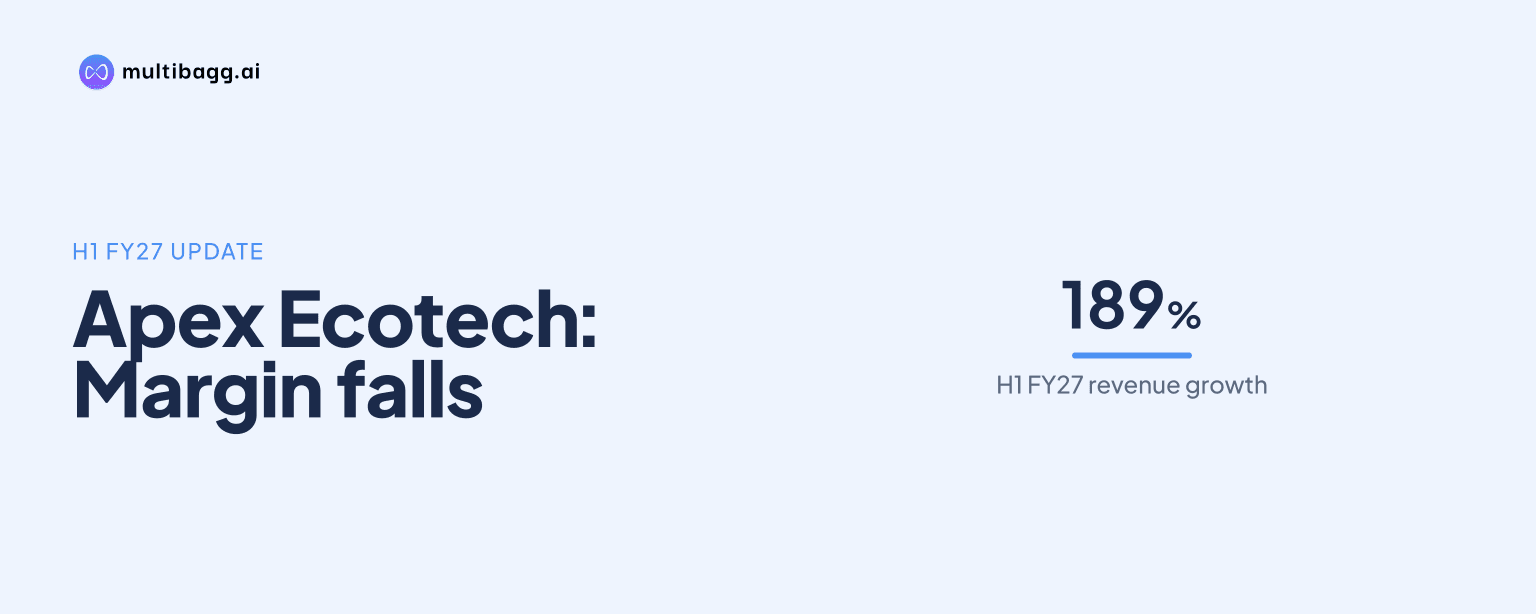
Apex Ecotech Limited said H1 FY27 revenue rose 189% year on year to Rs 94.27 crore, while EBITDA increased 75% to Rs 5.25 crore because legacy contracts absorbed input-cost increases and two large projects booked installation costs before their certification-linked revenue could be recognised.
Know Apex Ecotech inside out
Results, valuation, peers and who's buying, in one view.
Why did Apex Ecotech's H1 FY27 margins moderate?
Apex Ecotech's H1 FY27 margins moderated because certain earlier contracts bore higher material costs without contractual protection to pass price increases on to customers. Management linked those increases to the ongoing geopolitical conflict and said the affected contracts lacked price-escalation provisions. The cost pressure was concentrated in material procurement for projects whose execution contributed to H1 FY27 revenue of Rs 94.27 crore.
Management said procurement for most of these older projects is now substantially complete, meaning the associated input-cost effect was largely absorbed in H1 FY27. Apex Ecotech has revised prices on newer projects to reflect prevailing input costs. That change is a contractual and pricing response, rather than a statement that all cost pressure has ended, and its effect will depend on the mix and execution of new work.
How did Apex Ecotech's H1 FY27 profit growth compare with revenue?
Apex Ecotech's revenue rose faster than its profit measures in H1 FY27, consistent with management's explanation of higher legacy input costs and costs booked ahead of milestone-linked revenue. Revenue from operations increased from Rs 32.57 crore in H1 FY26 to Rs 94.27 crore in H1 FY27, while profit before tax rose from Rs 3.44 crore to Rs 5.42 crore.
Profit after tax increased from Rs 2.57 crore to Rs 4 crore, while management described the increase as approximately 55%. EBITDA, or earnings before interest, tax, depreciation and amortisation, rose approximately 75% to Rs 5.25 crore. The difference between 189% revenue growth and 75% EBITDA growth is the reported indication that additional project scale did not translate proportionately into H1 operating profit.
When can Apex Ecotech recognise the delayed project revenue?
Apex Ecotech expects the relevant milestones at two large sites to be completed during H2 FY27, when management says the remaining installation and commissioning revenue can be recognised. Each project has two parts: equipment and material supply, followed by installation and commissioning. Supplies had been completed, but the latter work was still progressing across both sites during H1 FY27.
The accounting and execution timing created the stated mismatch: labour and site costs for erection, installation and commissioning were charged in H1 FY27, while revenue for the remaining work awaits completion of the relevant milestones. Management said the majority, though not all, of the associated expense had already been taken in the first half. Because the two sites formed a major part of execution, management described their effect on H1 margins as meaningful.
Got a follow-up? Ask IRIS
What does the certification timing mean for cash flow and working capital?
Apex Ecotech said the H1 FY27 increase in execution and invoicing also raised receivables and working-capital deployment. The company cited vendor advances and payments made to mitigate incremental costs as additional uses of cash. Its stated H2 FY27 priorities are completing installation and commissioning milestones, collecting dues on time and improving cash conversion.
This means the expected H2 benefit is not limited to revenue recognition and reported profitability. Management said it wants business growth to translate progressively into stronger operating cash flows while maintaining financial discipline. The outcome depends on customer certifications, timely collections and the conversion of invoices into cash, none of which management presented as completed at the November 19, 2026 H1 FY27 earnings call.
Can Apex Ecotech improve margins in H2 FY27?
Apex Ecotech said it expects completion of the two large-site milestones in H2 FY27 to contribute positively to second-half margins, while cautioning that this is based on project progress and ongoing customer engagement. The company is also using revised pricing for newer contracts after older agreements did not allow input-cost escalation. These are the two mechanisms management identified for a potential improvement after H1 FY27 EBITDA of Rs 5.25 crore.
The company ended H1 FY27 with a pending order book of more than Rs 55 crore following substantial project execution in the first half. Management reiterated a previously communicated revenue-growth objective of approximately 30% to 40% year on year for FY27. It also said it is assessing opportunities based on growth, profitability, execution capacity and working-capital requirements, rather than accepting every large order.
Conclusion
Apex Ecotech's H1 FY27 results show that the move from Rs 32.57 crore to Rs 94.27 crore of revenue came with two identified profitability costs: unprotected input-cost overruns on older contracts and installation expenses recognised before revenue on two major sites. Profit after tax still increased to Rs 4 crore, but it grew materially more slowly than revenue.
The next test is H2 FY27 completion of the two customer certification milestones, collection of higher receivables and conversion of the Rs 55 crore-plus pending order book. Management is also targeting approximately 30% to 40% FY27 revenue growth and expects to begin commercialisation efforts in operation and maintenance toward the end of the current financial year.

