








Globe Civil pauses new wins as steel reaches about Rs 67/kg
MAX Plan at ₹4,999/yr

Find your next multibaggerBe a Pro Investor
Research stocks and track your picks on the go. Download the app.
Key highlights
- Globe Civil said steel rose from Rs 48-Rs 49 per kg to about Rs 67 per kg.
- Globe Civil reported no new project wins for roughly five to six months amid cautious bidding.
- Globe Civil's pending order book was about Rs 600 crore, covering roughly one year to 1.5 years of work.
- Management is targeting Rs 400 crore to Rs 500 crore of new projects at better prices.
powered by IRIS
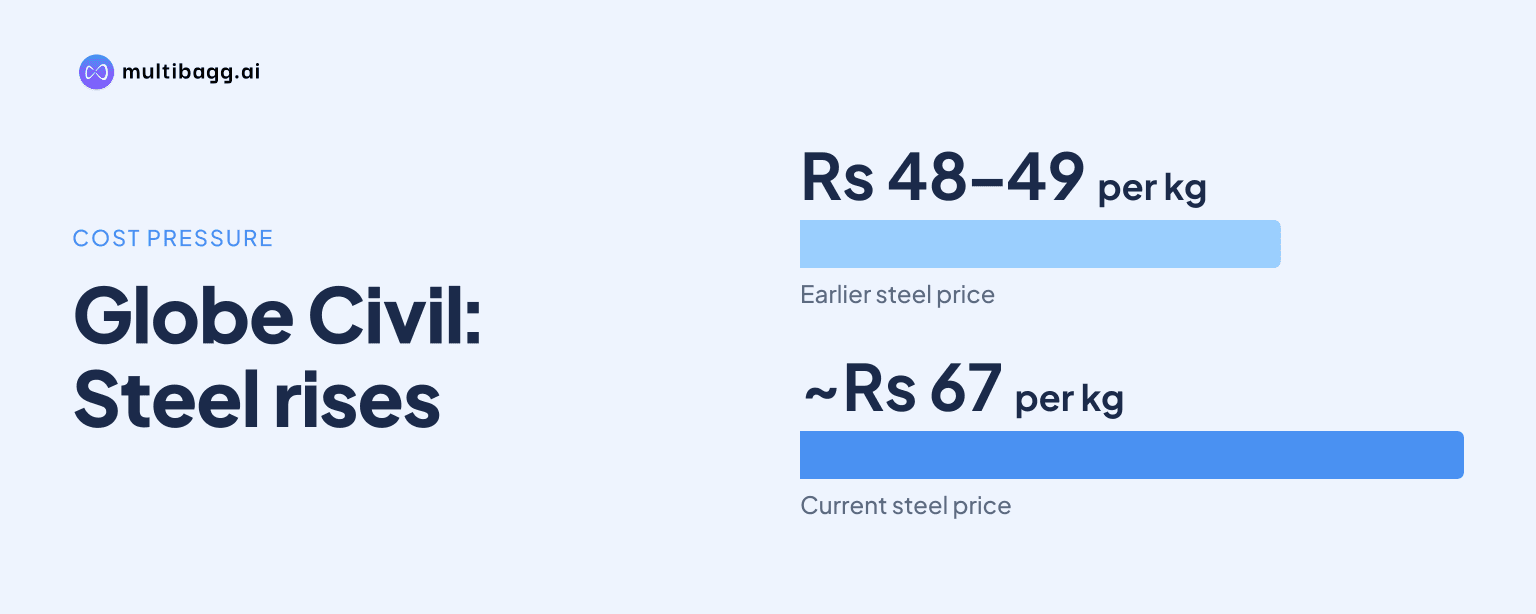
Globe Civil had no new project wins for roughly six months as steel increased from Rs 48-Rs 49 per kg to about Rs 67 per kg, management said during its H1 FY27 call. Management attributed lower profitability to volatile material costs and said it was waiting to secure contracts at rates that could preserve margins.
Know Globe Civil Projects inside out
Results, valuation, peers and who's buying, in one view.
Why did Globe Civil have no new project wins?
Globe Civil had no new project wins because management continued to bid cautiously during a volatile cost environment. Management said it had been trying to bid for new work for the previous six months, but did not receive projects because it structured bids to protect margins rather than accept inadequate rates.
The decision affected future order inflow rather than execution of existing work. Management said projects already under construction generally have variation clauses, with adjustments received on a three-month cycle, while engineering, procurement and construction, or EPC, projects can have execution timelines of about 18 to 36 months. It cited the Central University Bathinda project as having an 18-month timeline.
How did material inflation affect Globe Civil's profitability?
Globe Civil said volatile material prices were the main reason profitability declined compared with Q1 FY27, despite higher revenue. Management cited steel at about Rs 67 per kg, versus Rs 48-Rs 49 per kg previously, and also named copper, aluminium and transportation as higher-cost inputs.
The company said escalation and variation clauses do not immediately offset the cost increase. Management explained that variation payments are generally processed after three months, while recovery through price-index-based escalation comes later. This creates a timing gap in which Globe Civil can incur higher procurement costs before contractual adjustments are reflected in customer payments.
Management said projects priced six to eight months earlier were based on materially lower costs than those in the current market. It said its objective is to maintain margins earned over the last year, but did not disclose a specific margin target. The stated approach is to bid only when tender prices account for current costs and expected project economics.
What work supports Globe Civil during the bidding gap?
Globe Civil reported an order book of about Rs 600 crore of pending projects, which management said provides work for roughly the next year to 1.5 years. At an annual execution pace of around Rs 400 crore, management said the existing order book supports current activity but requires replenishment for revenue in the following year.
The Central University Bathinda project and the Haryana Cricket Association Stadium were among the largest H1 FY27 contributors. Management said stadium billing was around Rs 30 crore to Rs 40 crore in H1 FY27, while Bathinda billing was around Rs 7 crore each month, or about Rs 40 crore to Rs 45 crore for the half year. It also identified Bangalore as a major contributing project.
Management said Globe Civil needs at least two or three new projects over the next four to five months so their revenue can contribute next year. The Rs 600 crore order book therefore provides current execution coverage, but it does not eliminate the need for order additions following the five-to-six-month period without wins.
Got a follow-up? Ask IRIS
When does Globe Civil plan to add new orders?
Globe Civil is targeting Rs 400 crore to Rs 500 crore of new projects at better prices after tender rates increased, according to management. Management did not give a date for awards, but said it needs two or three projects in the next four to five months to support next year's revenue.
The target represents a planned resumption of order intake rather than confirmed contracts. Management said it would continue to assess bids cautiously because higher steel, copper, aluminium and transport costs can affect project returns before escalation claims are recovered. It did not identify any awarded project within the Rs 400 crore to Rs 500 crore target.
Globe Civil also said it was pursuing selected opportunities outside its existing markets. Management referred to a Madhya Pradesh tender to build a statue as a niche project where competition could be lower, but did not disclose its value, award status or timing. The opportunity therefore cannot be treated as part of the targeted new-order amount.
How are material purchases and collections affecting cash flow?
Globe Civil said it increased purchases of steel and other major materials to limit exposure to further price volatility, contributing to higher inventory as of September 2026. Management said EPC projects require some materials, including tiles, to be procured early even when installation takes place later in the project cycle.
Net cash generated from operating activities was negative by Rs 11.97 crore in the first six months, although operating profit before working-capital changes was positive by Rs 27 crore. Management attributed the difference mainly to higher trade receivables, security deposits and defect-liability deposits in newer projects, including the Haryana Cricket Association Stadium.
Management said payment on the stadium project can arrive around 2.5 to three months after execution, while retention money is 7.5%. It also said subcontractors may need to be paid before the company receives final client payments. These billing and retention terms can raise working-capital needs even where management says the projects have good margins.
Conclusion
Globe Civil's lack of new wins for roughly six months reflects management's decision to avoid contracts priced before material costs adjusted, after steel reached about Rs 67 per kg from Rs 48-Rs 49 per kg. The existing Rs 600 crore order book and H1 FY27 billing from Bathinda and the stadium project provide ongoing execution while the company waits for appropriately priced work.
The next issue is whether Globe Civil can convert its Rs 400 crore to Rs 500 crore target into two or three new awards over the next four to five months. Management also needs those orders to support next year's revenue, while the pace of escalation recoveries, 7.5% retention on certain projects and collection cycles of up to three months remain relevant to operating cash flow.

